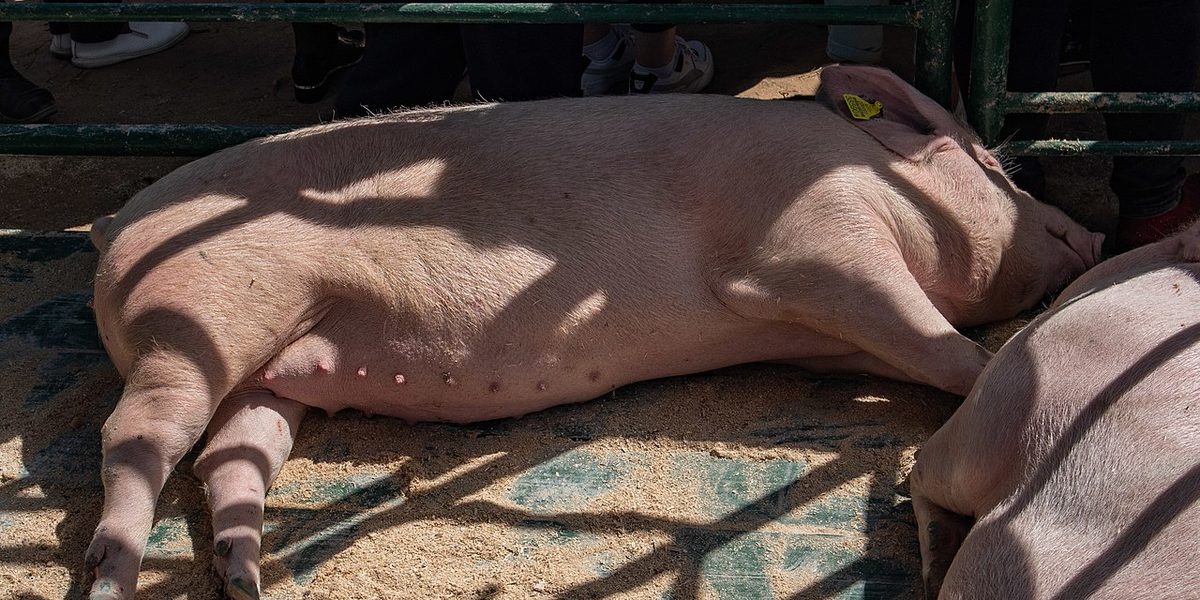
The Backbone of Philippine Pork
If you ask any commercial pig operator in Bulacan or Pampanga what breed runs their maternal line, the answer is almost always Large White. This English-origin breed — called Yorkshire in North America — has dominated Philippine swine production for decades because it does three things reliably: grows fast, converts feed efficiently, and farrows big litters. Roughly 60-70% of the commercial sow herd in the Philippines carries Large White genetics, either as purebreds or as the maternal half of F1 crosses with Landrace.
That dominance is not an accident. Large White performs consistently under good management, and punishes you fast when management slips.
At a Glance
| Trait | Value | Notes |
|---|---|---|
| Mature Weight (Boar) | 180-200 kg | At 18-24 months |
| Mature Weight (Sow) | 150-180 kg | Working weight, not show condition |
| Litter Size (Born Alive) | 10-14 piglets | 12+ by third parity with good nutrition |
| Days to Market (90 kg) | 150-170 days | Under commercial feed programs |
| Feed Conversion Ratio | 2.8-3.2 | Means 2.8-3.2 kg feed per 1 kg gain |
| Dressing Percentage | 72-76% | Higher than native breeds (55-65%) |
| Backfat Thickness | 18-22 mm | Lean carcass, less liempo fat than Duroc |
| Ear Type | Erect | Key visual difference from Landrace (drooping) |
| Skin/Coat | White, thin-skinned | Sunburn risk — see heat management below |
| Temperament | Docile | Easier handling than Duroc or native boars |
Who Is This Breed For?
Commercial grower-finisher operations — Large White is the default maternal line for the standard three-way cross: (Landrace x Large White) dam x Duroc sire. If you are running 50+ sows and selling to traders or wet markets, this is your bread and butter.
F1 gilt production — Multiplier farms cross Large White boars with Landrace sows (or vice versa) to produce F1 gilts that combine the prolificacy and milk production of both maternal breeds. These F1 gilts are what commercial farms buy as replacement breeding stock. A well-managed F1 gilt sells for P18,000-P25,000 depending on age and genetics.
Institutional and cooperative farms — Large White performs predictably under standardized SOPs, which makes it ideal for cooperatives and government-backed programs like the DA's INSPIRE swine repopulation initiative, which has distributed 32,000 gilts (many LW and LW-crosses) nationwide.
Sa Bisaya
When NOT to Choose Large White
Large White is not always the right call. Knowing when to skip it saves you money.
Pure backyard operations (1-5 heads) — At backyard scale with kitchen scraps and local feeds, Large White underperforms badly. Its genetics are optimized for 16-20% crude protein commercial rations. Feed it camote tops and rice bran alone, and you will wait 8-10 months to reach market weight instead of 5-6. A native pig or native cross will give you better returns on low-cost feeds.
Lechon-focused production — Pure Large White produces lean, pale meat. For lechon, you want flavor and skin quality. Native pigs or Duroc crosses are superior. The three-way cross (LW x Landrace dam, Duroc sire) is the commercial compromise — the Duroc sire line adds the marbling and color that lechoneros pay for.
Extremely hot, open-pen environments — Large White pigs are white-skinned and thin-skinned. In direct tropical sun without shade structures, they sunburn, overheat, and stop eating. If your setup is open-air with no roofing or cooling, this breed will cost you in heat stress losses before you ever get to market.
Areas with poor feed supply chains — If you cannot reliably source commercial feeds at competitive prices, Large White's genetic potential is wasted. The breed only makes economic sense when you can keep it on a proper feeding program.
If you are still mapping breeds to your scale and market channel before committing to a maternal line, our best pig breeds for Philippine small farmers guide compares Large White against Landrace, native, and the three-way cross alternatives.
Economics: What a Grow-Out Cycle Actually Costs
This is for one head, weaner to market (90-100 kg), under 2025-2026 Central Luzon conditions.
| Cost Item | Amount (PHP) | Notes |
|---|---|---|
| Weaner piglet | P5,000-P8,000 | Price depends on genetics and source |
| Starter feed (25 kg, ~3 weeks) | P950 | B-MEG starter at P38/kg |
| Grower feed (120 kg, ~8 weeks) | P4,440 | B-MEG grower at P37/kg |
| Finisher feed (130 kg, ~6 weeks) | P4,550 | B-MEG finisher at P35/kg |
| Total feed cost | P9,940 | Premium grower/finisher ran P34.90-P38.20/kg as of 12 July 2026 |
| Vaccines & deworming | P350-P500 | Hog cholera, mycoplasma, dewormer |
| Vitamins & supplements | P200-P300 | Iron dextran, B-complex |
| Utilities & misc | P300-P500 | Water, electricity, bedding |
| TOTAL COST | P15,790-P19,240 | Feed is 52-63% of it, depending on what you paid for the weaner |
| Sale price (90 kg live @ P185/kg) | P16,650 | SINAG's industry average was P180-190/kg in May 2026 |
| Margin per head | -P2,590 to P860 | Thin at best, negative at worst. See note below. |
Budget feed alternative: Switching from B-MEG to budget brands (P22-29/kg) saves P2,000-P3,500 per head on feed, but expect 10-15% slower growth and slightly worse FCR. Run the numbers for your specific operation.
The negative-to-thin margin above is exactly why volume matters with Large White. Before you scale up, project your specific cost structure and farmgate price through the 10-pig backyard profit guide — most farms only break even on grow-out alone, so the path to actual profit is either farrowing your own weaners or stacking enough batches per year that fixed cost gets diluted.
Financing: LandBank's SWINE Lending Program offers 3% per annum for swine production. DBP's Swine R3 (Recovery, Rehabilitation, Repopulation) program is another option. Both require a viable farm plan and collateral.
Heat Management for the Tropics
This matters more for Large White than any other commercial breed. White, thin skin and northern European genetics make them the most heat-sensitive of the big three (LW, Landrace, Duroc).
What heat stress does: When ambient temperature exceeds 27C (common year-round in lowland Philippines), Large White pigs reduce feed intake by 100-200g per day per degree above that threshold. Less feed intake means slower growth, worse FCR, and in breeding stock, smaller litters and lower conception rates. Severe heat stress (above 33C) can cause mortality in finishers.
Practical cooling strategies:
- Roof and shade — Non-negotiable. Use galvanized iron or cogon roofing with at least 3m ceiling height. Orient the building east-west so the long sides face north-south (less direct sun exposure).
- Sprinklers or drip cooling — Install drip lines above the sow area. Run them 15 minutes on, 45 minutes off during peak heat (11 AM - 3 PM). Cost: roughly P2,000-P5,000 per bay to install.
- Cross-ventilation — Open-sided housing with roll-up curtains. If natural airflow is poor, add tunnel ventilation fans (P8,000-P15,000 per unit, 48-inch).
- Wallow or concrete pad — For backyard setups, a shallow concrete wallow (3-4 inches of water) is the cheapest effective cooler.
- Tree cover around the pen — Madre de cacao, ipil-ipil, or bamboo planted on the west and south sides reduce radiant heat load.
Sunburn: Large White pigs exposed to direct sun for even 30-60 minutes can develop skin reddening and blistering, especially on the ears and back. This is not cosmetic — sunburned pigs stop eating and are susceptible to secondary infections. Keep them under roof during daylight hours, always.
Feeding Program
Feed is about 57% of hog operating cost (PIDS), and in a bought-weaner grow-out like the one above it is over half of everything you spend. You will see "60-70%" quoted a lot. That number comes from a feed-tariff advocacy statement covering poultry and swine together, so treat 70% as an upper bound, not a hog benchmark. Either way, getting feed right is the difference between profit and loss. Read our feed economics deep-dive for a full breakdown.
Pre-Starter / Creep Feed (Day 7 to Weaning)
| Detail | Value |
|---|---|
| Crude Protein | 20-22% |
| Feed per piglet | 5-8 kg total |
| Cost per kg | P38-P45 (specialty creep) |
| Target weaning weight | 6-8 kg at 21-28 days |
Start creep feeding at day 7. Use a shallow tray inside the creep area. Large White piglets are aggressive eaters — they will take to creep feed faster than native piglets. Early creep feeding reduces the post-weaning growth dip.
Starter Phase (Weaning to 25 kg)
| Detail | Value |
|---|---|
| Crude Protein | 18-20% |
| Daily intake | 0.5-1.2 kg/day (gradually increasing) |
| Duration | ~3-4 weeks post-weaning |
| Cost per kg | P38/kg (B-MEG) or P24-29/kg (budget) |
| Total feed consumed | ~25 kg |
| Phase cost per head | P950 (B-MEG) or P600-P725 (budget) |
Grower Phase (25-60 kg)
| Detail | Value |
|---|---|
| Crude Protein | 16-18% |
| Daily intake | 1.5-2.5 kg/day |
| Duration | ~7-8 weeks |
| Cost per kg | P37/kg (B-MEG) or P23-28/kg (budget) |
| Total feed consumed | ~120 kg |
| Phase cost per head | P4,440 (B-MEG) or P2,760-P3,360 (budget) |
Finisher Phase (60-90+ kg)
| Detail | Value |
|---|---|
| Crude Protein | 14-16% |
| Daily intake | 2.5-3.5 kg/day |
| Duration | ~5-6 weeks |
| Cost per kg | P35/kg (B-MEG) or P22-27/kg (budget) |
| Total feed consumed | ~130 kg |
| Phase cost per head | P4,550 (B-MEG) or P2,860-P3,510 (budget) |
Premium grower and finisher were trading at P34.90-P38.20/kg (P1,747-P1,910 per 50 kg bag) as of 12 July 2026, averaging about P36.69/kg. Feed has climbed P1-2/kg through 2026 and no miller has announced a rollback. Do not budget for one. Corn is 50-65% of the formulation and its tariff was not cut, so EO 62 stands to 2028.
Sa Bisaya
Breeding Sow Nutrition
Lactating Large White sows nursing 10-14 piglets need 5-6 kg of 16-18% CP feed per day plus 20-30 liters of fresh water. Underfeeding during lactation is the single biggest mistake in sow management — it causes body condition loss, delayed re-breeding, and poor milk production that stunts the entire litter.
Health & Biosecurity
Vaccination Schedule
| Vaccine | Age/Timing | Notes |
|---|---|---|
| Iron dextran | Day 1-3 | Prevents anemia — Large White piglets grow fast and deplete iron stores quickly |
| Mycoplasma | Day 7 + Day 28 | Two-dose protocol |
| Hog Cholera (CSF) | Day 45 + booster Day 90 | Required in the Philippines |
| PRRS | Gilts before first breeding | Herd-specific decision with your vet |
| Parvovirus | Gilts 2 weeks pre-breeding | Prevents reproductive failure |
| E. coli | Sows 2-3 weeks pre-farrowing | Protects piglets via colostrum |
| Deworming | Every 3 months | Ivermectin or fenbendazole |
African Swine Fever (ASF)
ASF gutted the Philippine pig industry and it is not finished. The national herd was 8.93M heads on 1 July 2026 (PSA), about 30% below the 12.70M of 1 July 2019, the last count before ASF, and that is after a 2.6% gain in the quarter. Large White, like every other breed, has zero natural resistance.
The Visayas went backwards in the middle of 2026. San Enrique, Negros Occidental was confirmed on 23 June, with roughly 1,902 hog deaths province-wide by 25 June, not all of them from ASF. Barotac Viejo in Iloilo broke a four-year clean run on 29 June. Bacolod and La Libertad, Negros Oriental followed on 1 July. Capiz red-zoned five LGUs and shut its border to pork on 24 June, and Cebu shut out Negros hogs and pork on 7 July under EO 39. BAI's last published national count (8 active barangays across 7 provinces) is dated 8 May 2026 and has not been refreshed since, so read it as history, not as today's map.
The AVAC vaccine is real, but you cannot buy it. It runs under a controlled government rollout (CPR-MR) that has stayed Luzon-centred since August 2024. Commercial sale is a DA target for Q3 2026, not a fact. Until it lands, biosecurity is your defense:
- Perimeter fence — No stray animals, no unauthorized people
- Vehicle disinfection — Spray tires and undercarriage of any truck entering the farm
- Foot baths — Every entry point, change solution daily
- No swill feeding — Or cook ALL food waste at 100C for 30+ minutes
- Quarantine new stock — 30 days minimum, separate housing
- Source from ASF-free zones — Check BAI disease status reports before buying
- Limit visitors — Every person entering the production area is a risk vector
Read our ASF recovery-era farming guide for the full biosecurity SOP.
Large White-Specific Health Notes
- Leg and joint problems — Large White's rapid growth puts stress on leg joints. On concrete flooring, watch for swollen hocks and lameness. Rubber mats in the farrowing crate help.
- Skin conditions — Thin white skin is prone to mange, sunburn, and greasy pig disease (exudative dermatitis) in humid conditions. Ivermectin at regular intervals plus dry bedding.
- Respiratory sensitivity — LW pigs in poorly ventilated, dusty, or high-ammonia housing develop respiratory issues faster than hardier breeds. Ventilation is not optional.
Regional Intelligence
Central Luzon: The Pig Belt
Bulacan, Pampanga, Tarlac, and Nueva Ecija are the center of Philippine commercial swine production. Feed mills, veterinary suppliers, and livestock traders are concentrated here. If you are raising Large White at commercial scale, Central Luzon gives you the best infrastructure:
- INFARMCO — The largest pure Large White and Landrace nucleus herd in the Philippines. Source of high-genetic-merit breeding stock.
- Family Farms (Topigs Norsvin genetics) — Supplies Topigs-line LW and Landrace genetics to multiplier farms.
- PIC Philippines — Operates in Luzon with PIC genetic lines for commercial integrators.
Visayas
In Cebu, Iloilo, and Negros, Large White is common in semi-commercial operations (10-50 sows). Pure LW stock is harder to source here — most operators use F1 crosses from Luzon-sourced gilts. The lechon trade drives demand for Duroc-sired crosses rather than pure LW finishers.
Mindanao
Davao, South Cotabato, and Bukidnon have growing commercial pig operations. The DA's INSPIRE program has distributed Large White-cross gilts here for swine repopulation. Feed is slightly cheaper (local corn supply), but genetic stock still largely comes from Luzon multiplier farms.
Sourcing Breeding Stock
When buying Large White breeding stock, verify:
- Source farm ASF status — Ask for BAI certification or at minimum the municipal vet's clearance
- Performance records — Reputable farms provide dam's litter size, sire's progeny FCR
- Age and weight — Gilts should be 5-6 months, 90-100 kg at purchase
- Physical soundness — Check feet, legs, underline (minimum 12 functional teats for LW gilts)
Common Mistakes
1. Buying the cheapest weaners from unknown sources
You save P1,000-P2,000 per head and risk introducing ASF, PRRS, or poor genetics onto your farm. One sick pig can wipe out your entire herd. Always buy from farms with known health status, even if it costs more upfront.
2. Skipping the cooling infrastructure
"I will just give them shade." Shade alone is not enough for Large White in lowland Philippines. Without active cooling (sprinklers, fans, or at minimum a wallow), you lose 5-15% of growth performance to heat stress. On a 100-head finisher operation, that is P80,000-P200,000 in lost revenue per cycle.
3. Feeding breeding sows like finishers
Lactating sows need 5-6 kg/day of high-protein feed. Operators who limit sows to 3 kg/day (finisher rations) to "save on feed" get thin sows, poor milk, small piglets, delayed re-breeding, and fewer piglets in the next litter. The P30-P50/day you "save" costs you P5,000-P10,000 in lost productivity per litter.
4. No record-keeping
If you do not track individual sow performance (litter size, piglet weight, weaning-to-service interval), you cannot cull poor performers. After three parities, the bottom 20% of your sow herd is dragging down the average. Cull them. Replace with better genetics.
5. Ignoring the breed's ventilation needs
Large White in a closed, poorly ventilated building with high ammonia levels will develop chronic respiratory disease. This is not a hardy backyard breed — it needs airflow. If you can smell ammonia when you walk into the barn, your pigs are breathing it 24/7 and their lungs are paying the price.
Frequently Asked Questions
Magkano ang Large White piglet ngayon? Weaner piglets (20-25 kg) range from P5,000 to P8,000 in Central Luzon as of early 2026. Breeding-quality gilts from multiplier farms run P18,000-P25,000. Prices are higher in Visayas and Mindanao due to transport costs.
Large White ba o Yorkshire — magkaiba ba? Same breed, different names. "Yorkshire" is the North American name; "Large White" is the British and international name. In Philippine commerce, both terms are used interchangeably. The genetics are identical.
Pwede bang i-backyard ang Large White? Technically yes, but you will not get the breed's full performance without commercial feeds and proper housing. For 1-5 head backyard operations, a Large White x native cross is more practical — you get some of the growth speed with better heat tolerance and lower feed requirements. Read our native vs. commercial comparison for the full analysis.
Ano ang pinakamabilis na paraan para mag-90 kg? Under optimal conditions (full commercial feed program, good genetics, cooling, health protocol), Large White-sired pigs can reach 90 kg in 150-155 days. Typical farm conditions push this to 160-170 days. The biggest factor is not genetics — it is consistent feed intake. Any day your pig eats less than its target is a day added to your grow-out period.
Magkano ang kita per head? At the farmgate prices actually being paid (P180-190/kg live, SINAG's May 2026 industry average), a 90 kg finisher sells for roughly P16,200-P17,100. Total cost per head, weaner included, runs P15,800-P19,200 depending on feed brand and what you paid for the weaner. So the honest answer is that a bought-weaner grow-out clears roughly P900 to P1,300 per head at best, and loses P2,600 to P3,000 at worst, depending on where in that price band you sell and what the weaner cost you. National cost of production is around P180/kg (SINAG and NatFed land there independently), which means the average farm is selling at roughly its own cost. Do not budget on the DA's P210/kg minimum farmgate price either. It was set in November 2025 and no month of the national series has hit it, the Cordillera being the only region that has. Farrow-to-finish operations that produce their own weaners are the ones still earning, because they eliminate the P5,000-P8,000 weaner cost.
Ilang buwan bago manganak ang Large White sow? Gestation is 114 days (3 months, 3 weeks, 3 days) — same as all domestic pig breeds. A well-managed Large White sow can produce 2.2-2.4 litters per year with a 5-7 day weaning-to-service interval.
Sa Bisaya
Paano malaman kung legit ang breeder? Ask for: (1) BAI or municipal vet ASF-free certification, (2) performance records of the dam, (3) physical inspection of the farm before buying. If the seller cannot provide any of these, walk away. On baboyph.com, check the breeder's trust level and reviews from previous buyers.
Large White vs Landrace — alin ang mas maganda for breeding? Both are maternal breeds. The industry standard is to cross them: Large White x Landrace produces an F1 gilt that combines LW's growth and litter size with Landrace's mothering ability and milk production. You do not choose one over the other — you use both in a crossbreeding program with Duroc as the terminal sire.