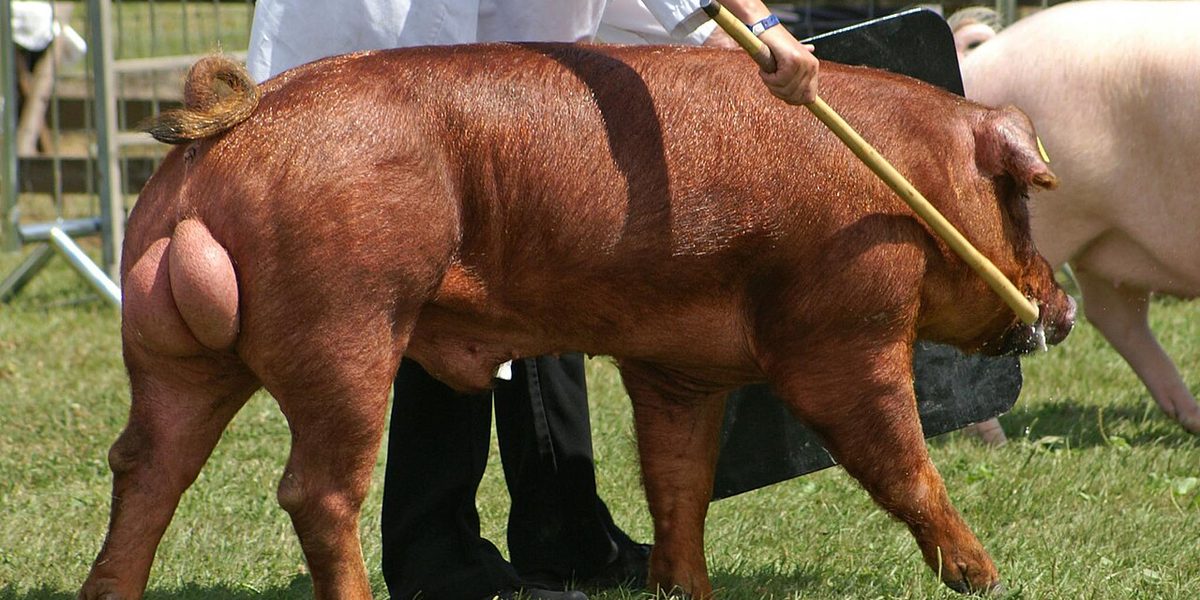
If you ask any commercial pig operation in the Philippines which boar line they use to sire their finishers, the answer is almost always Duroc. There is a reason for that: no other breed delivers the same combination of marbling, growth rate, and feed efficiency in the terminal position. Run 50 sows farrow-to-finish or buy weanlings to fatten, it makes no difference: the genetics on the sire side decide your carcass value, and Duroc owns that role.
Duroc Pig Price in the Philippines (2026)
| What you are buying | Typical price (2026) | Notes |
|---|---|---|
| Duroc-sired weaner (8-10 kg) | ₱3,800–₱5,500 | F1 or F2 crossbreds. Higher than generic LW × Landrace weaners by ₱500–₱1,200 |
| Duroc × Native crossbred weaner | ₱2,500–₱3,800 | Lechon-track. Cheaper because dam side is native |
| Pure Duroc gilt (breeding-ready) | ₱25,000–₱45,000 | With pedigree docs from accredited multiplier |
| Pure Duroc boar (proven, working) | ₱45,000–₱80,000 | Multiplier-sourced. Young, unproven: ₱30,000–₱50,000 |
| Duroc semen (AI dose, fresh) | ₱300–₱600 | Per dose. Frozen costs more and needs equipment |
| Duroc-sired live finisher (95 kg) | ₱14,250–₱16,382 | ₱150/kg (DA, August 2026) to ₱172.44/kg (PSA, Q2 2026) liveweight; a marbling premium is whatever your buyer agrees to |
Prices vary by region, and not in the direction most guides tell you. In PSA's March 2026 farmgate series the top regions were Cordillera at ₱208.88/kg and Eastern Visayas at ₱206.70/kg. Central Luzon sat mid-pack at ₱178.41/kg. The bottom was Negros at ₱163.19/kg and SOCCSKSARGEN at ₱152.63/kg. So check your own region's number before you price anything off a national average. Always verify pedigree documentation before paying premium prices for "Duroc" stock; red-coated crossbreds sold on Facebook without papers are not Duroc.
Duroc is not a breed you raise in isolation. It is a tool, the terminal sire in a crossbreeding system, and knowing how to use it correctly is worth real money.
At a Glance
| Trait | Value | Notes |
|---|---|---|
| Mature Weight (Boar) | 160–180 kg | Frame depends on bloodline |
| Mature Weight (Sow) | 130–160 kg | Rarely kept as purebred dams |
| Litter Size | 9–12 piglets | Lower than Landrace/LW, not a maternal breed |
| Days to Market (90–100 kg) | 150–165 days | Duroc-sired crosses, good management |
| Feed Conversion Ratio | 2.7–3.0 | Among the best of any purebred line |
| Dressing Percentage | 74–78% | Higher than maternal breeds |
| Intramuscular Fat (IMF) | 3.5–5.0% | The defining advantage: superior marbling |
| Average Daily Gain | 750–900 g/day | Under Philippine commercial conditions |
| Backfat Thickness | 12–18 mm | Moderate; less than native, more than Pietrain |
| Coat Color | Red-brown to dark cherry | Darker skin = better tropical sun tolerance |
Who Is This Breed For?
If you operate a multiplier or commercial farrow-to-finish farm, you need Duroc boars or Duroc semen to produce your terminal cross finishers. Your dam line is typically Landrace x Large White F1 gilts. The Duroc sire closes the triangle.
If you are a grower-finisher buying weanlings to fatten, you want Duroc-sired piglets, so look for that red tinge in the coat. These weanlings convert feed more efficiently and produce carcasses that buyers pay more for.
If you are a lechon operator sourcing premium pigs, Duroc crosses (especially Duroc x Native) produce pork with the marbling and fat cover that makes lechon skin crispier and meat more flavorful. More on this below.
If you are a backyard farmer with 1–5 sows, a purebred Duroc boar is probably too expensive to justify unless you share him with neighbors or offer stud service. AI (artificial insemination) doses are the smarter path.
If you are still picking your terminal sire, my best pig breeds for Philippine small farmers guide compares Duroc against Pietrain, Hampshire, and the dam-line breeds for backyard scale before you commit semen money.
Sa Bisaya
Terminal Sire Economics: Boar vs. AI
This is the first real decision for any operation using Duroc genetics. You either keep a live boar or buy artificial insemination doses. Here is the math.
Keeping a Duroc Boar
| Cost Item | Amount |
|---|---|
| Purchase (proven boar, multiplier farm) | P45,000–P80,000 |
| Annual feed (2.5 kg/day x 365 days x P30/kg) | P27,375 |
| Housing & maintenance | P8,000–P12,000/year |
| Vet care & vaccines | P3,000–P5,000/year |
| Total annual cost (after purchase) | P38,000–P44,000 |
A healthy boar can serve 3–4 sows per week, roughly 150–200 matings per year. That puts your cost per mating at P190–P295. Cheap per dose, but you carry the overhead regardless of how many sows you breed.
Buying AI Doses
| Cost Item | Amount |
|---|---|
| Duroc semen dose (fresh, local AI center) | P300–P600 per dose |
| Doses per sow per heat (2–3 inseminations) | P600–P1,800 per breeding |
| AI technician fee (if not doing it yourself) | P200–P500 per visit |
| Total per breeding | P800–P2,300 |
AI also gives you access to superior genetics. Multiplier farms like PIC Philippines and INFARMCO offer semen from boars with genomic evaluations, tested for FCR, backfat, loin depth, and IMF. A backyard farmer with 5 sows can use the same genetics as a 500-sow commercial unit. That was not possible a decade ago.
Replacement Timeline
Duroc boars are productive for 2–3 years. After that, libido declines and the risk of structural problems (feet, legs) increases. Budget for replacement. Some farmers sell retired boars for slaughter. If your buyer pays the finisher rate, a 160 kg boar recovers about P24,000 at the DA's August 2026 P150/kg, or P27,590 at PSA's Q2 2026 P172.44, which offsets part of the replacement cost.
Meat Quality Premium
This is where Duroc earns its keep. The breed's intramuscular fat (IMF) content of 3.5–5.0% is significantly higher than Large White (1.5–2.5%) or Landrace (2.0–3.0%). That IMF is marbling — the white flecks of fat within the muscle that melt during cooking and produce tenderness, juiciness, and flavor.
What the Market Pays
In the Philippine pork chain, Duroc-sired carcasses command a premium at several levels:
- Farmgate (live): PSA's last official national average is P172.44/kg for Q2 2026; it has not yet published July onward. The DA put August 2026 at P150/kg (Manila Times). The P180–P190/kg SINAG quoted in May 2026 is history: the price fell hard after June. The P210/kg floor agreed on 4 November 2025 is an industry target the DA backed, not an enforceable minimum. The national average has never reached it since; in PSA's regional data Cordillera did in 5 months, BARMM and Central Visayas in 2 each (Nov and Dec 2025) and NCR in 1 (January 2026). Treat it as a target, not money you can count on. Duroc-sired pigs with visible marbling can fetch a premium from buyers who know what they are looking at, particularly wet market traders supplying restaurants and lechoneros. Nobody publishes how much, so get the number agreed before the pigs go on the truck.
- Retail liempo: P379/kg average in NCR wet markets (DA Bantay Presyo, 12 July 2026), against an MSRP of P370. Marbled liempo from Duroc crosses sits at the top of that band. Note that almost none of the retail price reaches you: NatFed puts the trader/biyahero margin at roughly P120/kg.
- Lechon-grade whole pigs: Small (15–25 kg dressed) at P8,000–P13,000, large (25–40 kg dressed) at P13,400–P19,000. Duroc crosses are preferred by premium lechon operators in Cebu, Davao, and Metro Manila.
Why Marbling Matters for Filipino Pork
Filipino cooking methods — lechon, inihaw, adobo, sinigang, sisig — all benefit from intramuscular fat. Lean pork dries out on the grill or in the roasting pit. Marbled pork stays moist. That is not marketing talk. It is the physics of heat transfer through fat.
The restaurant and hotel/resort segment increasingly specifies "Duroc-sired" or "heritage marbled pork" on procurement specs. If you can consistently supply marbled pork with documentation of genetics, you access a market segment that pays 10–20% above commodity prices.
Lechon Cross Guide: Duroc x Native
The highest-value cross for the Philippine lechon market is Duroc boar x Native sow. Here is why this specific combination works.
| Trait | Duroc Contribution | Native Contribution |
|---|---|---|
| Intramuscular fat | 3.5–5.0% IMF, rich marbling | Superior pork flavor, thinner skin |
| Growth rate | Faster than pure native | Adapted to local conditions |
| Frame size | Moderate muscling | Smaller frame = lechon-sized (20–35 kg dressed) |
| Fat cover | Even subcutaneous fat | Naturally good fat distribution |
| Skin quality | Thicker, more durable | Thinner, crisps better |
The F1 cross hits a sweet spot: enough marbling for flavor, enough subcutaneous fat for crispy skin, small enough frame for traditional lechon sizes, and faster growth than pure native (180–220 days to 50–70 kg vs. 240–365 days for pure native).
Sa Bisaya
Economics of the Lechon Cross
A Duroc x Native F1 pig raised to 60 kg liveweight (roughly 40–45 kg dressed at 68–72% dressing) can sell as a lechon-grade pig at a per-head price you negotiate with the lechonero, against about P10,350 at commodity farmgate (P172.44/kg, PSA Q2 2026, x 60 kg). No one publishes lechon-grade live prices, so that P10,350 is the floor to beat, and the feed cost is often lower because native-cross pigs tolerate higher inclusion rates of local feeds (rice bran, copra meal, camote).
Read more about the native vs. commercial pig economics and how to structure a profitable pig operation.
Feeding Program
Duroc-sired finishers perform best on high-energy diets. They are efficient converters, so do not waste that genetic potential on cheap, low-energy feeds. Feed is about 57% of pig operating cost (PIDS), so getting this right is non-negotiable. Premium grower and finisher rations were running P34.90–P38.20/kg as of 12 July 2026, roughly P1,747–P1,910 a 50 kg bag, and they have climbed P1–P2/kg through the year with no miller announcing a rollback.
Phase 1: Pre-Starter (Birth to 21 days)
| Parameter | Target |
|---|---|
| Crude Protein | 22% |
| Feed Type | Creep pellet, ad libitum from Day 7 |
| Feed Brand Example | B-MEG Pre-Starter, ~P36–P44/kg |
| Target Weight at 21 days | 6–8 kg |
| Total Feed Consumed | 2–4 kg |
| Cost per piglet | P72–P176 |
Start creep feeding early. Duroc-sired piglets grow fast, and early nutrition sets the trajectory for the entire finishing period.
Phase 2: Starter (21–56 days / 8–22 kg)
| Parameter | Target |
|---|---|
| Crude Protein | 20% |
| Feed per Day | Ad lib, transitioning to 0.5–1.0 kg/day |
| Feed Brand Example | B-MEG Starter, ~P33/kg |
| Total Feed Consumed | 18–28 kg |
| Cost per pig | P594–P924 |
This phase is critical. Duroc piglets can outgrow their nutrition. If you skimp on starter feed quality, you lose growth potential you will never recover.
Phase 3: Grower (56–112 days / 22–60 kg)
| Parameter | Target |
|---|---|
| Crude Protein | 16–18% |
| Feed per Day | 2.0–2.8 kg |
| Feed Brand Example | B-MEG Grower, ~P36.70/kg (premium band P34.90–P38.20, July 2026) |
| Total Feed Consumed | 90–130 kg |
| Cost per pig | P3,300–P4,770 |
Monitor body condition weekly. Durocs deposit fat earlier than lean breeds like Pietrain. If backfat gets excessive, reduce energy density slightly, but do not cut protein or you sacrifice lean growth.
Phase 4: Finisher (112–160 days / 60–100 kg)
| Parameter | Target |
|---|---|
| Crude Protein | 14–16% |
| Feed per Day | 3.0–4.0 kg |
| Feed Brand Example | B-MEG Finisher, ~P36.70/kg (premium band P34.90–P38.20, July 2026) |
| Total Feed Consumed | 130–180 kg |
| Cost per pig | P4,770–P6,610 |
Total Feed Cost Summary
| Phase | Feed (kg) | Cost (PHP) |
|---|---|---|
| Pre-Starter | 2–4 | P72–P176 |
| Starter | 18–28 | P594–P924 |
| Grower | 90–130 | P3,300–P4,770 |
| Finisher | 130–180 | P4,770–P6,610 |
| Total | 240–342 kg | P8,736–P12,480 |
At 90–100 kg liveweight sold at P172.44/kg (PSA's Q2 2026 national average), gross revenue is P15,520–P17,244 per head. At the DA's August 2026 figure of P150/kg (Manila Times) it is P13,500–P15,000. Feed alone takes P8,700–P12,500 of that.
Now the part most breed guides will not tell you. Producer groups put the full cost of production at P180–P190/kg in October 2026 (Daily Tribune). A 95 kg pig therefore costs roughly P17,100–P18,050 to put on the truck and brings P16,382 at PSA's P172.44, or P14,250 at the DA's P150. That is a loss of about P700–P1,700 a head on the official number and P2,850–P3,800 on the DA's. The average farm today is selling below its own cost, and the national average has never reached the P210/kg floor since it was set, so do not plan around it.
Which is exactly why the Duroc premium matters. A negotiated premium for visible marbling, or a lechon buyer who pays per head above farmgate, is not a bonus on top of a healthy commodity margin. At these prices it is the only margin there is. If you cannot sell into a channel that pays for the genetics, Duroc semen is money you will not get back this cycle.
Read the full feed economics breakdown and explore alternative feeding strategies to reduce costs.
Health & Biosecurity
Duroc-Specific Advantages
Duroc has two traits that matter in Philippine conditions:
-
Sun tolerance. The dark red-brown skin contains more melanin than white breeds. Duroc and Duroc-sired pigs handle outdoor or semi-outdoor housing better than Landrace or Large White, which sunburn easily. This is a real advantage for backyard and semi-commercial operations without fully enclosed, climate-controlled housing.
-
General hardiness. Durocs tend to have slightly better disease resistance and stress tolerance than the maternal white breeds. They are not bulletproof, no breed is, but they are more forgiving of imperfect management.
Vaccination Schedule
| Vaccine | Timing | Notes |
|---|---|---|
| Mycoplasma | Day 7, booster Day 28 | Prevents enzootic pneumonia |
| CSF (classical swine fever) | Day 45, booster Day 90 | Mandatory in PH |
| PRRS | Before breeding (sows/gilts) | If farm is PRRS-positive |
| Parvovirus | Gilts before first breeding | Prevents mummified piglets |
| Erysipelas | Annually (boars and sows) | Durocs may have slightly higher susceptibility |
| E. coli | Sows, 2 weeks pre-farrowing | Protects neonatal piglets |
| Circovirus (PCV2) | Day 21–28 | Increasingly standard in PH |
African Swine Fever (ASF)
Duroc pigs have zero natural resistance to ASF, and no breed does. The damage to the national herd is real but often overstated: PSA counted 8.93 million heads on 1 July 2026, against 12.70 million on 1 July 2019, the last count before ASF. That is about 30% below where the herd stood when it arrived, not the 90-plus percent wipeout you sometimes see quoted.
BAI's latest national bulletin, dated 9 October 2026, counts 226 active barangays across 24 provinces. The count bottomed at 6 barangays in 4 provinces on 22 May 2026, then rose with every bulletin to a peak of 293 barangays in 31 provinces on 24 September. The resurgence started in the Visayas from late June 2026. San Enrique in Negros Occidental was confirmed on 23 June with 1,902 pig deaths province-wide by 25 June, not all of them from ASF, Barotac Viejo in Iloilo on 29 June (its first case in four years), then Bacolod and La Libertad in Negros Oriental on 1 July. Capiz red-zoned five LGUs and shut its border to pork on 24 June. Cebu banned Negros pigs and pork on 7 July under EO 39, and ASF was confirmed inside Cebu province in September 2026 (Ginatilan, then Pamutan, Toong and Buhisan in Cebu City, per the Daily Tribune).
The AVAC vaccine is not the escape hatch either. BAI cleared AVAC ASF LIVE for commercial sale on 2 September 2026, for fatteners only, sold through accredited veterinary outlets, and the DA is seeking ₱1 billion in the 2027 budget to subsidise it for backyard raisers (DA). It is not for breeding stock, so it does nothing for a Duroc boar or sow. Biosecurity is still your defense.
Non-negotiable biosecurity measures:
- Zero swill feeding unless thoroughly cooked (30 minutes at rolling boil)
- Vehicle disinfection: tire baths and spray-down for all vehicles entering the farm
- Quarantine all new stock for 30 days minimum before mixing with existing herd
- Source genetics only from ASF-free farms with documented health status
- Perimeter fencing to prevent contact with feral pigs and backyard free-range pigs
- Dedicated footwear and clothing for farm workers. No wearing farm boots off-site
Regional Intelligence: Where to Source Duroc Genetics
Multiplier Farms
The major sources of purebred Duroc boars and semen in the Philippines:
| Farm / Company | Location | Product | Notes |
|---|---|---|---|
| INFARMCO (International Farms Corp.) | Office in Mandaluyong; farm sites not published | Boars, semen, gilts | Says it holds the largest pure Landrace and Large White nucleus herd in PH (INFARMCO); ask which Duroc lines it has in collection |
| Family Farms (Topigs Norsvin) | Tarlac, Bulacan | Boars, semen | European Duroc lines, genomic testing |
| Golden Harvesta (Genesus) | Bulacan | Boars, semen | Canadian Duroc genetics |
| PIC Philippines | Batangas, Bulacan | Semen, technical support | Global genetics program |
| Various BAI-accredited farms | Central Luzon, CALABARZON | Boars, semen | Check BAI registry for current list |
Regional Demand Patterns
- Central Luzon (Bulacan, Pampanga, Tarlac, Nueva Ecija): The commercial pig belt. Duroc is the dominant terminal sire. Largest concentration of AI centers and multiplier farms.
- CALABARZON (Batangas, Laguna, Cavite): Second major production cluster. Strong demand for Duroc-sired finishers supplying Metro Manila.
- Visayas (Cebu, Iloilo, Negros Occidental): Growing demand for Duroc genetics, particularly for lechon-grade crosses. Fewer local sources, most genetics shipped from Luzon.
- Mindanao (Davao, South Cotabato, Bukidnon): Expanding commercial operations increasingly using Duroc as terminal sire. Davao lechon market drives demand for Duroc x Native crosses.
Sa Bisaya
Common Mistakes
1. Using a Duroc as a Maternal Line
Duroc sows have smaller litters (9–12) and produce less milk than Landrace or Large White. Every parity, you are leaving 2–4 piglets on the table compared to an F1 Landrace x Large White dam. Use Duroc as the sire, not the dam. The exception is Duroc x Native crosses for lechon, where the native sow is the dam.
2. Buying "Duroc" from Unverified Sources
Red-coated pigs are not automatically Duroc. The Philippines has plenty of red-tinted crossbreds and even some native pigs with reddish coats. If you are paying P45,000–P80,000 for a purebred Duroc boar, demand documentation: pedigree records, farm of origin, health certificates, and ideally performance data (FCR, backfat, growth rate). Source from BAI-accredited multiplier farms only.
3. Feeding Cheap Finisher Rations
The entire point of Duroc genetics is superior carcass quality. If you feed budget finisher rations with 12% crude protein and filler ingredients, you negate the marbling advantage and produce a carcass indistinguishable from cheaper genetics. You paid for Duroc; feed accordingly. Budget brands at P22–P29/kg can work for the grower phase but should not be your finisher ration if you are targeting the premium marbling market.
4. Ignoring Boar Replacement Cycles
A Duroc boar past his third year is a liability: declining libido, increasing lameness risk, and rising inbreeding coefficient if you are breeding his daughters back to him (which you should never do). Budget P45,000–P80,000 for replacement every 2–3 years, or switch to AI and avoid the problem entirely.
5. No Market Differentiation Strategy
Raising Duroc-sired pigs and selling them at commodity prices is leaving money on the table. If you are not telling buyers that your pigs are Duroc-sired, if you are not targeting lechon operators or restaurants, if you are not documenting genetics, you are paying for premium genetics and selling at generic prices. Build relationships with buyers who understand and pay for quality.
FAQ
How much does a Duroc piglet cost in the Philippines? Duroc-sired weaners (8-10 kg) run ₱3,800–₱5,500 in 2026, which is ₱500–₱1,200 above generic three-way crosses. Duroc × Native lechon-track weaners are cheaper at ₱2,500–₱3,800 because the dam side is native. Pure Duroc breeding stock is a different category entirely. Gilts run ₱25,000–₱45,000.
Magkano ang purebred Duroc boar? Proven purebred Duroc boars from multiplier farms cost P45,000–P80,000. Young boars (8–10 months, unproven) may be available for P30,000–P50,000. Do not buy from Facebook sellers without pedigree documentation. You are likely getting a red crossbred, not a purebred Duroc.
Can I use Duroc for backyard farming? Yes, but not as a purebred breeding herd. Buy Duroc-sired weanlings to fatten, or use AI doses on your sows. Keeping a purebred Duroc boar is not economical for fewer than 20 sows. Duroc-sired finishers adapt well to backyard conditions, and their dark skin handles sun exposure better than white breeds.
What is the best cross for Duroc? The industry standard three-way cross: Landrace x Large White dam mated to a Duroc boar. The offspring are commercial hybrids optimized for growth, feed efficiency, and meat quality. For lechon, Duroc x Native is the premium cross.
Duroc ba o Pietrain ang mas maayo para sa terminal sire? In the Philippines, Duroc wins for most operations. Pietrain produces leaner carcasses with less backfat, but also less marbling, and the Filipino market values marbling (for lechon, liempo, inihaw). Pietrain is also more stress-susceptible and less heat-tolerant. Duroc is the safer, more profitable choice for Philippine conditions.
How do I know if a piglet is Duroc-sired? Look for the red or red-brown coat tinge. Duroc-sired crossbreds almost always show some red coloring, even when the dam is white. Muscular build and slightly shorter ears compared to pure Landrace or Large White are additional indicators. But color alone is not proof of genetics. Ask the seller for breeding records.
Pila ka bulan before ma-market ang Duroc cross? Duroc-sired commercial crosses reach 90–100 kg in 150–165 days (about 5–5.5 months) under good management with quality commercial feeds. If you are targeting heavier weights for premium marbling (100–110 kg), add 1–2 weeks. Duroc x Native crosses take longer, 180–220 days to 50–70 kg, because the native genetics slow growth.
Is Duroc resistant to ASF? No. No pig breed is resistant to ASF. Duroc pigs are fully susceptible. Do not let anyone tell you otherwise. The AVAC vaccine went on commercial sale in September 2026, but for fatteners only, not breeding stock, so for a Duroc boar or sow biosecurity is the only protection.
Where can I buy Duroc semen for AI? Contact INFARMCO (through infarmco.com), Family Farms/Topigs (Tarlac), Golden Harvesta/Genesus (Bulacan), or PIC Philippines (Batangas). Your provincial veterinary office or local AI technician may also have access to Duroc semen from accredited sources. Fresh semen costs P300–P600 per dose; frozen semen is available but requires specialized equipment and training.