Feed is the biggest expense in raising pigs. Not housing, not meds, not labor. Feed. PIDS puts it at about 57% of pig operating cost, and for backyard raisers buying commercial pellets by the sack it runs higher. You will see "60-70%" quoted everywhere. That number comes from a feed-tariff advocacy statement covering poultry and swine together, so treat 70% as an upper bound, not a pig benchmark.
That means your margins live or die on two numbers: what you pay per kilo of feed, and how efficiently your pigs convert it. Everything else is noise.
Free Tool
Feed Cost Calculator
Plug in your herd size and feed prices to see total cost from starter to market weight.
Here are verified 2026 prices, brand-by-brand comparisons, and the math behind mixing your own feed versus buying commercial.
What a Single Pig Actually Costs to Feed Per Month
A growing pig in the Philippines costs roughly ₱1,600 to ₱2,800 per month in feed at 2026 commercial prices. The exact number depends on which growth stage the pig is in:
| Growth stage | Pig weight | Daily intake | Feed/month | Cost/month |
|---|---|---|---|---|
| Starter | 8-25 kg | 0.7-1.1 kg | 25-30 kg | ₱1,000-₱1,300 |
| Grower | 25-60 kg | 1.5-2.0 kg | 45-55 kg | ₱1,700-₱2,100 |
| Finisher | 60-100 kg | 2.4-2.8 kg | 65-75 kg | ₱2,400-₱2,800 |
Across the full grow-out (weaning to market, about 4.5 to 5 months), expect ₱8,700 to ₱11,400 in feed per pig at the ₱34.90-₱38.20/kg commercial prices surveyed on 12 July 2026. Backyard farms that mix local feeds in can shave 15-30% off these monthly figures.
A pig raised from weaning (about 8 kg) to market weight (90-100 kg) eats roughly 250-300 kg of feed over 4.5 to 5.5 months. Across the low-to-high July 2026 sack prices, that is PHP 8,700 to PHP 11,400 in feed alone per head. At the ₱36.69/kg mean it is PHP 9,200 to PHP 11,000, which is the band the full cost-to-raise breakdown uses, so treat anything in that range as normal.
But that number swings wildly depending on your FCR. The feed conversion ratio measures how many kilos of feed produce one kilo of liveweight gain. The DA's Hog Industry Roadmap 2022-2026 pegged the national average FCR at 3.19 in 2020, with a target of 2.27 by 2026. Most backyard operations land somewhere around 3.0 to 3.5.
Here's what that means in pesos, at PHP 37/kg, the middle of the July 2026 grower-finisher band:
| FCR | Feed Cost/kg | Cost per kg of Gain | Feed Cost for 85 kg Gain |
|---|---|---|---|
| 2.5 (commercial best) | PHP 37 | PHP 92.50 | PHP 7,863 |
| 3.0 (good backyard) | PHP 37 | PHP 111 | PHP 9,435 |
| 3.5 (typical backyard) | PHP 37 | PHP 129.50 | PHP 11,008 |
The difference between an FCR of 2.5 and 3.5 is PHP 3,145 per head. On 20 pigs, that is nearly PHP 63,000 per batch. Sus, that's not a rounding error.
Every 0.1 improvement in FCR saves roughly PHP 300 per head (0.1 × 85 kg of gain × PHP 37 feed). The cheapest way to improve FCR isn't better feed, it's better management: consistent feeding times, clean water, proper ventilation, and timely deworming. Use the FCR calculator to track your own numbers.
2026 Commercial Feed Prices by Brand
The whole premium grower and finisher market sat in a narrow band on 12 July 2026: PHP 34.90 to PHP 38.20 per kilo, a mean of PHP 36.69, which works out to PHP 1,747 to PHP 1,910 per 50-kg sack. Brand-to-brand spread is smaller than most raisers assume. Note that B-MEG and most majors now sell in both 50-kg and 25-kg repacked bags, so the table shows per-kg first because that is the only number that lets you compare honestly:
| Brand (premium line) | Grower PHP/kg | Grower 25-kg bag | Grower 50-kg sack | Finisher PHP/kg |
|---|---|---|---|---|
| B-MEG (San Miguel) | 36-38 | 900-950 | 1,800-1,900 | 35-37 |
| Thunderbird | 35-37.50 | 875-940 | 1,750-1,875 | 35-36.50 |
| Sarimanok | 35-37.50 | 875-940 | 1,750-1,875 | 35-36.50 |
| Vitarich | 36-38 | 900-950 | 1,800-1,900 | 35-37 |
| Pigrolac | 36.50-38.20 | 915-955 | 1,825-1,910 | 35.50-37.50 |
A 50-kg sack of grower from a major brand runs about PHP 1,750-1,910 near the Luzon mills and a bit more once freight is added. The 25-kg bag is convenient for small backyard raisers but you pay a few centavos more per kilo for the repacking. Online listings on Lazada and Shopee look higher because the price includes shipping. If you're in Bulacan or Pampanga near the manufacturing hubs, you'll get the low end. In Visayas or Mindanao, add PHP 50-150 per sack for freight.
Do not budget for a rollback. Feed has crept up by PHP 1-2/kg through 2026 and no miller has announced a cut. Corn is 50-65% of the formulation and its tariff was left alone (EO 62 runs to 2028), so the one input that could move the price is not moving.
One thing most guides won't tell you: "economy" or store-brand feeds that cost 10-15% less per bag often have lower crude protein and inconsistent quality. You save on the bag price but your FCR gets worse, and the pig takes longer to finish. In most cases, it's a wash or worse. It happens often enough that paying for a known brand is usually the safer bet than gambling on a cheaper one.
So which one should you actually buy? For most backyard raisers, B-MEG or Thunderbird grower-finisher is the safe default: widest dealer network, consistent batches, easy to resell pigs raised on a name buyers recognize. Go Vitarich or Pigrolac only if you're chasing the last bit of FCR and your local dealer keeps stock fresh. In Mindanao, a trusted local mill (Feedmix Specialist, Sarangani Agri) at ₱100-200 less per sack beats a Luzon brand if other farmers in your area vouch for it, test one batch first. The brand matters far less than buying it fresh and not switching mid-phase. If you're weighing a full home-mix instead, the backyard feed-mix guide and feed formulation walkthrough have the rations.
How Many Sacks Does One Pig Need?
At 250-300 kg of feed from an 8 kg weaner to a 95-100 kg market pig, that's 5 to 6 sacks of 50 kg feed per pig across the whole grow-out, roughly one sack of starter, two of grower, and two to three of finisher. For a 10-head batch, budget 55-60 sacks. The exact split by stage is in the pig feed consumption chart.
Regional Pricing Reality (Luzon vs Visayas vs Mindanao)
The same sack of B-MEG grower feed does not cost the same in Pampanga as it does in Davao or Tagbilaran. Manufacturing concentrates in Bulacan, Pampanga, and Batangas. Everything else is freight. The national survey band as of 12 July 2026 is PHP 1,747-1,910 per 50-kg sack; the Luzon mills sit at the bottom of it and the far south sits at the top, or just past it once trucking is added:
| Region | Price Range/Sack | Freight Add | Notes |
|---|---|---|---|
| Central Luzon (Bulacan, Pampanga) | PHP 1,750-1,850 | baseline | Direct from depot or factory |
| NCR / Calabarzon | PHP 1,780-1,880 | +PHP 30-80 | Short haul, dense distributor network |
| Bicol / Cagayan Valley | PHP 1,820-1,930 | +PHP 80-150 | Long-haul trucking, fewer dealers |
| Western Visayas (Iloilo, Negros) | PHP 1,850-1,960 | +PHP 100-180 | Roll-on/roll-off ferry from Batangas |
| Central / Eastern Visayas (Cebu, Leyte, Bohol) | PHP 1,870-1,990 | +PHP 120-200 | Inter-island freight, repackaging |
| Northern Mindanao (Cagayan de Oro, Bukidnon) | PHP 1,880-2,020 | +PHP 130-220 | RoRo + inland trucking |
| Davao / SOCCSKSARGEN | PHP 1,900-2,050 | +PHP 150-250 | Furthest from Luzon mills |
In Mindanao, local feed millers like Feedmix Specialist (CDO) and Sarangani Agricultural Co. price below Luzon-shipped brands by PHP 100-200 per sack. Quality is uneven. Some are excellent, some inconsistent. Ask your local extension worker or other farmers in your area which mill they trust, then run a small batch yourself before committing your whole herd.
If you are within 50 km of a feedmill, picking up by your own vehicle saves PHP 30-60 per sack compared to having a delivery truck come to you. On a 20-sack order, that pays for diesel and the half-day spent hauling.
Raw Ingredient Prices (for Self-Mixers)
If you mix your own feeds, here's what ingredients cost as of early 2026:
| Ingredient | Price/kg | CP% | Notes |
|---|---|---|---|
| Yellow corn (ground) | PHP 20-24 | 8-9% | Cheapest Oct-Jan (harvest). PSA farmgate: PHP 23.42/kg |
| Rice bran (darak) | PHP 20-45 | 12-13% | Quality matters hugely. Fresh from the mill, not stored or mixed with husk |
| Soybean meal | PHP 27-30 | 44-48% | 100% imported. PH imports 3.35M MT/year. Price tracks USD |
| Copra meal | PHP 13-17 | 20-22% | PCA data. High fiber, limit to 10-20% of ration |
| Fish meal (local) | PHP 35-50 | 55-60% | Great palatability but expensive and sometimes rancid |
| Premix (vitamins/minerals) | PHP 80-100 | n/a | Non-negotiable. Don't skip this |
A big warning on darak: the price spread (PHP 20-45/kg) isn't just regional variation. It's quality. D1 grade fresh from the rice mill is a different product from the stored, sometimes adulterated stuff that sits in warehouses. If your darak smells rancid or looks gray instead of tan, walk away. Bad darak will tank your FCR and can cause digestive issues.
Sample Grower Ration (16% CP Target)
| Ingredient | % in Mix | Cost/kg | Cost per kg of Feed |
|---|---|---|---|
| Ground yellow corn | 50% | PHP 22 | PHP 11.00 |
| Rice bran (darak, D1) | 20% | PHP 25 | PHP 5.00 |
| Soybean meal | 16% | PHP 28 | PHP 4.48 |
| Copra meal | 10% | PHP 15 | PHP 1.50 |
| Premix/vitamins/minerals | 2% | PHP 90 | PHP 1.80 |
| Salt + limestone | 2% | PHP 12 | PHP 0.24 |
| Total | 100% | PHP 24.02 |
At PHP 24/kg versus commercial grower at PHP 35-38/kg, that's PHP 11-14 per kilo savings. A grower-phase pig eats 80-120 kg of feed, so that's PHP 880-1,680 saved per head during grower phase alone. Pretty significant.
But self-mixing has real costs you need to account for: a hammer mill (PHP 15,000-35,000), storage bins, your time (mixing takes 1-2 hours per batch), and the risk of getting the formulation wrong. If you're running fewer than 10 heads, the numbers often don't justify the equipment. At 20+ heads per batch, it starts to make sense. Run it through the profit simulator with your actual prices.
Why Philippine Feed Is Expensive (and What You Can Do About It)
The Philippines has some of the highest feed costs in Asia. That PIDS benchmarking study found Philippine wholesale corn running USD 0.42-0.44/kg, compared to USD 0.19-0.24/kg in Thailand and USD 0.22-0.29/kg in Vietnam. Corn tariffs of 35-50% are a big part of the gap. Soybean meal is almost entirely imported: USDA FAS Manila counts one soybean crushing plant in the country.
That structural disadvantage is why the DA and PCAARRD promote alternative protein sources like azolla, moringa leaf meal, and black soldier fly larvae. None of these replace soybean meal at scale yet. But blending them at 5-10% inclusion can shave PHP 1-2/kg off your ration cost without hurting performance.
Strategies That Actually Save Money
Buy in volume or join a cooperative. Pallet or truckload pricing cuts 5-10% off per-bag cost. Farmer cooperatives in Tarlac and Central Luzon pool orders from 10-20 small farms to negotiate directly with manufacturers. Even informal groups of 3-4 neighbors splitting a truckload helps.
Time your corn and darak purchases. Corn is cheapest October through January (main harvest). Darak supply peaks during milling season. Buy 2-3 months ahead when prices dip, store it properly in sealed containers off the ground, and you'll save 10-15% on those ingredients.
Fix your management before switching feeds. This is the one most farmers get backwards. They chase cheaper feed when they'd save more by improving FCR. A consistent feeding schedule (same times daily, measured portions), clean water available 24/7, good pen ventilation, and timely deworming can drop your FCR by 0.3-0.5 points. That's worth more per head than any feed discount.
Use phase feeding, not just starter and finisher. This deserves its own section below. The short version: most backyard raisers feed too much expensive starter and not enough cheaper finisher.
Consider wet feeding. Research from CLSU and UPLB shows fermented liquid feed (rice bran + copra meal + water + fermentation starter) can improve digestibility by 5-8%. That effectively lowers FCR without changing ingredient costs. It's more labor and you need good hygiene, but honestly, the farmers who stuck with it don't go back.
For a deeper look at low-cost feeding, see cheapest way to feed pigs in the Philippines and alternative feeding systems.
Phase Feeding Math: Where Most Backyard Farms Overspend
Pre-starter and starter feeds run PHP 38-48/kg because they have higher crude protein (20-22% CP), more lysine, and often probiotics. A finisher pig past 60 kg does not need that. Feeding starter all the way to market is one of the most common mistakes, and it costs real money.
Here is what a well-phased ration looks like compared to a two-stage shortcut, both targeting a 95-kg market pig:
| Phase | Weight Window | Feed Type | CP% | PHP/kg | Kg Eaten | Phase Cost |
|---|---|---|---|---|---|---|
| Pre-starter | 8-15 kg | Pre-starter pellet | 22% | 48 | 10 | PHP 480 |
| Starter | 15-30 kg | Starter | 20% | 42 | 35 | PHP 1,470 |
| Grower | 30-60 kg | Grower | 16-17% | 37 | 75 | PHP 2,775 |
| Finisher | 60-95 kg | Finisher | 14-15% | 35 | 130 | PHP 4,550 |
| Phased total | 8-95 kg | all four | mixed | blended | 250 | PHP 9,275 |
Compare to a two-stage shortcut (starter to 25 kg, then one grower-finisher mix):
| Phase | Weight Window | Feed Type | CP% | PHP/kg | Kg Eaten | Phase Cost |
|---|---|---|---|---|---|---|
| Starter | 8-25 kg | Starter | 20% | 42 | 40 | PHP 1,680 |
| Grower-Finisher | 25-95 kg | One mix | 16% | 37 | 220 | PHP 8,140 |
| Two-stage total | 8-95 kg | two only | mixed | blended | 260 | PHP 9,820 |
The four-phase approach saves PHP 545 per head. On a 20-pig batch, that is PHP 10,900 with no change in genetics, housing, or labor. The catch is logistics: you have to buy and store four different feeds, manage transitions cleanly (3-5 day blends between phases), and have the discipline to switch on weight, not on time.
If you cannot manage four phases, three is the realistic minimum: starter (8-25 kg), grower (25-60 kg), finisher (60+ kg). Skip the pre-starter only if you are buying weaners at 12+ kg already on starter. Most backyard farms in the Philippines are in this three-phase sweet spot.
Feed Wastage: The Silent Cost
Backyard farms routinely waste 8-15% of their feed. Spilled out of poorly designed troughs. Eaten by rats and cats. Soaked by rain in open feeders. Scooped by hand without measurement, then over-portioned. On PHP 10,000 in feed per pig, even a 10% wastage rate is PHP 1,000 per head straight to the ground.
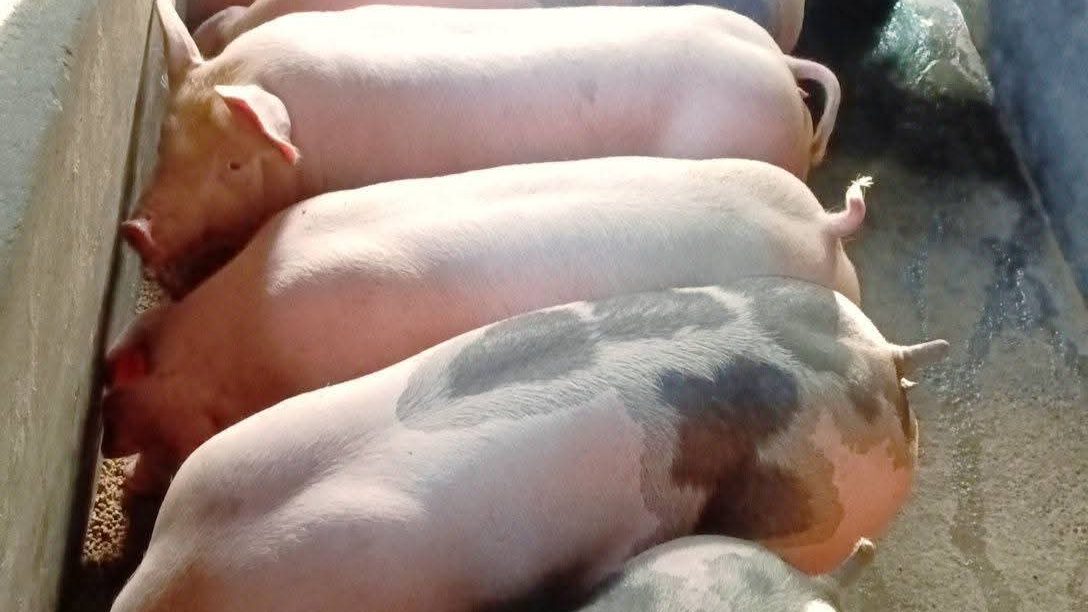
The fixes are not complicated:
- Use feeders sized for the pig, not the pen. A pre-starter trough is shorter and shallower than a finisher trough. Pigs that can put both front feet in the trough waste 2-3x more feed.
- Switch to a wet-and-dry feeder once pigs reach 30 kg. Pellet feeders with a small water nozzle attached cut wastage by 5-10% versus open troughs. They cost PHP 800-1,500 per unit and pay back in one batch.
- Cover feed storage. Rats can eat 20-30 g per visit and contaminate 10x that with droppings. A sealed metal drum with a clamping lid (PHP 600-1,200 used) ends the problem.
- Measure portions, do not eyeball. A 1-kg coffee can taped to a stick is enough. Most "feed by feel" approaches over-portion by 15-25%.
- Repair leaks fast. A cracked trough leaks slurry feed all night. Cheap to weld or replace, expensive to ignore.
Farms in Cebu and Bukidnon have cut their feed bill 8-12% in one batch by fixing wastage alone. No FCR change, no diet change, just better mechanics.
DA and Cooperative Programs Worth Knowing
A few public programs offer real per-bag savings if you qualify and have the patience to enroll. None of them give free feed, but they do drop the per-kg cost meaningfully.
- DA INSPIRE (Integrated National Swine Production Initiatives for Recovery and Expansion). Loan and input support for repopulation, including subsidized feed bundles for accredited multipliers and cooperative members. Coordinate through your municipal agriculture office.
- AGAP (Agricultural Guaranty Program). Working-capital loans through Land Bank that smallholders use to buy feed in bulk at trade prices. Interest typically runs 6-9% per year, which beats supplier credit by a wide margin.
- PPSC and provincial cooperatives. The Philippine Pork Stakeholders Coalition and several provincial pork producer co-ops aggregate orders. Members in Bulacan, Pampanga, and Iloilo report 7-12% bag-price savings versus walk-in retail.
- DA Bantay Presyo / NLP feed assistance. During price spikes (typhoon disruptions, ASF outbreaks), the National Livestock Program has occasionally distributed subsidized feed to RSBSA-registered backyard raisers in declared calamity areas. If a spike catches you with no buffer, the emergency pig feeding playbook covers what to stretch and what never to cut. Get RSBSA-listed even if you do not need it today. Paperwork is the difference between getting help and watching it pass you by.
- PCIC livestock insurance bundling. The free Philippine Crop Insurance Corporation premium for RSBSA-listed smallholders applies to your feed-financed pigs too. Enroll through your municipal agriculture office at the same time you register on the RSBSA list.
The honest reality: the bureaucracy is real. Plan for 4-8 weeks from inquiry to first benefit, and budget your feed as if these programs do not exist. Treat the savings as upside, not your operating margin.
Forex Risk on Imported Inputs
Soybean meal is 100% imported. Premix vitamins are largely imported. A meaningful share of the corn substitutes in commercial pellets (DDGS, wheat shorts) come in by ship. When the peso weakens against the dollar, your feed cost goes up within 4-8 weeks.
By the BSP reference rate, the peso-dollar rate sat around ₱56-58 through most of 2024, weakened to ₱58-60 across 2025, and has hovered near ₱58-59 in early 2026 (approximate ranges, check BSP for the current figure). Every ₱1 of peso depreciation against the dollar adds roughly ₱0.30-0.50 per kg to commercial feed prices, depending on import content. That is small per kilo but adds up to PHP 75-125 per pig over a full grow-out cycle.
Three practical responses, ranked by what actually works:
- Lock in 2-3 months of feed when the peso strengthens. If you see the rate move from PHP 59 to PHP 57, that is the moment to top up storage. Pellets keep 60-90 days in cool dry storage without quality loss.
- Increase corn share if you self-mix. Local corn is less forex-sensitive than soybean meal. Raising corn from 50% to 55% of your ration with a small protein top-up trims peso risk by 15-20%.
- Stop watching the news, start watching the PSA price monitor. Forex moves fast but feed prices lag. The PSA weekly retail price for darak, corn, and concentrate is the leading indicator that matters for your costs. The state of the industry dashboard shows the blended feed cost trend alongside live farmgate, so you can see the squeeze in one view.
One refinement on all three, now that there are three and a half years of weekly BAI ingredient prices to test them against. Soybean meal turns out to move with the world price inside the same month rather than over 4-8 weeks, and local yellow corn does not follow the world price at any lag at all. What actually sets the price of your feed sack has the arithmetic, and it makes response 2 above the stronger of the three.
Breed Choice Changes Your Feed Math
Your choice of native versus commercial pig genetics changes everything about feed economics. Here's the honest comparison:
| Factor | Commercial Cross | Native Pig |
|---|---|---|
| Days to market | 150-170 | 240-360 |
| Market weight | 90-100 kg | 40-60 kg |
| FCR (backyard) | 3.0-3.5 | 4.0-5.0+ |
| Feed protein needed | 16-18% CP | 12-14% CP |
| Total feed cost/head | PHP 8,700-11,400 | PHP 5,000-8,000 |
| Feed cost/kg gain | PHP 100-130 | PHP 120-160 |
Native pigs eat cheaper feed but convert it less efficiently. Their total feed bill is lower because they're sold at a lighter weight. But per kilo of gain, commercial crosses win on feed efficiency. The tradeoff is that native pigs sell at a premium for lechon (especially in Cebu and the Visayas), tolerate heat and cheaper ingredients better, and don't need the same level of housing.
Worked Examples: 5-Head Backyard vs 50-Head Semi-Commercial
Numbers in tables are useful but abstract. Here is how feed economics actually plays out for two common Philippine setups, raising pigs from 8 kg weaners to 95 kg market weight over a single batch.
Both examples are priced off ₱172.44/kg, PSA's Q2 2026 national average and the last official quarter (PSA has not yet published July to September 2026). Each is then checked at ₱150/kg, the national figure the DA gave for August 2026, because that is closer to what buyers are reportedly paying now.
Setup A: 5-head backyard, Cebu, sari-sari sack buying, FCR 3.4
- Feed type: B-MEG retail, mixed phases, no self-mixing
- Average price per kg across phases: PHP 37
- Total feed per pig: 290 kg (FCR 3.4 on 87 kg gain)
- Feed cost per pig: PHP 10,730
- Total batch feed cost (5 pigs): PHP 53,650
- Selling at PHP 172.44/kg liveweight (95 kg, PSA Q2 2026) = PHP 16,382/head
- Gross margin per pig before non-feed costs: PHP 5,652
- Margin per kilo gain: PHP 65
- At PHP 150/kg (DA, August 2026): PHP 14,250/head, gross margin PHP 3,520
Read that again before you get excited. PHP 5,652 is what is left before the weaner (PHP 3,500-4,000), meds and vet (PHP 500-800), water, power, and your own labor. Take those out and Setup A clears maybe PHP 850-1,350 a head at ₱172.44, and one runt or one bout of scours eats it. At the DA's August ₱150 the same pig loses PHP 780-1,280 before water, power and labor. That is not a broken spreadsheet, that is the market: producer groups put cost of production at ₱180-₱190/kg, which means the average Philippine farm is selling below its own cost. FCR 3.4 on retail-priced feed leaves no cushion at all.
Setup B: 50-head semi-commercial, Bukidnon, self-mix grower-finisher + commercial starter, FCR 2.9
- Feed type: Commercial pre-starter and starter (₱42-48/kg), self-mixed grower-finisher (₱24/kg), blends to about ₱28/kg across the full grow-out
- Blended price per kg across phases: PHP 28
- Total feed per pig: 250 kg (FCR 2.9 on 87 kg gain, less wastage from better feeders)
- Feed cost per pig: PHP 7,000
- Total batch feed cost (50 pigs): PHP 350,000
- Selling at PHP 165/kg liveweight (95 kg; a volume buyer typically shaves ₱5-10/kg off the going farmgate for taking the whole batch, here off the ₱172.44 PSA quarter) = PHP 15,675/head
- Gross margin per pig before non-feed costs: PHP 8,675
- Margin per kilo gain: PHP 100
- At PHP 143/kg (the same shave off the DA's August ₱150): PHP 13,585/head, gross margin PHP 6,585
The 50-head operation makes PHP 35/kg-gain more on each pig despite getting a lower farmgate price, because feed cost per kilo of gain is PHP 80 versus PHP 123. At ₱172.44, let alone the ₱150 the DA reported for August, that gap is the whole business: after a PHP 3,500-4,000 weaner and meds, Setup B still clears roughly PHP 3,900-4,700 a head at ₱165 and PHP 1,800-2,300 at ₱143, while Setup A is near zero or underwater. Scale matters, but so does the discipline to phase-feed, self-mix, control wastage, and measure FCR.
The flip side: setup A finishes with PHP 28,260 in gross feed margin across the batch at ₱172.44, with relatively low risk and no equipment investment beyond pens. Setup B finishes with PHP 433,750 in gross feed margin but risks PHP 350,000 in feed alone if anything (ASF, disease outbreak, market crash) goes sideways. Bigger is not automatically better. It is just different.
Run your own version through the profit simulator before committing capital to scale up.
The Number That Matters Most
Forget feed price per bag. The number that actually determines your profit is cost per kilo of liveweight gain. Here's why:
A PHP 35/kg feed with an FCR of 2.9 costs you PHP 101.50 per kg of gain. A PHP 38/kg premium feed with an FCR of 2.65 costs PHP 100.70 per kg of gain. Halos pareho lang. The more expensive feed that converts better costs the same per kilo of actual pig growth, sometimes less.
Track your own FCR. Weigh your pigs every two weeks, record every sack of feed, and divide total feed consumed by total weight gained. You can't manage what you don't measure, and most backyard raisers have never calculated their actual FCR. The FCR calculator makes this easy.
Do not budget around the DA floor price. The DA announced a ₱210/kg minimum farmgate price on 4 November 2025 with SINAG, NFHFI, and PROPORK, and the national average has not reached it since. Four regions have, for a few months: the Cordillera (five, most recently April to June 2026), BARMM and Central Visayas (two each, late 2025) and NCR (one, January 2026). It is an industry-agreed, DA-backed target that cannot be enforced, not a guarantee that anyone will pay you ₱210. PSA's last official quarter is ₱172.44 (Q2 2026; June ₱171.76), and July to September is not yet published. The DA told the Manila Times the national figure was about ₱150/kg in August 2026, and producer groups report ₱120-₱160 in some areas. Farmgate has not been above ₱200 since mid-2025, when it peaked at ₱214.52 in June. Against a cost of production of ₱180-₱190/kg, a feed cost of ₱130/kg of gain does not work. At ₱172.44 you need to be under about ₱125/kg of gain just to break even after the weaner and meds; at ₱150, under about ₱100-₱115. Size your break-even for what buyers pay, not for what the DA announced. Use the break-even calculator.
Tools
- Break-even Calculator: find the minimum farmgate price to cover your costs
- Feed Calculator: estimate feed consumption and cost by growth phase
- Profit Simulator: model batch economics with your specific feed prices
- FCR Calculator: track your actual feed conversion ratio
Related reading
- Cost to raise a pig in the Philippines: the full per-head cost breakdown that builds on these same feed numbers
- Pig farming profit for 10 pigs: what feed-economics decisions actually do to batch profit
- Cheapest way to feed pigs: budget feeding strategies that move the per-head line
- Feeding and Nutrition topic cluster: the rest of the feed-side library
Sources
- DA via Manila Times, 28 Sep 2026: August 2026 national liveweight about ₱150/kg (trade-reported, not PSA); producer groups, cost of production ₱180-₱190/kg (Daily Tribune 2 Oct, BusinessMirror 9 Oct 2026)
- PIDS: Philippines among highest-cost pork producers in Asia (BusinessWorld, Nov 2025)
- DA sets live hog floor price at PHP 210/kg (PNA, Nov 2025)
- DA, hog farmers set pork floor price at P210 per kilo (Department of Agriculture, Nov 2025)
- Philippine Hog Industry Roadmap 2022-2026 (DA, FCR baseline 3.19 / 2026 target 2.27)
- Toward Competitive Livestock, Poultry, and Dairy Industries: A Consolidated Benchmarking Study (PIDS Discussion Paper 2022-20, Briones)
- PSA Corn Farmgate Prices (Tridge/PSA data)
- Philippines soybean meal imports forecast (Philstar, Mar 2025)
- PCA Copra/Copra Meal Pricing (Philippine Coconut Authority)
- USDA FAS Manila: Livestock and Products Annual
- DOST-PCAARRD Swine Industry Strategic Plan
Bisaya / Cebuano
Ang feeds mao gyud ang pinakadako nga gasto sa pag-alaga og baboy, mga 57% sa tanan nimong gastos sumala sa PIDS, ug mas taas pa kung sako-sako ka og palit sa retail. PHP 8,700 hangtod PHP 11,400 ang gasto sa feeds matag baboy gikan weaning ngadto sa market weight, depende sa imong FCR ug presyo sa sako.
Hinumdumi: ang katapusang opisyal nga presyo sa PSA kay PHP 172.44/kg (Q2 2026), ug sumala sa DA mga PHP 150/kg na lang ang nasudnong presyo niadtong Agosto 2026. Ang gasto sa produksyon mga PHP 180 hangtod PHP 190/kg. Ubos sa gasto ang baligya karon. Ang PHP 210/kg target ra, wala kini maabot sa nasudnong average sukad gitakda. Ayaw pagsalig ana.
Ang importante nga numero dili ang presyo per sako, kondili ang gasto matag kilo nga modako ang baboy. Pananglitan: kung PHP 36/kg ang imong feeds ug FCR 3.0, PHP 108 ang imong gasto matag kilo nga gain. Kung mas dako ang FCR, mas mahal ang matag kilo. Mao nga ang pinakaayo nga paagi sa pagdaginot dili ang pagpalit og barato nga feeds, kondili ang pagpaayo sa imong management. Limpyo nga tubig, regular nga pagpakaon, sakto nga deworming.
Phase feeding mahinungdanon kaayo. Ayaw og hatagi og starter feeds (PHP 42-48/kg) ang baboy nga kapin na 60 kg. Hatagi og finisher (mga PHP 35/kg). Pareho ra ang gain nila pero mubo ang gasto. Tulo ka phase na lang ang minimum: starter (8-25 kg), grower (25-60 kg), finisher (60+ kg).
Pag-bantay sa wastage. Mga 8-15% sa feeds nausik tungod sa daot nga pakaonan, ilaga, ulan, o sobra nga sukod. Sealed metal drum para sa storage (PHP 600-1,200), wet-and-dry feeder (PHP 800-1,500), ug measured nga sukod imbes nga "sa pakigbati". Mao kana ang naka-save og PHP 1,000+ matag baboy.
Pag-RSBSA register ka sa inyong munisipyo, libre ra. Mahimo nimong i-access ang DA INSPIRE, AGAP loan, ug PCIC insurance pagkahuman. Ayaw paghulat nga moabot ang typhoon o ASF outbreak. Kanang oras, ulahi na.
Kung dili nimo i-record ang imong gasto ug timbang sa baboy, dili nimo mahibaw-an kung nalugi ka. Datos lang ang makasulti.