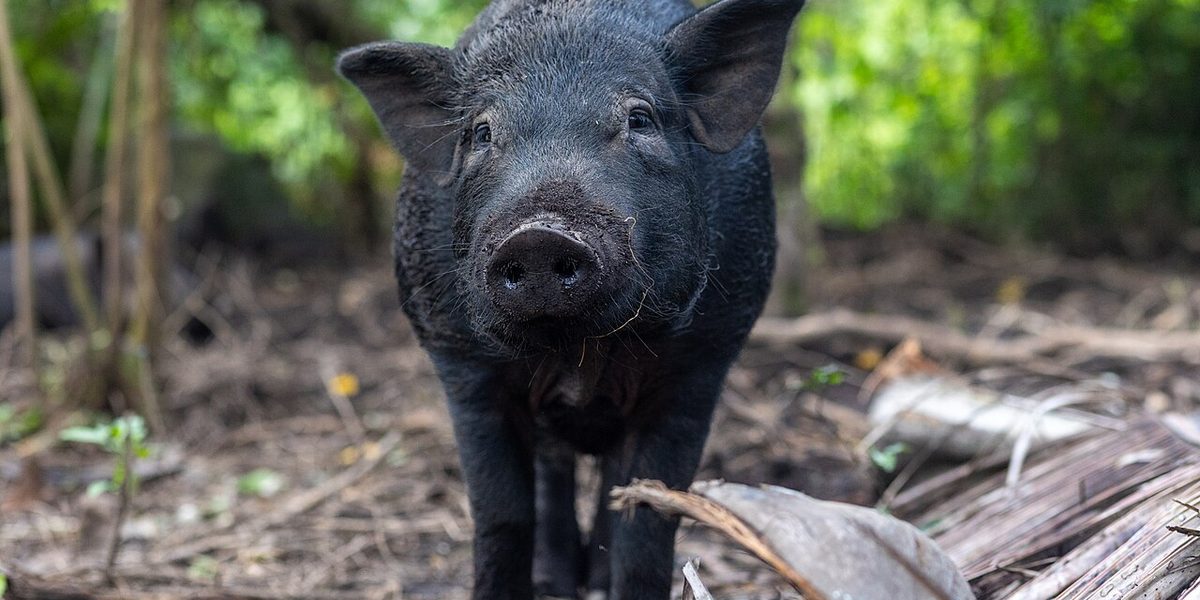
Every province in the Philippines has a native pig. Before Landrace genetics arrived on refrigerated cargo ships, before B-MEG bags lined the shelves of every farm supply store, Filipino families raised black, pot-bellied pigs on camote tops, banana trunks, and kitchen scraps. Those pigs built the lechon tradition. They fed rural communities through typhoons, economic crises, and now through ASF. They are still here -- and for farmers who understand their economics, they are more relevant than ever.
Native pigs are not a step backward. They are a different business model, built on low inputs, premium pricing, and a market that commercial breeds cannot serve.
At a Glance
| Trait | Native Pigs | Commercial Comparison |
|---|---|---|
| Mature weight (boar) | 50-80 kg | 160-200 kg |
| Mature weight (sow) | 40-70 kg | 130-170 kg |
| Litter size (born alive) | 5-8 piglets | 10-14 piglets |
| Days to market weight | 240-365 days (40-60 kg) | 140-170 days (90-110 kg) |
| Feed conversion ratio | 3.50 (formulated) / 4.21 (traditional) | 2.4-3.0 |
| Dressing percentage | 65-72% | 74-78% |
| Intramuscular fat | 4-7% | 1.5-3% |
| Heat tolerance | Excellent | Poor to moderate |
| Disease resistance | High | Low to moderate |
| Farmgate price (live, per kg) | P180-280 | P180-190 (SINAG industry average, May 2026) |
| Housing investment per sow | P2,000-5,000 | P15,000-25,000 |
That FCR gap narrows fast when you factor in feed cost. A native pig converting P15/kg darak at 4.21 FCR spends P63 per kg of gain. A commercial pig converting P36.69/kg finisher (the premium grower-finisher average as of 12 July 2026) at 2.8 FCR spends about P103 per kg of gain. The native pig wins on cost per kilo of meat produced. It only wins on price if you have a premium buyer: at the wet-market end, native and commercial farmgate now sit in the same P180s.
Who Is This Breed For?
This breed is for you if:
- You have access to cheap or free feedstuffs -- camote, banana trunks, copra meal, kitchen scraps, foraged vegetation
- Your target market is lechon operators, heritage restaurants, longganisa/tocino producers, or direct-to-consumer premium channels
- You are farming in an upland, remote, or typhoon-prone area where commercial feed supply chains break down
- Your capital for housing and infrastructure is limited (under P50,000 startup)
- You want to build a brand around provenance, flavor, and tradition
This breed is NOT for you if:
- You need to supply wet market volume at standard commercial prices
- Your business model depends on throughput and fast turnover (5-6 month cycles)
- You have reliable access to cheap formulated feeds and established wet market buyer relationships
For a detailed side-by-side comparison of native vs commercial systems, see my guide on native vs commercial pig breeds. For a broader comparison across all eight breeds, including the white commercial lines and the lechon-favorite Duroc crosses, see the best pig breeds for Philippine small farmers guide.
Economics: The Real Numbers
Here is what it actually costs to raise a native pig from weaning to market weight, using 2025-2026 prices.
Cost Breakdown Per Head (Traditional Feeding System)
| Item | Cost (PHP) | Notes |
|---|---|---|
| Piglet acquisition | 3,000-6,000 | Pure native weanling, 8-12 weeks |
| Feed (darak + local feeds) | 4,500-7,000 | 8-10 months, mostly local feedstuffs at P15-25/kg |
| Commercial supplement | 1,000-2,000 | Mineral premix, occasional concentrate |
| Veterinary (deworming, vaccines) | 300-500 | Minimal inputs needed |
| Housing (amortized per head) | 200-400 | Bamboo/nipa shelter, very low cost |
| Total cost per head | 9,000-15,900 |
Revenue Scenarios
| Market Channel | Live Weight | Price | Revenue | Net Margin |
|---|---|---|---|---|
| Live sale (farmgate) | 50 kg | P220/kg | P11,000 | P1,100-2,000 |
| Live sale (premium buyer) | 60 kg | P250/kg | P15,000 | P5,100-6,000 |
| Lechon de leche (whole pig) | 15-20 kg dressed | P8,000-13,000/head | P8,000-13,000 | P4,000-7,000 |
| Processed (longganisa, tocino) | 35-40 kg carcass | P350-450/kg retail | P12,250-18,000 | P6,350-8,100 |
The sweet spot is selling to lechon operators or processing your own meat products. Farmgate live sales at standard prices barely break even -- you need the premium channels to make native pigs profitable.
For a closer comparison against the commercial-breed margin pattern, the 10-pig backyard profit guide walks through what a wet-market grower-finisher actually earns per batch. Side by side, the native operation wins on margin per head when you have the lechon channel locked in, but the commercial operation wins on absolute pesos per year when you can run multiple batches through the same pen.
Sa Bisaya
Lechon Production Guide
This is where native pigs really shine. The best lechon in the Philippines -- Cebu lechon, Talisay lechon, Carcar lechon -- is built on native or native-cross pigs. Here is why, and how to produce lechon-grade stock.
Why Native Pigs Make Better Lechon
- Thinner skin -- Crisps faster and more evenly over charcoal. Commercial pig skin is thicker and often turns leathery before the meat is done.
- Higher intramuscular fat -- 4-7% vs 1.5-3% in commercial breeds. The fat bastes the meat from inside during roasting, keeping it juicy.
- Smaller frame -- A 15-20 kg dressed native pig roasts in 3-4 hours. Even heat penetration, no raw center.
- Flavor -- This is subjective but universally acknowledged. Native pork tastes different. The slower growth, diverse diet, and higher fat content produce deeper, more complex flavors.
Lechon-Grade Specifications
| Parameter | Lechon de Leche | Medium Lechon | Full-Size Lechon |
|---|---|---|---|
| Live weight | 8-15 kg | 20-35 kg | 40-60 kg |
| Dressed weight | 5-10 kg | 13-22 kg | 26-40 kg |
| Age | 2-3 months | 4-6 months | 8-12 months |
| Market price (whole, cooked) | P8,000-13,000 | P11,700-13,400 | P13,400-19,000 |
| Breed preference | Pure native | Native or F1 cross | F1 cross or native |
| Skin quality | Ultra-thin, superior | Thin, excellent | Moderate |
Producing Lechon de Leche
Lechon de leche (roast suckling pig) is the highest-value product per kilogram from native pigs. Target: 8-15 kg live weight at 2-3 months old.
- Keep piglets with the sow until sale. Sow milk + creep feed produces the tender, mild-flavored meat that lechon de leche demands.
- Creep feed with finely ground rice + coconut milk starting at 2 weeks. No commercial starter needed.
- Do not deworm or vaccinate piglets destined for lechon de leche -- the withdrawal periods are longer than the animal's lifespan. Keep the sow healthy instead.
- Price lechon de leche piglets at P5,000-8,000 per head for live sale to lechoneros. Some Cebu operators pay P600-800 per kg live weight for premium native lechon de leche stock.
Sa Bisaya
Conservation and Sourcing
The Conservation Crisis
The Philippine native pig population has declined sharply over the past three decades. Uncontrolled crossbreeding with commercial imports has diluted the gene pool. Many farmers cannot tell you whether their "native" pig is actually pure or already carries Large White or Landrace genetics from a neighbor's boar three generations back.
PCAARRD Purified Breeds
The Philippine Council for Agriculture, Aquatic, and Natural Resources Research and Development (PCAARRD) runs a native pig conservation program that has identified and purified six distinct breeds:
| Breed Name | Region of Origin | Key Traits |
|---|---|---|
| Benguet | Cordillera (Benguet) | Black coat, compact frame, cold-hardy, 40-55 kg mature |
| Yookah | Cordillera (Kalinga) | Black with white belt, culturally significant, ritualistic use |
| ISUbela | Cagayan Valley (Isabela) | Medium frame, good forager, adapted to lowland heat |
| Markaduke | CALABARZON (Marinduque) | Dark coat, docile temperament, good mothering |
| Q-Black | Central Luzon (Nueva Ecija) | Black, improved growth rate among native breeds |
| Sinirangan | Eastern Visayas (Samar/Leyte) | Strong foraging instinct, thrives on root crops |
These breeds are maintained at state university research stations. Contact PCAARRD or the host universities directly to source certified breeding stock. Expect waiting lists -- demand exceeds supply. What DOST-PCAARRD actually publishes for each of the six, and the columns where a strain has no published figure at all, is set out in the six native strains side by side.
Where to Find Native Pig Breeders
- Cordillera -- Benguet State University maintains Benguet and Yookah lines. Mountain Province backyard farms still have relatively pure populations.
- Visayas -- Visayas State University (Leyte) maintains Sinirangan stock. Cebu and Bohol have the strongest commercial native pig populations driven by lechon demand.
- Mindanao -- Bukidnon and Davao uplands still have native populations, though crossbreeding is widespread.
- Isabela -- Isabela State University maintains the ISUbela line.
- Online -- Buy-and-sell groups carry native stock year round, and nobody in them is vetted. Treat every listing as unverified until you have seen the parent stock yourself.
Crossbreeding Strategies
Pure native pigs serve the heritage and lechon de leche markets well. But for farmers who want faster growth while keeping the native flavor advantage, strategic crossbreeding is the answer.
Native x Duroc (The Lechon Cross)
This is the most popular cross for the Philippine lechon market. The native dam contributes flavor, fat content, and hardiness. The Duroc sire contributes muscling, growth rate, and superior meat color.
F1 Performance:
- Market weight: 60-80 kg in 180-220 days
- FCR: 3.0-3.8 (on mixed feeds)
- Intramuscular fat: 3-5% (higher than pure commercial, lower than pure native)
- Lechon quality: Excellent -- thin enough skin, rich enough fat, adequate frame size
Use the Duroc boar on native sows, never the reverse. Native sows farrow easily without assistance, tolerate heat, and produce adequate milk on local feeds. A commercial sow bred to a native boar loses every maternal advantage.
For more on Duroc genetics, see my Duroc breed guide.
Native x Large White (The Growth Cross)
This cross prioritizes growth rate over flavor. The Large White sire pushes frame size and lean meat percentage up. F1 offspring grow faster than pure natives but lose some of the intramuscular fat that makes native pork special.
F1 Performance:
- Market weight: 70-90 kg in 180-240 days
- FCR: 3.0-3.5 (on mixed feeds)
- Intramuscular fat: 2.5-4%
- Best for: Wet market sales at a moderate premium, processed meats
Details on Large White performance in my Large White breed guide.
Rotational Crossbreeding
For farms maintaining native sow herds, a rotational system alternates between native and commercial sires across generations. This maintains heterosis (hybrid vigor) without requiring purebred herds of both types. The key discipline: always retain gilts from the cross that used the native sire, so your replacement females carry more native genetics and retain maternal hardiness.
What NOT To Do
- Do not cross native x native from the same bloodline. Inbreeding depression hits native breeds hard -- smaller litters, weaker piglets, higher mortality.
- Do not use F1 cross females as the foundation for a "native" breeding program. Each backcross dilutes the native characteristics you are trying to sell.
- Do not use Pietrain or Belgian Landrace as the terminal sire on native dams. The extreme muscling genetics produce birthing difficulties (dystocia) in small-framed native sows.
Feeding Program
Feed is where native pigs earn their keep. Their ability to convert cheap, locally available feedstuffs into quality meat is the whole point. Waste that advantage by feeding them P35-38/kg commercial finisher and you have a pig that grows slowly on expensive feed. Worst of both worlds.
Phase 1: Creep Feed (Birth to Weaning, 0-8 Weeks)
- Piglets nurse primarily from the sow
- Offer creep feed starting at 2 weeks: finely ground rice (binlid) mixed with coconut milk or powdered milk
- No commercial starter needed for native piglets -- they wean naturally at 6-8 weeks
- Cost: P200-400 per piglet for the creep period
Phase 2: Starter/Grower (8-20 Weeks)
| Ingredient | Inclusion Rate | Cost/kg | Notes |
|---|---|---|---|
| Darak (rice bran) | 40-50% | P15-25 | Source within 2 weeks of milling to avoid rancidity |
| Copra meal | 15-20% | P12-18 | Good protein, limit to 20% due to high fiber |
| Camote (sweet potato) | 20-25% | P5-10 (or free) | Chop tubers and tops, sun-dry if storing |
| Corn (yellow, ground) | 10-15% | P18-22 | Energy source |
| Mineral premix | 0.5-1% | P80-120/kg | Essential for bone development |
- Target: 15-25 kg body weight by 20 weeks
- Feed 1-1.5 kg/day of the mixed ration
- Supplement with kangkong, gabi (taro) leaves, banana trunks (chopped), and kitchen scraps as available
- Formulated feed cost: P14-18 per kg of mixed ration
Phase 3: Finisher (20 Weeks to Market)
| Ingredient | Inclusion Rate | Cost/kg | Notes |
|---|---|---|---|
| Darak (rice bran) | 35-45% | P15-25 | Backbone of the ration |
| Copra meal | 20-25% | P12-18 | Increase slightly for protein |
| Camote + banana trunk | 20-30% | P3-8 (or free) | Bulk and energy |
| Corn (ground) | 5-10% | P18-22 | Can reduce if camote is abundant |
| Salt + mineral premix | 0.5-1% | P80-120/kg |
- Target: 40-60 kg live weight at 8-12 months
- Feed 1.5-2.5 kg/day of mixed ration + ad libitum access to forage/scraps
- Formulated feed cost: P12-16 per kg of mixed ration
Total Feed Cost Per Head (Weaning to Market)
| System | Total Feed Used | Cost/kg Feed | Total Feed Cost |
|---|---|---|---|
| Traditional (mostly scraps/forage) | 250-350 kg | P8-12 | P2,000-4,200 |
| Semi-formulated (darak + copra + local) | 300-400 kg | P14-18 | P4,200-7,200 |
| Full commercial feed | 280-380 kg | P35-38 | P9,800-14,440 |
Commercial feed pricing above is the premium grower/finisher range as of 12 July 2026: P34.90-38.20/kg, or P1,747-1,910 per 50 kg bag. Feed has climbed P1-2/kg through 2026 and no miller has announced a rollback, so treat the top of that range as the planning number, not the bottom.
The P7,800-10,200 difference between traditional and commercial feeding is your margin. Native pigs are built for the traditional system -- use it.
For detailed guidance on alternative feed formulations, see my guide on alternative feeding systems. For commercial feed price benchmarks, see Philippine feed economics.
Sa Bisaya
Health and Biosecurity
Native pigs are hardier than commercial breeds across almost every disease metric. But "hardier" does not mean "invincible." ASF does not care about breed -- it kills native and commercial pigs equally.
Vaccination Schedule
| Vaccine | Age/Timing | Booster | Cost/Dose | Notes |
|---|---|---|---|---|
| ---------------------------- | ---------------------------------------- | ------------------------ | ------------------- | --------------------------------------------------------------------------------------------- |
| Deworming (ivermectin) | 8 weeks | Every 3 months | P15-30 | Internal + external parasite control |
| Mange treatment (ivermectin) | As needed | 14 days after first dose | P15-30 | Common in native pigs, treat early |
| AVAC ASF vaccine | Fatteners only; ask your vet for the age | Single dose | Ask your vet outlet | On commercial sale since 2 Sep 2026 via accredited veterinary outlets; not for breeding stock |
Native Pig Health Advantages
- Heat tolerance -- Perform normally at 30-35 C ambient temperature without misting or fans. Commercial breeds sit in a thermoneutral zone of about 18-25 C and start thermoregulating above it.
- Disease resistance -- Stronger immune response to common swine diseases. Lower mortality rates in backyard conditions.
- Parasite tolerance -- Can carry moderate worm burdens without significant production loss. Still deworm, but the impact of missed deworming is less catastrophic.
- Stress resistance -- Handle transport, mixing, and environmental changes better than commercial breeds. Lower incidence of porcine stress syndrome.
ASF Biosecurity for Backyard Native Pig Farms
BAI's latest national bulletin, dated 9 October 2026, counts 226 active barangays across 24 provinces. The count bottomed at 6 barangays in 4 provinces on 22 May 2026, then rose with every bulletin to a peak of 293 barangays in 31 provinces on 24 September. It is not an all-clear.
What has happened since matters a lot if you raise native pigs, because it is happening in the Visayas. San Enrique in Negros Occidental was confirmed on 23 June 2026, with 1,902 pig deaths province-wide by 25 June, not all of them from ASF. Barotac Viejo in Iloilo followed on 29 June, its first case in four years. Bacolod and La Libertad in Negros Oriental on 1 July. Capiz red-zoned five LGUs and shut its border to pork on 24 June. Cebu banned Negros pigs and pork on 7 July under EO 39, and in September ASF was confirmed inside Cebu province (Ginatilan, then Pamutan, Toong and Buhisan in Cebu City, per the Daily Tribune). If your buyer is a Cebu lechonero, those transport bans are your business, not somebody else's news story.
The AVAC vaccine is now on sale for fatteners, but it is not a rescue you can plan around. Follow the essentials:
- No swill feeding -- Never feed kitchen scraps containing pork or pork products. This is the number one transmission route for backyard farms.
- Perimeter control -- Fence your pig area. Keep dogs, chickens, and wild animals away from the pigs and their feed.
- Boot dip -- A basin of disinfectant (citric acid solution or commercial disinfectant) at the entry to your pig area. Change it daily.
- No shared equipment -- Do not borrow or lend ropes, feeding troughs, or tools to other pig raisers.
- Quarantine new arrivals -- Isolate any new pig for 30 days before introducing to your herd. No exceptions.
- Report sick pigs -- If you see hemorrhagic symptoms (bleeding from ears, nose, or rectum), blue discoloration of skin, or sudden death, contact your municipal agriculturist immediately. Do not sell or transport sick animals.
For the full biosecurity framework, see my guide on ASF-era pig farming.
Regional Intelligence
Visayas (Cebu, Bohol, Leyte, Iloilo)
The Visayas is the heartland of native pig farming in the Philippines. The Cebu lechon industry is the primary demand driver -- lechon operators in Cebu City, Talisay, Carcar, and Liloan actively source native and native-cross pigs. Expect farmgate prices of P220-280/kg live weight for verified native stock, higher for lechon de leche. Bohol has strong native pig populations in interior municipalities. Leyte's Visayas State University maintains the Sinirangan breed for conservation and breeding stock distribution.
Supply chain: Direct farmer-to-lechonero relationships dominate. No major consolidators. Build relationships, deliver consistent quality, and your buyers will stay.
Cordillera (Benguet, Mountain Province, Kalinga)
Native pigs here are culturally embedded -- used in rituals, celebrations, and community feasts (canao). The Benguet and Yookah breeds are adapted to cool highland conditions (15-25 C). Benguet State University is the primary source for certified breeding stock. Prices tend to be higher due to cultural value -- a pig for a canao is not priced by the kilo.
Supply chain: Community-based, culturally mediated. Outsiders cannot easily enter this market. If you are from the region, use your cultural connections.
Mindanao (Bukidnon, Davao, Zamboanga)
Mindanao has native pig populations in upland areas, but crossbreeding with commercial genetics is widespread. Finding pure native stock requires effort. The Davao lechon market is growing and beginning to differentiate on breed quality, creating demand pull for native pigs. Bukidnon's cooler uplands (Malaybalay, Valencia) support native pig production well.
Supply chain: Less organized than the Visayas. Opportunity for farmers who can aggregate native pigs and supply the urban Davao and Cagayan de Oro markets.
Luzon (Ilocos, Cagayan Valley, CALABARZON)
Ilocos has a strong backyard native pig tradition linked to bagnet production. Cagayan Valley's Isabela State University maintains the ISUbela breed. CALABARZON (particularly Marinduque) is home to the Markaduke breed. Central Luzon's Nueva Ecija hosts Q-Black conservation herds.
Supply chain: Proximity to Metro Manila is a double-edged sword -- higher potential prices but also more competition from commercial producers. Position native pork as a premium, differentiated product for the farm-to-table restaurant segment.
Common Mistakes
1. Feeding Native Pigs Like Commercial Pigs
The single most common mistake. Farmers buy P35-38/kg commercial finisher for a pig that grows at half the rate of a commercial breed. The math is brutal: 350 kg of feed at P36.69/kg (the premium grower-finisher average on 12 July 2026) = P12,840 in feed cost for a pig that sells at P11,000-13,000 live. You are already underwater before you count the piglet. Native pigs need native feeding systems -- darak, copra meal, camote, banana, forage. Save the commercial feed budget for mineral premix and targeted supplementation.
2. Claiming "Native" With Crossed Genetics
Buyers -- especially lechon operators -- are learning to spot fakes. A pig with a long snout, erect ears, pink skin, and 90 kg frame weight is not native, regardless of what the seller says. If you are marketing native pigs at a premium, your genetics must be verifiable. Source from PCAARRD-affiliated herds or maintain documented breeding records. One crossed boar in your neighborhood can dilute your entire sow herd's native characteristics within two generations.
3. Neglecting Biosecurity Because "Native Pigs Are Hardy"
Hardiness against common swine diseases does not protect against ASF. A single ASF introduction wipes out your entire herd -- native and commercial alike, 100% mortality, no treatment. The P500 you save skipping biosecurity basics costs you P50,000+ when ASF arrives. Maintain perimeter control, boot dips, and quarantine protocols regardless of breed.
4. Inbreeding
Backyard native pig farms in rural areas often have one boar serving all sows in the community for years. The result: inbreeding depression -- smaller litters (3-4 piglets instead of 6-8), weaker piglets, higher pre-weaning mortality, reduced growth rates. Exchange boars with farmers in distant barangays or municipalities every 2-3 years. Better yet, source boars from PCAARRD-affiliated herds with documented pedigrees.
5. Selling Into the Wrong Market
Native pigs sold at farmgate to middlemen at standard commercial prices (P180/kg) are a losing proposition. The margins only work when you sell into premium channels: lechon operators (P220-280/kg), heritage restaurants, direct-to-consumer, or processed meat products. Know your buyer before you raise the pig.
FAQ
Magkano ang native na piglet? (How much is a native piglet?)
Native piglets cost P3,000-6,000 for standard weanlings and P5,000-8,000 for premium bloodlines from PCAARRD-affiliated breeders. Lechon de leche stock (8-15 kg, 2-3 months old) sells for P5,000-9,600 per head when sold directly to lechon operators, especially in Cebu.
Pwede bang i-cross ang native sa Duroc? (Can I cross native with Duroc?)
Yes, and this is the most popular crossbreeding strategy for the lechon market. Use the native as the dam (mother) and Duroc as the sire (father). The F1 offspring combine native flavor and fat content with Duroc muscling and faster growth. Expect market weight of 60-80 kg in 180-220 days. See my Duroc breed guide for sire selection tips.
Ano ang pinaka-magandang feeds para sa native na baboy? (What is the best feed for native pigs?)
Local feedstuffs: darak (rice bran) as the base (40-50% of ration), supplemented with copra meal, camote (sweet potato tubers and tops), banana trunks, corn, and kitchen scraps (no pork products). Add mineral premix at 0.5-1% of the ration. This costs P12-18/kg of mixed feed versus P35-38/kg for premium commercial grower/finisher as of 12 July 2026. See alternative feeding systems for detailed formulations.
Saan ako makakabili ng pure native na baboy? (Where can I buy pure native pigs?)
Start with PCAARRD-affiliated state universities: Benguet State University (Benguet, Yookah breeds), Isabela State University (ISUbela), Visayas State University (Sinirangan). For commercial quantities, the Visayas -- particularly Cebu, Bohol, and Leyte -- has the strongest native pig populations. Buy from the herd you can visit. There is no register of verified native breeders in this country, so a seller's claim is worth exactly what you can check on the farm.
Kumikita ba ang native pig farming? (Is native pig farming profitable?)
Yes, but only if you sell into the right market. At farmgate commercial prices (P180/kg), native pigs barely break even due to their slower growth. At premium prices (P220-280/kg live) or through lechon/processed product channels, net margins of P2,000-8,000 per head are achievable. The key variables are feed cost (use local feeds), selling price (target premium buyers), and mortality (maintain biosecurity).
Gaano katagal bago i-harvest ang native na baboy? (How long before a native pig is ready for harvest?)
It depends on your target market. Lechon de leche: 2-3 months (8-15 kg live weight). Medium lechon: 4-6 months (20-35 kg). Full market weight: 8-12 months (40-60 kg). Native pigs will never match commercial breeds on speed to market -- the value proposition is flavor and premium pricing, not throughput.
Kailangan ba ng aircon o misting ang native pigs? (Do native pigs need air conditioning or misting?)
No. Native pigs are fully adapted to Philippine tropical conditions. They perform normally at 30-35 C without any cooling intervention. Simple shade (bamboo shelter with nipa or GI sheet roofing) and clean water are sufficient. This is a major infrastructure cost advantage over commercial breeds, which show heat stress above 27 C and require ventilation systems in enclosed housing.
Paano protektahan ang native pigs sa ASF? (How do I protect native pigs from ASF?)
The same way you protect any pig: strict biosecurity. No swill feeding (especially no pork scraps), perimeter fencing, boot dips, quarantine of new arrivals for 30 days, and no sharing of equipment with other farms. Do not wait for the vaccine to save you. AVAC has been on commercial sale since 2 September 2026, but for fatteners only, through accredited veterinary outlets. And ASF came back to the Visayas from late June 2026, with confirmed cases in Negros Occidental, Iloilo, Negros Oriental, plus pork transport bans in Capiz and Cebu, then cases inside Cebu province in September. BAI's 9 October 2026 bulletin counts 226 active barangays across 24 provinces. If you raise in the lechon belt, tighten your biosecurity now. Native pigs have zero natural resistance to ASF despite their general hardiness. See my full ASF biosecurity guide.