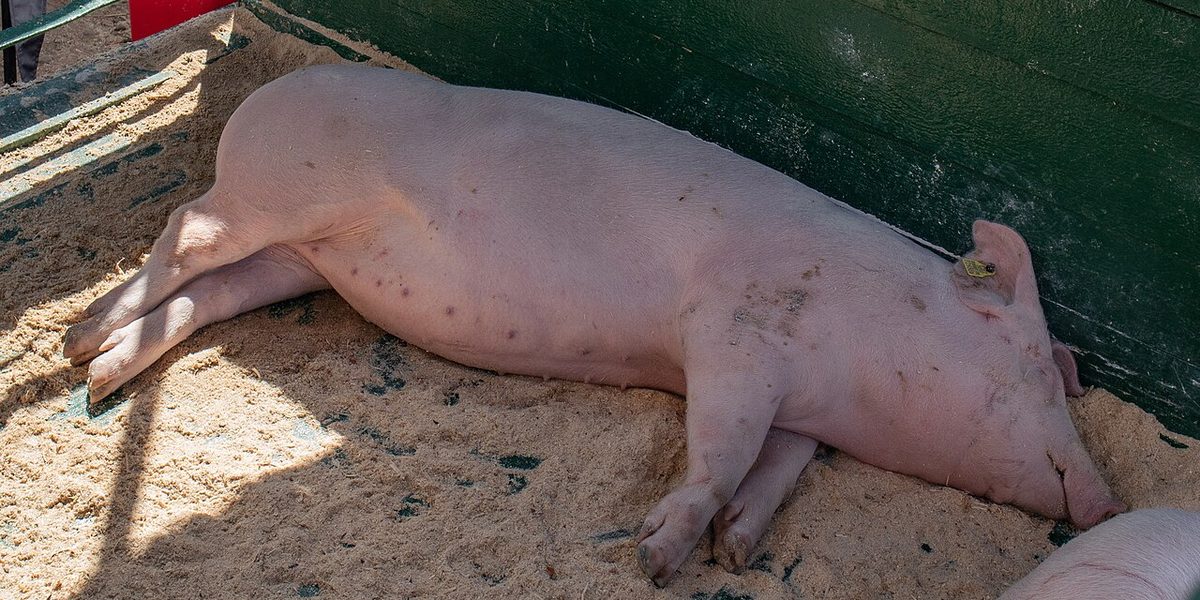
The Dam Line That Runs Philippine Commercial Pig Production
Trace any profitable three-way cross operation in the Philippines back to its foundation and you land on the Landrace. Not because it grows the fastest or finishes the heaviest -- that is the Duroc's job. The Landrace earns its keep in the farrowing crate. More piglets born alive, more milk per teat, more weaned per sow per year. The national herd is still about 30% below its July 2019 level (8.93 million head as of 1 July 2026, PSA, up from 8.70 million in April) and farmgate is sitting close to the cost of production, so the Landrace sow is the asset that pays for everything else.
Paired with a Large White boar, the Landrace dam produces the F1 gilt (the single most commercially valuable breeding animal in Philippine swine production). That gilt, crossed to a Duroc terminal sire, produces the three-way commercial hybrid that dominates every wet market and supermarket chiller in the country.
At a Glance
| Trait | Value |
|---|---|
| Origin | Denmark (developed 1890s–1920s) |
| Mature Weight (Boar) | 170–190 kg |
| Mature Weight (Sow) | 140–170 kg |
| Litter Size (born alive) | 11–14 piglets |
| Weaning Rate | 10–12 piglets (with good management) |
| Days to Market (90 kg) | 155–175 days |
| Feed Conversion Ratio | 2.9–3.3 |
| Dressing Percentage | 73–76% |
| Milk Production | Excellent (14 functional teats typical) |
| Backfat Thickness | 16–20 mm |
| Temperament | Docile, excellent mothering instinct |
| Heat Tolerance | Low (requires cooling infrastructure) |
| Primary Role | Maternal/dam line |
Who Is This Breed For?
The Landrace is not a backyard pig. If you are raising 5–10 fatteners for the local market, a native cross or purchased hybrid weanlings will serve you better. The Landrace is for operations where reproductive output is the profit center:
- Multiplier farms producing F1 gilts (Landrace x Large White) for sale to commercial growers
- Breeding stock producers maintaining purebred Landrace nucleus herds
- Integrated operations running their own sow herd to supply their grower-finisher barns
- Contract growers under integrator programs (Monterey, San Miguel, Bounty) who manage company-owned Landrace sows
If you are entering the breeding stock business, the Landrace is your foundation. A well-managed Landrace sow produces 55–65 piglets across 5–6 parities before culling. At current gilt prices, that is a serious return on your genetics investment.
If you are still deciding between Landrace, Large White, or a hybrid dam line, my best pig breeds for Philippine small farmers guide compares all eight breeds against typical Philippine market channels and scale levels.
Sa Bisaya
Sow Productivity Playbook
The Landrace sow's value is in her reproductive output. Here is how to get the most from it.
Litter Management From Day One
Landrace sows routinely farrow 12–14 piglets. Getting them born is not the problem. Keeping them alive is. Pre-weaning mortality above 10% means you are leaving money on the floor.
Critical first 72 hours:
- Ensure colostrum intake within 6 hours of birth (split-suckle if the litter exceeds 14)
- Maintain creep area temperature at 32–34°C (heat lamp or heat mat, not the whole barn)
- Cross-foster piglets within 24 hours to balance litter sizes across sows
- Clip needle teeth and dock tails on Day 1 to reduce teat damage
Milk production advantage: The Landrace consistently outperforms other breeds in milk yield. A well-fed Landrace sow with 12 nursing piglets can produce 10–12 liters of milk per day at peak lactation (Day 14–21). This is why lactation feeding is non-negotiable. Underfeed the sow and you crash the entire litter's growth.
Weaning Strategy
- Target 21–28 day weaning depending on facility
- Aim for 6.5–7.5 kg weaning weight per piglet
- Landrace sows lose 15–20 kg body condition during a 21-day lactation with a large litter. This is normal, but the condition must be recovered before rebreeding
- Wean-to-estrus interval: 4–7 days for well-conditioned sows. If over 10 days, your lactation feeding was inadequate.
Breeding Targets
| Metric | Target | Red Flag |
|---|---|---|
| Born alive per litter | 11–13 | Below 9 |
| Pre-weaning mortality | Less than 10% | Above 15% |
| Weaning weight (21 days) | 6.5–7.5 kg | Below 5.5 kg |
| Wean-to-estrus interval | 4–7 days | Above 10 days |
| Farrowing rate | 85–90% | Below 80% |
| Litters per sow per year | 2.3–2.5 | Below 2.1 |
| PSY | 24–26 | Below 20 |
F1 Gilt Production Economics
This is where the Landrace operation makes real money. The Landrace x Large White F1 gilt is the industry-standard dam for three-way cross programs. Every integrator, every commercial farm, every contract grower needs these gilts. Demand consistently outstrips supply, especially post-ASF.
The Math
A purebred Landrace sow bred to a Large White boar produces an F1 litter. Roughly half are female. From a litter of 12:
- 6 gilts selected for breeding stock (after culling bottom performers)
- 4–5 gilts meet breeding-quality standards
- Asking price for a 90–100 kg F1 gilt: ₱18,000–₱32,000 depending on genetics source and your area (no breeder publishes a list, so get quotes)
- Remaining males and culled females sold as fatteners at the going liveweight rate. PSA's last official national average is ₱172.44/kg for Q2 2026, and the DA put August 2026 at ₱150/kg (Manila Times, 28 Sep 2026)
Revenue per litter (conservative):
- 4 breeding-quality gilts at P20,000 = P80,000
- 6 fatteners at 90 kg x P172.44/kg = P93,118
- Total: P173,118 per litter
Compare that to a straight fattener operation where all 12 go to market at P172.44/kg x 90 kg = P186,235 total. The gross looks bigger. The margin is not. Producer groups put the cost of production at ₱180–₱190/kg in October 2026 (Daily Tribune, 2 Oct 2026), so a 90 kg pig costs roughly ₱16,200–₱17,100 to produce and sells for about ₱15,520 at the PSA Q2 average. That is a loss of ₱680–₱1,580 a head, and at the DA's ₱150 August figure the loss is ₱2,700–₱3,600. The gilt side is where the money actually is, because a P20,000 gilt is priced on genetics, not on a farmgate number you do not control.
Do not build the plan on the ₱210/kg farmgate figure either. It is an industry-agreed, DA-backed target from 4 November 2025, and the DA has no legal power to make it a mandatory floor (Philstar, 21 Sep 2026). The PSA national average has not reached it since it was set. A few regions have, in a few months, per PSA: Cordillera five, BARMM and Central Visayas two each, NCR one.
The gilt-vs-fattener spread above only holds if your sow farrows on schedule and your weaning losses stay under 10%. Before scaling up, run your specific farrowing rate, litter size, and culling pattern through the 10-pig backyard profit guide to see whether your current numbers actually support the multiplier business model or whether you should keep the F1s as terminal-cross fatteners for now.
Gilt Selection Criteria
Not every F1 female qualifies as breeding stock. Select for:
- At least 14 well-spaced, functional teats (reject 12 or uneven)
- Sound feet and legs: no splayed toes, no swollen joints
- Body length that shows the Landrace contribution
- At least 6 months old, 90–100 kg at selection
- From sows with documented litter records (born alive above 10, good mothering)
Feeding Program
Feed is about 57% of pig operating cost (PIDS). The 60–70% figure that gets quoted everywhere comes from a feed-tariff position paper covering poultry and swine together, so treat 70% as a ceiling, not a pig benchmark. For a Landrace breeding operation, the lactation phase is where you either make or break profitability. For more on optimizing feed costs, read my feed economics guide.
Prices below are as of July 2026. Premium grower and finisher is trading at P34.90–38.20/kg (P1,747–1,910 per 50 kg bag), mean P36.69. Feed has climbed P1–2/kg through 2026 and no miller has announced a rollback, so budget upward, not downward. Corn is 50–65% of the formulation and its tariff was not cut, so do not wait for relief there either.
Phase-by-Phase Breakdown
Creep/Starter (Day 7 – 8 weeks)
| Item | Detail |
|---|---|
| Feed type | Pre-starter then starter, 20% CP |
| Brand examples | B-MEG starter around P38–42/kg (starter always prices above the grower band), budget brands P30–34/kg |
| Daily intake | 100g (Week 2) ramping to 800g (Week 8) |
| Total consumption | 15–18 kg per piglet |
| Cost per piglet | P570–756 (B-MEG) or P450–612 (budget) |
| Key point | Start creep feed at Day 7. Landrace sows produce enough milk, but early creep reduces weaning stress |
Grower (8–16 weeks)
| Item | Detail |
|---|---|
| Feed type | Grower, 16–18% CP |
| Brand examples | B-MEG grower at about P37/kg (premium band P34.90–38.20), budget brands P29–33/kg |
| Daily intake | 1.5–2.5 kg |
| Total consumption | 85–110 kg per pig |
| Cost per pig | P3,145–4,070 (B-MEG) or P2,465–3,630 (budget) |
| Key point | Do not restrict future gilts. Ad lib feeding supports frame development |
Finisher (16 weeks – market/selection)
| Item | Detail |
|---|---|
| Feed type | Finisher, 14–16% CP |
| Brand examples | B-MEG finisher at about P35/kg (premium band P34.90–38.20), budget brands P27–31/kg |
| Daily intake | 2.5–3.5 kg |
| Total consumption | 100–130 kg per pig |
| Cost per pig | P3,500–4,550 (B-MEG) or P2,700–4,030 (budget) |
| Key point | Gilt candidates: do not over-finish. Target P3 body condition at selection, not fat. |
Gestation (114 days)
| Item | Detail |
|---|---|
| Feed type | Gestation/maintenance, 14% CP |
| Daily intake | 2.0–2.5 kg (bump to 3.0 kg in last 2 weeks) |
| Total consumption | 240–280 kg per pregnancy |
| Cost per sow | P6,240–7,280 (at P26/kg gestation feed) |
| Key point | Do not overfeed in early-mid gestation, because fat sows have farrowing problems |
Lactation (21–28 days): THE CRITICAL PHASE
| Item | Detail |
|---|---|
| Feed type | Lactation, 16–18% CP, high energy |
| Daily intake | 5–7 kg (build up over first 5 days) |
| Total consumption | 110–175 kg per lactation |
| Cost per sow | P3,960–6,300 (at P36/kg lactation feed) |
| Key point | A Landrace sow nursing 12 piglets needs 5–7 kg/day minimum. Underfeeding crashes milk supply and extends wean-to-estrus interval. It is the most expensive mistake in sow management. |
Hydration
Landrace sows drink 20–30 liters per day during lactation. Nipple drinkers must deliver at least 2 liters per minute. Restricted water = restricted feed intake = restricted milk = lighter piglets. Check water flow daily.
Total Feed Cost: Birth to 90 kg Market Weight
Using B-MEG pricing across all phases at July 2026 rates: approximately P7,200–P9,400 per pig to reach 90 kg. Budget brands can bring this down to P5,600–P8,300 but watch for inconsistent quality. At PSA's official farmgate of P172.44/kg, a 90 kg pig grosses roughly ₱15,520, so feed alone eats half to well over half of it before you have paid for the weaner, vet, or power. See my alternative feeding systems guide for strategies to reduce cost without sacrificing growth.
Health & Biosecurity
Vaccination Schedule
| Vaccine | Timing | Notes |
|---|---|---|
| Mycoplasma | Day 7 + booster Day 28 | Essential (Landrace is susceptible to respiratory issues) |
| CSF (classical swine fever) | Day 45 + booster Day 90 | Mandatory in PH |
| Parvovirus | Gilts at 6 months, before first breeding | Prevents mummified piglets |
| E. coli | Sows 6 weeks + 2 weeks pre-farrowing | Protects neonatal piglets via colostrum |
| PRRS | Gilts before breeding, sows per vet protocol | Farm-specific. Consult your vet |
| Erysipelas | Every 6 months for breeding stock | Landrace more susceptible than Duroc |
African Swine Fever (ASF)
ASF took the national herd from 12.70 million head on 1 July 2019, the last count before it (PSA), to 8.93 million as of 1 July 2026. That is about 30% down. The herd grew 2.6% over that last quarter, its biggest April-to-July gain in the quarterly series PSA has published since 2010, and it is still smaller than it was a year ago. No breed has natural resistance, Landrace included.
BAI cleared the AVAC ASF LIVE vaccine for commercial sale on 2 September 2026, for fatteners only, sold through accredited veterinary outlets, and the DA is seeking ₱1 billion in the 2027 budget to subsidise it for backyard raisers (DA). It is not for breeding stock, so a Landrace sow herd gets nothing from it. Dose totals quoted for the program could not be sourced, so they are not here.
And the disease is not over. BAI's latest national bulletin, dated 9 October 2026, counts 226 active barangays across 24 provinces. The count bottomed at 6 barangays in 4 provinces on 22 May 2026, then rose with every bulletin to a peak of 293 barangays in 31 provinces on 24 September. The resurgence started in the Visayas in late June 2026: Negros Occidental confirmed San Enrique on 23 June (1,902 pig deaths province-wide by 25 June, not all of them from ASF), Iloilo's Barotac Viejo broke a four-year clean run on 29 June, Bacolod and Negros Oriental followed on 1 July, Cebu banned Negros pigs and pork on 7 July, Capiz shut its border to pork on 24 June, and ASF was confirmed inside Cebu province in September 2026 (Ginatilan, then Pamutan, Toong and Buhisan in Cebu City, per the Daily Tribune). If you are moving breeding stock across island lines, read the current LGU orders before you load a truck. Biosecurity is still your primary defense.
Non-negotiable biosecurity for Landrace breeding herds:
- Perimeter fencing that keeps out stray animals and unauthorized people
- Vehicle disinfection at the gate (sodium hypochlorite or quaternary ammonium)
- Shower-in/shower-out for personnel in nucleus herds
- 30-day quarantine for all incoming replacement stock
- Zero swill feeding unless pressure-cooked at 100°C for 30+ minutes
- Sentinel monitoring: report any unusual mortality to your municipal vet or BAI immediately
For more on post-ASF recovery strategies, read my ASF recovery guide.
Landrace-Specific Vulnerabilities
Heat stress is the number one management challenge for Landrace in the Philippines. White skin, large body mass, and high metabolic demand during lactation create a perfect storm during the hot-dry months (March–May).
Signs of heat stress: panting above 80 breaths/minute, reduced feed intake, lying stretched out on cool surfaces, drop in milk production.
Mitigation:
- Drip cooling or sprinkler systems in farrowing and gestation, set to trigger every 15 minutes when ambient temperature exceeds 28°C
- Minimum 60 CFM airflow per sow in enclosed housing
- Feed during cool hours (early morning, late afternoon)
- Tree cover or insulated roofing (bare GI sheets without insulation will cook your sows)
Other vulnerabilities:
- Respiratory issues (Mycoplasma, PRRS), to which Landrace is more susceptible than Duroc or native breeds
- Leg weakness: the long body puts structural stress on joints. Select hard for feet and leg soundness.
- Thin skin that sunburns easily, so outdoor housing requires shade structures
Sa Bisaya
Regional Intelligence
Where the Genetics Are
Purebred Landrace genetics in the Philippines are concentrated in a few key locations:
Central Luzon: The commercial pig belt. Bulacan, Pampanga, Nueva Ecija, and Tarlac account for the majority of purebred Landrace nucleus stock. Proximity to Manila market, established feed supply chains, and veterinary infrastructure make this the center of gravity for breeding operations.
INFARMCO (International Farms Corp.): In operation since 1982, it says it holds the largest pure Landrace and Large White nucleus herd in the Philippines (INFARMCO). It does not publish its farm address; inquiries go through its Mandaluyong office. This is the benchmark source for purebred Landrace genetics in the country. If you are starting a multiplier operation, this is where you source your foundation stock.
Family Farms / Topigs Norsvin: Operates under the Topigs genetics program, offering TN70 (Landrace x Large White) gilts with internationally benchmarked performance data.
PIC Philippines: Provides Landrace lines as part of their Camborough dam line program for integrator partners.
Emerging Markets
- Visayas (Cebu, Iloilo): Semi-commercial operations increasingly using Landrace crosses. Growing demand for quality breeding stock.
- Mindanao (Davao, South Cotabato): Post-ASF repopulation driving demand for replacement gilts. Limited local supply of purebred Landrace means premium pricing for delivered genetics.
- Cordillera: Small but growing interest from commercial operators expanding into cooler highland areas where heat stress is less of a constraint.
Financing
- LandBank SWINE Program: launched in 2021 at a fixed 3% a year for the first three years, repriced annually after that (DOF, April 2021). Covers working capital and fixed assets. Ask for the current rate; the 3% was a launch term.
- DBP Swine R3: Development Bank of the Philippines lending program for swine recovery and restocking.
Contact your nearest LandBank or DBP branch for current terms and requirements. Both programs prioritize operations with biosecurity plans and ASF-free certifications.
Common Mistakes
1. Buying Cheap Genetics
Purebred Landrace gilts from reputable multiplier farms are quoted at ₱22,000–₱38,000 depending on your area. "Purebred Landrace" from unknown sources at P12,000–P15,000 are almost certainly crossbreds. Bad genetics compound across every litter for the lifetime of that sow. Buy from documented nucleus herds with performance records.
2. Underfeeding During Lactation
Already covered above, but worth repeating because it is the most common and most expensive mistake in Landrace sow management. A sow nursing 12 piglets needs 5–7 kg/day of high-energy lactation feed. No exceptions.
3. Ignoring Leg Soundness in Selection
The Landrace's long body creates structural stress. Selecting gilts purely on teat count and body size without evaluating feet and legs results in sows that go lame by parity 3. Lame sows get culled early, destroying your per-sow lifetime productivity.
4. No Cooling System
Running Landrace sows through a Philippine summer without sprinklers, drip cooling, or adequate ventilation is a guaranteed path to reduced conception rates, smaller litters, and dead sows. Budget cooling infrastructure before you buy your first gilt.
5. Skipping Quarantine for Replacement Stock
Every new animal entering your farm is a disease risk. Thirty-day quarantine with observation and testing is the minimum. One PRRS-positive gilt introduced without quarantine can crash the reproductive performance of your entire herd for 6–12 months.
Frequently Asked Questions
Magkano ang purebred Landrace gilt sa Pilipinas? Expect ₱22,000–₱38,000 for a genuine purebred Landrace gilt from a reputable multiplier farm with performance records, depending on your area. No breeder publishes a price list, so get a written quote. Mindanao buyers typically pay more because of transport. Budget an additional P2,000–P5,000 for delivery and quarantine costs.
Puwede ba mag-backyard ng Landrace? Technically possible, but not practical or economical. Landrace sows need cooling infrastructure, proper farrowing facilities, and high-quality lactation feed to perform. Their value is in reproductive output. Without the volume to justify overhead, you are better off buying hybrid weanlings for fattening.
What is the difference between Landrace and Large White for the dam line? Landrace generally has higher milk production, slightly larger litters, and a longer body (more teats). Large White is slightly more heat-tolerant and grows a bit faster. In practice, you do not choose one or the other. You cross them. The Landrace x Large White F1 gilt combines both, which is why it is the industry standard. See my Large White breed guide for a direct comparison.
How many parities before culling a Landrace sow? Most commercial operations cull at parity 6–7. Litter size peaks at parity 3–5, then gradually declines. Cull earlier if the sow shows leg problems, low born-alive counts (below 9), or poor milk production. A sow that produces 55–65 piglets across her lifetime is performing well.
Ano ang pinakamahusay na cross sa Landrace? For gilt production: Landrace dam x Large White sire = F1 gilt (industry standard). For fatteners: F1 gilt (Landrace x Large White) x Duroc sire = three-way commercial hybrid with maximum growth, meat quality, and litter size in the dam. This is the most profitable cross system in Philippine commercial pig production.
Is Landrace suitable for free-range or pasture systems? No. Landrace pigs sunburn easily, have poor foraging instinct compared to native breeds, and their long body is not suited to rough terrain. They are confinement animals bred for intensive production systems.
Maayo ba ang Landrace para sa lechon? Not as a purebred. The Landrace is too lean for traditional lechon. But Landrace genetics contribute indirectly: the F1 gilt (Landrace x Large White) bred to a Duroc sire produces lechon-quality offspring with the right balance of size and marbling. For lechon-specific breeds, see my native pig guide.
Sa Bisaya
Where can I find Landrace breeders near me? This site does not list breeders. For purebred nucleus stock, contact INFARMCO (through infarmco.com), Family Farms (Topigs program), or PIC Philippines directly.