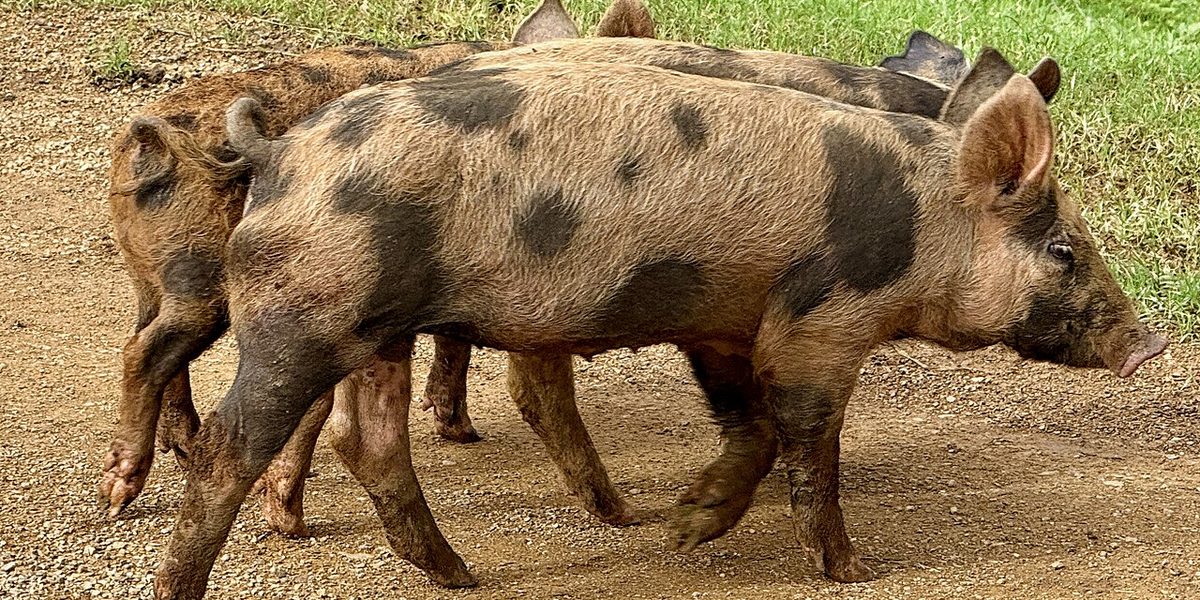
The Pietrain is the leanest commercial pig breed in the world. That is both its greatest asset and its biggest liability. Originating from the village of Pietrain in Belgium, this spotted, heavily muscled breed produces more lean meat per kilogram of carcass than any other line. Backfat as thin as 8 mm. Dressing is higher too, but by less than the hype says: about a point over Duroc-sired pigs, 74.0% against 73.1% (Edwards et al., J. Anim. Sci. 2003). If you are supplying lean pork processors or fresh meat markets that penalize fat, Pietrain genetics are the sharpest tool in the box.
But there is a cost. The same gene responsible for that extreme muscling, the halothane gene (RYR1), also makes Pietrain pigs vulnerable to porcine stress syndrome (PSS). Stress triggers sudden death or produces pale, soft, exudative (PSE) meat that processors reject. In the Philippines, where temperatures routinely hit 32 degrees C and humidity sits above 80%, that stress susceptibility is not academic. It is a daily management problem.
Pietrain genetics can add real value to the right operation. But they will punish you if you do not understand what you are working with.
At a Glance
| Trait | Value | Notes |
|---|---|---|
| Mature Weight (Boar) | 130–160 kg | Compact, heavily muscled frame |
| Mature Weight (Sow) | 120–140 kg | Smaller than Duroc or Large White sows |
| Litter Size | 8–10 piglets | Below average (not a maternal breed) |
| Days to Market (90–100 kg) | 160–180 days | Slower than Duroc by 10–20 days |
| Feed Conversion Ratio | 2.9–3.2 | Good but not elite (Duroc is better) |
| Dressing Percentage | 74.0% (Pietrain-sired crosses) | 0.9 points above Duroc-sired in a US trial (Edwards et al., J. Anim. Sci. 2003) |
| Average Daily Gain | 600–750 g/day | Slower growth is the trade-off for extreme leanness |
| Backfat Thickness | 8–12 mm | Very lean (the defining trait) |
| Coat Color | White with grey-black spots | Distinctive piebald pattern, thinner skin than darker breeds |
Who Is This Breed For?
If you are a contract grower for a lean pork integrator, Pietrain or Pietrain-cross genetics may be specified in your contract. Integrators supplying supermarket chains, cold storage processors, and export markets need carcasses with minimal backfat and maximum lean yield. Pietrain delivers exactly that.
If you supply fresh meat markets (not lechon), the lean carcass commands a premium from butchers and wet market traders who sell cuts like pork loin, tenderloin, and lean kasim. These buyers want maximum sellable lean meat per carcass. They are not paying for fat.
If you run a crossbreeding program and want to increase lean yield, a Pietrain boar or Pietrain semen crossed onto Landrace x Large White F1 dams produces finishers with significantly less backfat than Duroc-sired crosses, while retaining acceptable growth rates from the maternal side.
If you are a lechon operator or backyard farmer targeting the traditional roast pig market, Pietrain is the wrong breed. Lechon needs subcutaneous fat for crispy skin and intramuscular fat for flavor. Pietrain carcasses are too lean for good lechon. The skin will not crisp properly, and the meat dries out during roasting. Use Duroc or Duroc x Native crosses instead. For a side-by-side comparison of all eight breeds against typical Philippine market channels, see my best pig breeds for Philippine small farmers guide.
Sa Bisaya
Economics: Lean Premium vs. Growth Penalty
The question with Pietrain is simple: does the lean carcass premium cover the slower growth rate? Here is the math.
Pietrain-Sired vs. Duroc-Sired Finishers
| Parameter | Pietrain-Sired Cross | Duroc-Sired Cross |
|---|---|---|
| Days to 95 kg | 160–180 | 150–165 |
| Feed consumed to 95 kg | 280–340 kg | 240–310 kg |
| Feed cost (at P31/kg avg) | P8,680–P10,540 | P7,440–P9,610 |
| Backfat | 8–12 mm | 12–18 mm |
| Dressing % | 74.0% | 73.1% |
| Lean at slaughter | 52.6% | 50.7% |
| Liveweight price (commodity) | P172.44/kg PSA Q2 2026; P150/kg DA Aug 2026 | same |
The Pietrain-sired pig eats more total feed because it takes longer to reach market weight. That is an extra P1,000–P2,000 in feed cost per head. The dressing, lean and backfat rows come from one US trial of 162 crossbred pigs, with halothane-free Pietrain boars (Edwards et al., J. Anim. Sci. 2003); I found no Philippine trial. At those dressing rates a 95 kg Pietrain-sired pig gives about 70.3 kg of carcass and a Duroc-sired one about 69.4 kg, under 1 kg more per head. The real Pietrain gain is what the carcass is made of: more ham and loin, less backfat. Duroc-sired pork scored better on colour, marbling, firmness and drip loss in the same trial.
Where the Lean Premium Appears
- Processor contracts: Some processors buy on carcass grade instead of liveweight, and a lean grade pays more than a fat one. None of them publishes its grid, so the size of the lean premium is whatever your contract says. Get the backfat bands and the peso premium in writing before you buy Pietrain semen.
- Supermarket fresh meat: Lean loin and tenderloin sell above everyday cuts. For scale, BAI's weekly price monitor had retail kasim at P344/kg in mid-September 2026; I could not find a PH retailer listing for loin I trust enough to quote. Butchers prefer lean carcasses because they yield more high-value cuts and less trim waste.
- Export-grade pork: Operations targeting export markets (Japan, South Korea) need carcasses meeting strict lean specifications. Pietrain genetics help meet those thresholds.
Genetics Cost
Purebred Pietrain boars are harder to source and more expensive than Duroc in the Philippines. Expect P50,000–P90,000 for a proven boar from a multiplier farm, compared to P45,000–P80,000 for Duroc. AI doses run P400–P700 per dose. The higher cost reflects limited supply, not necessarily superior value. It is simply a smaller market in the Philippines. Before committing genetics money, run the carcass premium against your actual feed and weaner cost in the 10-pig backyard profit guide. The Pietrain math only clears the Duroc baseline if you have a processor contract, not a generic trader.
Feeding Program
Pietrain-sired finishers are lean-gaining machines, but they convert feed less efficiently than Duroc-sired pigs. The feeding program must support lean tissue deposition without excess energy that would normally go to fat (and in Pietrain, simply gets wasted as heat).
Phase 1: Pre-Starter (Birth to 21 days)
| Parameter | Target |
|---|---|
| Crude Protein | 22% |
| Feed Type | Creep pellet, ad libitum from Day 7 |
| Feed Brand Example | B-MEG Pre-Starter, ~P36–P44/kg |
| Target Weight at 21 days | 5–7 kg |
| Total Feed Consumed | 2–3 kg |
| Cost per piglet | P72–P132 |
Pietrain-sired piglets start slightly smaller than Duroc-sired ones. Early creep feeding is critical to establish gut development and growth trajectory.
Phase 2: Starter (21–56 days / 7–20 kg)
| Parameter | Target |
|---|---|
| Crude Protein | 20–21% |
| Feed per Day | Ad lib, transitioning to 0.5–1.0 kg/day |
| Feed Brand Example | B-MEG Starter, ~P33/kg |
| Total Feed Consumed | 16–25 kg |
| Cost per pig | P528–P825 |
Higher protein in the starter phase supports lean tissue growth. Do not reduce protein to cut costs. Pietrain genetics partition nutrients toward muscle, and inadequate protein means stunted lean growth that you cannot recover later.
Phase 3: Grower (56–120 days / 20–55 kg)
| Parameter | Target |
|---|---|
| Crude Protein | 17–18% |
| Feed per Day | 1.8–2.6 kg |
| Feed Brand Example | B-MEG Grower, ~P32/kg |
| Total Feed Consumed | 100–140 kg |
| Cost per pig | P3,200–P4,480 |
Maintain protein levels. Unlike Duroc, where you might reduce protein to manage excessive fat deposition, Pietrain-sired pigs rarely over-fatten. The risk with Pietrain is under-muscling from inadequate protein, not excessive backfat.
Phase 4: Finisher (120–175 days / 55–95 kg)
| Parameter | Target |
|---|---|
| Crude Protein | 15–16% |
| Feed per Day | 2.8–3.5 kg |
| Feed Brand Example | B-MEG Finisher, ~P30/kg |
| Total Feed Consumed | 140–185 kg |
| Cost per pig | P4,200–P5,550 |
Total Feed Cost Summary
| Phase | Feed (kg) | Cost (PHP) |
|---|---|---|
| Pre-Starter | 2–3 | P72–P132 |
| Starter | 16–25 | P528–P825 |
| Grower | 100–140 | P3,200–P4,480 |
| Finisher | 140–185 | P4,200–P5,550 |
| Total | 258–353 kg | P8,000–P10,987 |
At 90–95 kg liveweight sold at PSA's Q2 2026 national average of P172.44/kg, gross revenue is P15,520–P16,382 per head, and at the DA's August 2026 figure of P150/kg (Manila Times) it is P13,500–P14,250. Feed takes P8,000–P10,987 of that. Producer groups put the all-in cost of production at P180–P190/kg in October 2026 (Daily Tribune), above both prices, and Pietrain's slower growth puts you at the high end of it. Without a graded lean premium, a Pietrain-sired pig loses more than a Duroc-sired one this year.
The phase-by-phase ration above leans on commercial bagged feed because Pietrain-sired pigs cannot tolerate the protein swings of a sloppy home-mix. If you want to substitute parts of the grower or finisher phase with cheaper local ingredients, work from the same nutrient targets in the pig feed formulation guide for Philippine conditions and only swap one ingredient at a time so you do not push lysine below 0.9% during the lean-deposition window.
Health: The Halothane Gene Problem
This is the most important thing to understand about Pietrain. Not optional reading. It is the difference between a profitable operation and catastrophic losses.
What Is the Halothane Gene?
The halothane gene (technically the RYR1 mutation, or ryanodine receptor 1) is a point mutation that increases calcium release in muscle cells. In heterozygous carriers (Nn), it increases muscling and lean yield, which is why Pietrain became the leanest breed. In homozygous positive animals (nn), it causes porcine stress syndrome (PSS): sudden death triggered by stress, and pale, soft, exudative (PSE) meat in pigs that survive to slaughter.
Halothane Genotypes
| Genotype | Status | Effect |
|---|---|---|
| NN (halothane-negative) | Stress-resistant | Normal muscling, no PSS risk |
| Nn (carrier) | Intermediate | Enhanced muscling, low PSS risk, slight PSE risk |
| nn (halothane-positive) | Stress-susceptible | Extreme muscling, high PSS and PSE risk |
In purebred Pietrain populations globally, the nn genotype frequency was historically 40–80%. Modern European breeding programs have largely eliminated it through DNA testing. But in the Philippines, where Pietrain genetics are imported through various channels with inconsistent testing, nn animals still circulate.
Why This Matters in the Philippines
PSS is triggered by stress: transport, handling, mixing with unfamiliar pigs, fighting, high ambient temperature, and high humidity. The Philippines delivers most of these triggers daily:
- Ambient temperature: 28–35 degrees C in most lowland areas, regularly exceeding the 25 degrees C comfort zone for pigs
- Humidity: 75–90% year-round, severely limiting evaporative cooling
- Transport conditions: Open trucks, long distances, rough roads, limited ventilation
- Handling practices: Many farms lack proper handling facilities, leading to rough handling during loading and sorting
A halothane-positive (nn) Pietrain pig transported on an open truck in Bulacan in May at 34 degrees C and 85% humidity is a dead pig waiting to happen. Even Nn carriers face elevated risk under these conditions.
Heat Stress Management Protocol
Even with halothane-negative (NN) stock, Pietrain and Pietrain-sired pigs are more heat-sensitive than Duroc or native breeds. Mandatory measures for Philippine conditions:
| Measure | Specification |
|---|---|
| Shade and roof insulation | Full roof coverage, reflective paint or insulation panels on roof |
| Ventilation | Tunnel or cross-ventilation; minimum 1.5 m/s air speed at pig level |
| Sprinkler / drip cooling | Timed sprinklers every 15–20 min when temperature exceeds 30 degrees C |
| Stocking density | Maximum 0.9 sq m per finisher (more than the 0.75 sq m minimum for other breeds) |
| Water access | Nipple drinkers delivering 2 L/min minimum; 2 drinkers per 15 pigs |
| Transport timing | Early morning (before 7 AM) or evening (after 5 PM) ONLY |
| Fasting before transport | 8–12 hours pre-transport to reduce metabolic heat load |
PSE Meat: The Processor Nightmare
Even if your Pietrain-sired pigs survive to slaughter, improper pre-slaughter handling can produce PSE meat: pale color, soft texture, and excessive moisture loss (drip loss above 5%). Processors downgrade or reject PSE meat. The discount comes from the buyer's own grid, which no Philippine processor publishes, and a heavy one erases your lean premium.
On top of the heat and PSE management above, Pietrain-sired farms inside or near an active ASF zone face an additional layer of risk: a single biosecurity break wipes out genetics that took 2 years and P50,000+ in test-mated breeders to establish. Read the ASF recovery-era playbook for Philippine pig farms before you bring in your first Pietrain boar. The zone-by-zone restocking rules and the buffer-distance math matter more for high-genetic-cost breeds than for native or commercial white pigs.
Prevention:
- Minimize mixing of unfamiliar pigs in lairage
- Provide drinking water in holding pens
- Allow minimum 2 hours rest after transport before slaughter
- Avoid electric prods entirely and move pigs with boards and flags
- Ensure stunning is immediate and effective (CO2 or proper electrical stunning)
Sourcing Pietrain Genetics in the Philippines
Availability
Pietrain genetics are significantly harder to source in the Philippines than Duroc or the maternal breeds. The market is smaller because most Philippine pork goes to wet markets and lechon, two channels where lean carcasses are not preferred. Sources include:
| Source Type | Examples | Product |
|---|---|---|
| Integrator breeding programs | San Miguel Foods, Monterey | Internal use; may sell surplus boars |
| Multiplier farms (Central Luzon) | Select BAI-accredited farms in Bulacan, Tarlac | Boars, semen |
| Import channels | European genetics via PIC, Topigs Norsvin | Semen, limited live imports |
| AI centers | Provincial AI centers with imported doses | Semen doses P400–P700 |
What to Demand from Sellers
- Halothane gene DNA test: NN status only. No exceptions.
- Performance data: backfat thickness, lean meat percentage, ADG, FCR. If the seller cannot provide these numbers, the genetics are uncharacterized and not worth the premium price.
- Health certification: ASF-free farm status, standard vaccination records.
- Pedigree documentation: at minimum, sire and dam identification with breed registration.
Common Mistakes
1. Not Testing for the Halothane Gene
This is the most expensive mistake you can make with Pietrain. Buying a halothane-positive (nn) boar and breeding 50 sows to him means every single piglet carries at least one copy of the halothane gene. If any of those sows also carry the gene (common in Pietrain and Pietrain-cross populations), you will produce nn offspring that die during transport or produce PSE carcasses. One untested boar can cost you hundreds of thousands of pesos in dead pigs and rejected meat. Test every breeding animal. Always.
2. Using Pietrain for the Lechon Market
Pietrain-sired pigs produce carcasses with 8–12 mm backfat, which is far too lean for good lechon. Lechon needs subcutaneous fat to render under the skin during roasting, creating the crispy skin that defines the product. A Pietrain-sired lechon pig produces tough, dry meat with leathery skin. Lechon operators will not buy your pigs twice. If your market is lechon, use Duroc.
3. Exposing Pietrain Pigs to Heat Stress
Every dead-on-arrival pig or PSE carcass is money burned. If your farm does not have adequate ventilation, cooling systems, and shaded housing, Pietrain genetics will punish you harder than any other breed. In the Philippine lowlands during dry season (March–May), afternoon temperatures inside poorly ventilated pig houses can exceed 38 degrees C. That is lethal territory for stress-susceptible pigs. Invest in cooling infrastructure before investing in Pietrain genetics.
4. Expecting Duroc-Level Growth Rates
Pietrain-sired pigs reach market weight 10–20 days later than Duroc-sired crosses. That translates to extra feed, extra labor, and longer pen occupancy. If you budget based on Duroc growth curves, you will overshoot your feed budget and underestimate your days-to-market. Plan for 160–180 days, not 150–165.
5. Selling to Generic Traders Without Carcass Grading
The entire economic case for Pietrain is the lean carcass premium. Generic liveweight traders pay the commodity rate regardless of backfat or lean yield, and that rate is low right now: P172.44/kg was PSA's last official national average (Q2 2026), and the DA put August 2026 at P150/kg. At that price, Pietrain's slower growth and higher stress management costs make it inferior to Duroc. To capture the value of Pietrain genetics, you must sell into a graded market (processor contracts, supermarket suppliers, or export channels).
FAQ
Magkano ang purebred Pietrain boar sa Pilipinas? Expect P50,000–P90,000 for a proven, halothane-tested (NN) Pietrain boar from a multiplier farm. Untested boars may be cheaper (P35,000–P55,000), but buying untested Pietrain breeding stock is gambling with your entire operation. AI doses cost P400–P700 each, with 2–3 doses needed per breeding.
Can Pietrain survive in the Philippine climate? Yes, but only with proper heat management. Halothane-negative (NN) Pietrain and Pietrain-sired pigs can be raised in the Philippines if you provide adequate ventilation, cooling systems, shaded housing, and transport pigs only during cool hours. Without these measures, mortality and PSE meat losses will destroy your margins. Pietrain is not suitable for open-air backyard setups.
What is the best cross for Pietrain? Pietrain boar x Landrace x Large White F1 dam. The maternal cross provides litter size and milking ability, while the Pietrain sire maximizes lean yield in the finishers. Some programs use Pietrain x Duroc boar crosses (called PiDu) to balance leanness with growth rate and stress resistance. The Duroc genetics buffer the Pietrain's weaknesses.
Pietrain ba o Duroc ang mas maayo para sa Pilipinas? For most Philippine operations, Duroc is the better choice. The Filipino market overwhelmingly favors marbled pork for lechon, liempo, and grilled dishes. Duroc grows faster, handles heat better, and produces the marbling that Filipino consumers pay for. Pietrain only makes sense if you have a specific lean pork buyer (a processor contract, supermarket chain, or export channel) that pays a measurable premium for lean carcasses. Without that buyer, stick with Duroc.
Ano ang halothane gene at bakit importante? The halothane gene (RYR1 mutation) causes extreme muscling but also porcine stress syndrome: sudden death from stress, and PSE (pale, soft, exudative) meat. Pietrain has the highest frequency of this gene of any breed. You must DNA-test all breeding stock and use only NN (halothane-negative) animals. The test costs P500–P1,500 per animal. This is not optional. It is the single most important management decision when working with Pietrain genetics.
How does Pietrain compare to Hampshire? Both are lean breeds used as terminal sires, but Pietrain is leaner (8–12 mm backfat vs. Hampshire's 10–15 mm). In a Leeds University trial, Pietrain-type sires gave the most lean meat and Hampshire-type crosses grew fastest, 765 g/day against 710 (Farmers Weekly, 2009). In the Philippines, neither is as widely available as Duroc, but Hampshire is easier to manage in tropical heat because halothane is not its problem gene. Hampshire's is RN-, which costs processing yield rather than killing pigs in transport (Milan et al., Science 2000). The choice depends on how lean your target market demands.
Pila ka bulan before ma-market ang Pietrain cross? Pietrain-sired commercial crosses reach 90–95 kg in 160–180 days (about 5.5–6 months) under good management. This is 10–20 days slower than Duroc-sired crosses. Do not push for heavier weights beyond 95 kg. Unlike with Duroc, additional days do not add marbling value. They only add feed cost.
Where can I buy Pietrain semen in the Philippines? Availability is limited compared to Duroc. Check with PIC Philippines, Topigs Norsvin's local distributors, Europhil Swine Genetics (INFARMCO's semen venture, reached through infarmco.com), and BAI-accredited AI centers in Central Luzon. Some provincial AI centers carry Pietrain doses intermittently. Always confirm halothane-negative (NN) status of the sire before purchasing semen.
Sa Bisaya