For most backyard raisers in the Visayas or Mindanao, an F1 Large White × Landrace weaner at ₱2,800–₱4,200 is the practical pick, or a Duroc cross if you can spend ₱3,500–₱5,000 for faster growth. If your market is lechon, raise native pigs instead. The rest of this guide explains why, breed by breed.
Most breed guides quote performance numbers from controlled research barns in temperate climates. A farmer in Leyte, Davao, or Bohol is not running a European climate-controlled facility, so what matters is how each breed performs in Philippine heat, with Philippine feed quality, under Philippine management. That is the question this guide answers.
Browse breed data and pricing: View breeds
The Philippine Pig Industry's Breed Structure
Philippine commercial pig production is built on three imported European/American maternal and sire lines (Large White, Landrace, Duroc) plus indigenous native pigs. Virtually all commercial market pigs are crossbreds.
The supply chain works like this:
- Nucleus farms (NPPC-accredited, typically large corporations) maintain purebred Duroc, Large White, and Landrace lines
- Multiplier farms produce F1 crossbreds (typically Large White × Landrace) for sale as breeding gilts and commercial weaners
- Backyard and small commercial farms buy weaners from multipliers or other backyard sources and raise to market weight
- Native pig breeders operate independently, supplying lechon-focused buyers and niche markets
The majority of weaners sold in Cebu, Davao, Iloilo, and Tacloban markets are F1 or F2 Large White × Landrace crossbreds from regional multiplier farms.
The Reality Gap: Published Numbers vs Your Backyard
Before comparing breeds, understand this: published ADG and FCR numbers almost always overstate what backyard farmers achieve. The gap is typically 30–50%.
| Breed/Cross | Published ADG (controlled) | Realistic backyard ADG | Drop |
|---|---|---|---|
| Pure Native | 150–250 g/day | 80–150 g/day | ~40–50% |
| Native × Duroc F1 | 350–450 g/day | 200–300 g/day | ~35–40% |
| Duroc purebred | 700–850 g/day | 400–550 g/day | ~35–40% |
| Large White | 750–900 g/day | 350–500 g/day | ~45–50% |
| F1 LW×L crossbred | 700–850 g/day | 400–550 g/day | ~35–40% |
Why? Feed quality is lower (30–50% alternative feeds vs precision-balanced rations). Feeding is inconsistent. Heat stress reduces intake by 10–30%. Subclinical parasites and infections drain energy. Water access is often limited. Pens are smaller than optimal.
When planning your business, use the backyard ADG column, not the published numbers. A 10-pig batch planned on textbook FCR will overestimate your revenue by 30-40%. That's the difference between profit and loss.
Native pigs show the smallest percentage drop between controlled and backyard conditions because they are adapted to exactly these conditions. Commercial breeds show the largest drop because their genetic potential can only be expressed with optimal nutrition and environment.
Free Tool
Pig Profit Simulator
Run two side-by-side scenarios with different breeds, ADG, and FCR to see which one actually pays better at your local feed price and farmgate price.
Local farmer tip:
"Ang numero sa libro, lahi sa numero sa imong kulungan. Ayaw kalimti, ang baboy mo dili inside sa lab."
The numbers in the book are different from the numbers in your pen. Don't forget, your pigs aren't inside a lab.
1. Large White (Yorkshire)
Origin: Yorkshire, England. Most widely used maternal line breed globally.
Philippine Performance Data
| Metric | Large White (Philippine commercial conditions) |
|---|---|
| Average Daily Gain (ADG) | 650–800 g/day |
| Feed Conversion Ratio (FCR) | 2.6–2.9 |
| Days to 100 kg (from 8–10 kg weaner) | 140–160 days |
| Litter size (born alive) | 10–13 |
| Carcass lean % | 55–60% |
| Backfat at 100 kg | 16–22 mm |
| Heat tolerance | Moderate: requires ventilation |
| Temperament | Active, can be nervous |
Visayas/Mindanao Context
Large White genetics dominate the multiplier farms supplying Cebu, Davao, and Iloilo markets. The Cebu Agri-Park multiplier farms (NPPC-affiliated suppliers in the greater Cebu area) and Davao-region suppliers such as those in Carmen, Davao del Norte, run predominantly Large White × Landrace programs.
Large White performs well in Visayas conditions when housing is properly ventilated. The breed's white skin is photosensitive. Exposed to direct sun, it will sunburn (redness, blistering on ears, back, and shoulders), reduce feed intake, and slow growth. In open-sided shaded pens, performance is good. In enclosed, hot concrete pens without ridge ventilation, Large White performs 15–20% below potential.
Strength for small farmers: Best maternal performance of any commercial breed. If you're breeding your own sows, a Large White sow from an accredited multiplier gives you large, vigorous litters with strong milking. Good weaner survival rates.
Weakness: More nutritionally demanding than Duroc. Performs best with properly balanced commercial or home-mixed feed meeting protein and lysine targets. Will not compensate for poor feed quality the way a Duroc or native will. Also more reactive to handling, can be skittish around noise and unfamiliar people, which matters in a backyard setting where pigs are around household activity daily.
See the Large White breed page for current listings and market data.
2. Landrace
Origin: Denmark. Developed for lean pork production and maximum litter size.
Philippine Performance Data
| Metric | Landrace (Philippine conditions) |
|---|---|
| Average Daily Gain (ADG) | 650–780 g/day |
| Feed Conversion Ratio (FCR) | 2.6–2.9 |
| Days to 100 kg | 145–165 days |
| Litter size (born alive) | 11–14 |
| Carcass lean % | 58–63% |
| Backfat at 100 kg | 14–20 mm |
| Heat tolerance | Low: most heat-sensitive of commercial breeds |
| Temperament | Generally docile, good mothers |
Visayas/Mindanao Context
Landrace is the most problematic breed for Philippine backyard conditions. The breed's sensitivity to heat stress is well-documented. In Philippine ambient temperatures of 30–36°C, Landrace reduces feed intake disproportionately compared to Large White or Duroc. This translates directly to longer days to market and worse FCR.
In the Davao Region's dry season (March–May), ambient temperatures in enclosed pens can reach 38–42°C effective temperature. Pure Landrace in these conditions can show 30–40% reduction in feed intake from peak performance. That is a lot of lost production.
Skin vulnerability: Landrace has the most sun-sensitive skin of all commercial breeds. Pink skin shows damage quickly. In open backyard conditions without complete shade, sunburn is almost guaranteed. This leads to skin lesions, secondary bacterial infections, and chronic discomfort that tanks growth.
However: The F1 Large White × Landrace cross is the workhorse of Philippine commercial grow-out, and it clearly outperforms either parent breed in heat tolerance due to hybrid vigor. The F1 cross is what most backyard farmers are actually buying when they buy "commercial weaners." The Landrace problem applies to purebred animals; the cross handles it much better.
Strength: Highest litter size of the commercial breeds. If your goal is producing your own weaners (sow herd), F1 Large White × Landrace dams give the best piglet output per sow per year of any cross. Docile temperament and good mothering instinct make them easier to manage during farrowing.
Weakness: Pure Landrace difficult to manage in Philippine heat and humidity without climate-controlled housing. Leg weakness (osteochondrosis) more common than in other breeds, requires sound pen flooring.
See the Landrace breed page.
3. Duroc
Origin: United States (Jersey Red and Duroc-Jersey strains). Now the dominant terminal sire breed globally.
Philippine Performance Data
| Metric | Duroc (Philippine conditions) |
|---|---|
| Average Daily Gain (ADG) | 720–900 g/day |
| Feed Conversion Ratio (FCR) | 2.4–2.7 |
| Days to 100 kg | 128–148 days |
| Litter size (born alive) | 9–11 |
| Carcass lean % | 56–60% |
| Backfat at 100 kg | 18–24 mm |
| Intramuscular fat (IMF) | High |
| Heat tolerance | Good: best of the commercial breeds |
| Temperament | Generally calm, sometimes stubborn |
Visayas/Mindanao Context
Duroc is the best-performing commercial breed in Philippine backyard conditions for grow-out efficiency. The breed's red/brown pigmentation provides better UV protection than white Large White/Landrace skin. Its heavier muscling and higher intramuscular fat content help it hold up better during heat stress. When feed intake drops, Duroc holds its liveweight gain better than leaner breeds.
In Davao, Duroc-cross weaners command a 10–15% price premium over pure Large White × Landrace because buyers recognize the faster growth and better FCR. Carmen, Davao del Norte, and Digos, Davao del Sur, have established Duroc-cross multiplier farms supplying the Davao market specifically because of demand for faster-growing genetics.
Lechon market in Davao: Duroc and Duroc-cross pigs, while not the traditional lechon breed, produce roasted pork with excellent flavor due to high IMF. Some Davao lechon operators have shifted to Duroc-cross pigs for market roast (as opposed to the smaller whole-roasted lechon), commanding ₱350–₱450/kg dressed weight vs ₱280–₱340/kg for straight Large White.
Strength: Fastest growth, best FCR, best heat tolerance among commercial breeds. Performs well even on moderate-quality feed formulations. The Duroc compensates better for suboptimal nutrition than Landrace. Calm temperament makes it easier for beginners to handle.
Weakness: Smaller litters (9–11 vs 11–14 for Landrace). Not ideal as a maternal line. Higher purchase cost, Duroc-cross weaners typically ₱3,500–₱5,000 vs ₱2,800–₱4,000 for LW×L.
See the Duroc breed page.
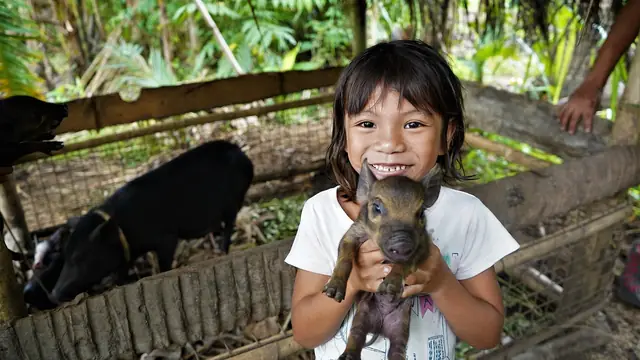
4. Native Pigs: Bisaya, Sinirangan, and Regional Types
Origin: Indigenous to the Philippines. See the native pig breeds page for current listings. Descended from Sus scrofa domesticus populations introduced via maritime trade with mainland Asia over centuries. Six genetic groups are now formally recognized by DOST-PCAARRD: Q-Black (Quezon), Markaduke (Marinduque), ISUbela (Isabela), Benguet (Cordillera), Sinirangan (Eastern Samar), and Yookah (Kalinga).
Conservation Status
Native Philippine pigs are in serious decline. They comprise only 1.4–4% of the national pig herd (except in the Cordillera, where they reach 74%). A 2023 genetic study by Banayo et al. (UPLB/Nagoya University) found critically low effective population sizes:
| Population | Effective Population Size (Ne) | Status |
|---|---|---|
| Benguet | 3.9 | Critically endangered |
| Quezon | 14.2 | Critically endangered |
| Isabela | 19.1 | Endangered |
| Samar | 22.5 | Endangered |
| Marinduque | 44.7 | Threatened |
| Kalinga | 125.9 | Relatively stable |
Several historical strains, Berkjala, Diani, Koronadal, Jalajala, Ilocos, have largely disappeared through crossbreeding and replacement by commercial breeds.
The BAI has formally established the Philippine Native Animal Development (PNAD) Program with a vision of conserving, producing, and marketing native animals under a sustainable environment. In 2025, BAI launched the Philippine Native Animal Breeder Farm Certification Program to standardize native pig breeding and ensure sustainable breeding stock supply.
Where to Source Native Breeding Stock
The DOST-PCAARRD maintains the Philippine Native Pig Breed Information System (PAB-IS) with verified institutional breeding farms. If you are serious about raising native pigs, for lechon, conservation, or crossbreeding, these are your primary sources:
| Breed | Institution | Contact Person | Phone / Email |
|---|---|---|---|
| Q-Black | BAI-NSPRDC, Tiaong, Quezon | Rico M. Panaligan | (042) 585-7727 / 0997-693-2766 |
| Q-Black | Tiaong Native Pig Farm | Edwin Mendoza | 0945-379-3173 |
| Q-Black | Kahariam Farm | Danilo Rubio | 0918-830-0191 |
| Sinirangan | ESSU Borongan, Eastern Samar | Dr. Felix Afable / Dr. Sharon Singzon | [email protected] / 0919-739-4910 |
| ISUbela | ISU Echague, Isabela | Dr. Joel L. Reyes | 0917-362-5996 / [email protected] |
| Benguet | BSU Animal Genetic Resource | Dr. Sonwright B. Maddul | 0929-311-3996 / 0916-364-2039 |
| Yookah | Kalinga State University | Sharmaine D. Codiam | 0927-722-4283 |
| Markaduke | Marinduque State College | Dr. Randell R. Reginio | 0999-924-5638 / [email protected] |
Source: DOST-PCAARRD Philippine Native Pig Breed Information System (pab-is.pcaarrd.dost.gov.ph/nativepigs/)
These institutional farms maintain nucleus herds and can supply certified breeding stock. For commercial-volume native pig sourcing, ask these contacts about cooperating private farms in your region.
For Visayas farmers: The Sinirangan breed from Eastern Samar is the only formally recognized native strain in the Visayas. Eastern Samar State University (ESSU) in Borongan City maintains the nucleus herd and has a registered trademark for "Sinirangan." The program is confirmed active, a 2025 study by Ordanel, Compendio, Pena and Singzon evaluated Sinirangan qualitative and quantitative traits, confirming ongoing research and breeding operations.
Performance Data
| Metric | Native pig |
|---|---|
| Average Daily Gain (ADG) | 200–380 g/day |
| Feed Conversion Ratio (FCR) | 4.0–6.0 |
| Days to 80 kg (from 5 kg) | 300–420 days |
| Litter size (born alive) | 6–9 |
| Carcass lean % | 38–48% |
| Backfat at market weight | 28–48 mm |
| Heat tolerance | Excellent: fully adapted |
| Disease hardiness | Excellent: natural selection over centuries |
| Temperament | Calm, docile, accustomed to humans |
These numbers look poor on paper versus commercial breeds. On a cost-per-kg-of-gain basis using purchased commercial feed, native pigs are uneconomical. But this comparison misses how native pigs are actually raised.
Why Native Pigs Make Economic Sense in the Visayas and Mindanao
1. Zero or near-zero feed cost in copra/coconut areas
In the coconut belt, Southern Leyte, Eastern Samar, Davao del Sur, Zamboanga del Sur, South Cotabato, native pig farmers feed primarily:
- Coconut by-products: fresh coconut meat, buko (young coconut) waste, copra rejects
- Root crops: camote (sweet potato), cassava, taro (gabi)
- Agricultural by-products: rice bran, corn bran, banana stalks
- Kitchen scraps and food waste
Total purchased feed cost for a native pig raised this way: near zero. If your copra rejects and camote tops are essentially free, the FCR and ADG comparisons become meaningless. The pig is converting waste that would otherwise be discarded.
Local farmer tip:
"Ang baboy nga lumad, dili ko-kaon ug daghan, pero dili pod ko-mamatay ug sayon."
The native pig doesn't eat much, but it doesn't die easily either.
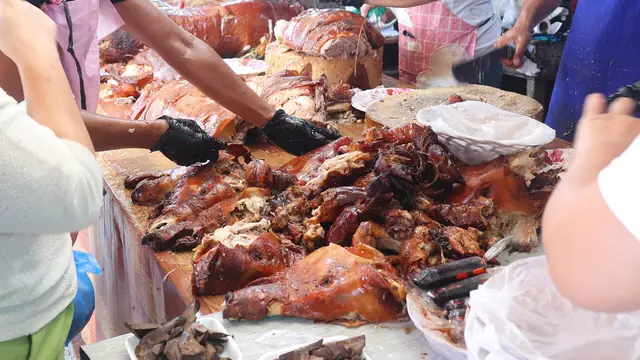
2. The Lechon Bisaya premium
This is the native pig's biggest commercial argument. Lechon made from native pigs, particularly 15–25 kg pigs roasted whole, commands a big price premium. DA genomics research (2023) confirmed that native pigs carry more favorable genes for intramuscular fat (marbling), which is what makes lechon crispier skin, more flavorful meat, and firmer texture.
| Lechon type | Market | Typical price/kg dressed weight |
|---|---|---|
| Lechon Bisaya (native, 15–25 kg pig) | Cebu City, Mandaue | ₱750–₱950/kg |
| Lechon Bisaya | Davao City, Butuan | ₱700–₱900/kg |
| Lechon Bisaya | Tacloban, Iloilo | ₱650–₱850/kg |
| Lechon Baboy (commercial pig, 50–70 kg) | All regions | ₱350–₱500/kg |
A 20 kg native pig raised for lechon, dressed at approximately 14–15 kg, sells at ₱700–₱950/kg dressed = ₱9,800–₱14,250 per lechon pig. If you raised it on farm waste and by-products for 10–12 months, your cash cost might be ₱1,500–₱3,000 (vet care, occasional purchased feed during dry season). Profit: ₱7,000–₱11,000 on a single pig.
The margin per pig beats commercial grow-out by a wide margin, at the cost of longer time and more land.
3. ASF resilience and post-ASF renaissance
Since the ASF outbreaks beginning in 2019, many Visayan and Mindanao farmers have shifted back to native and native-cross pigs. Native pig populations in remote barangays of Eastern Samar, Southern Leyte, and interior Mindanao have shown higher practical survival rates during outbreaks, but this is not genetic resistance. No peer-reviewed Philippine study has demonstrated innate ASF resistance in native pigs versus commercial breeds. All domestic pigs (Sus scrofa domesticus) are susceptible to ASFV.
The higher survival is explained by management factors: native pigs are typically kept in scattered small groups, free-range or semi-confined, with minimal transport mixing and no shared slurry systems, all of which reduce viral exposure compared to dense commercial operations. A CGIAR review (Goad et al. 2024) noted native pigs' "improved adaptability and survival rates" but did not cite controlled challenge studies.
Regardless of the mechanism, the practical result is the same: native pig farming has experienced a quiet renaissance across the Visayas and Mindanao islands since 2019.
4. Best temperament for beginners
Native pigs are accustomed to being around people in backyard and village settings. They are the easiest breed to handle, the most forgiving of management mistakes, and the least likely to cause handling injuries. For a first-time farmer who has never worked with pigs before, native or native-cross is the safest starting point.
Native Pig Market in the Visayas
Cebu has the most developed native pig lechon market in the Philippines. Wholesale buyers for Cebu lechon operators pay ₱300–₱450/kg liveweight for quality 15–25 kg native pigs, well above commercial pig farmgate prices. Supply is consistently below demand in Cebu's lechon industry, which means native pig producers with reliable quality and supply can develop long-term buyer relationships.
Davao City has a growing native pig/lechon Bisaya market driven by the Kadayawan food culture and premium restaurant demand. Buyers in Davao's Toril and Agdao markets pay ₱280–₱380/kg liveweight for 15–25 kg native pigs.
See the Native pig breed page for current listings.
5. Hybrid/Crossbred Pigs
The most commercially important "breed" in Philippine pig farming is not a breed at all, it is the F1 crossbred, typically Large White × Landrace. See the hybrid breeds page for current market prices and listings.
Why F1 Crossbreds Outperform Purebreds
Hybrid vigor (heterosis): F1 pigs, first-generation crosses between two purebred lines, typically show:
- 10–15% faster growth than the average of the two parent breeds
- 5–10% better FCR
- Higher piglet survival rates
- Better disease resilience under field conditions
The mechanism is well-established in genetics: crossing two inbred lines reveals beneficial heterozygosity that improves biological functioning. This effect is largest in the F1 generation and diminishes in F2, F3 (which is why commercial farms don't breed F1 × F1).
Common Crosses in Philippine Markets
| Cross | Characteristics | Best for |
|---|---|---|
| Large White × Landrace (F1) | Best balance of litter size, growth, meat quality | Standard commercial grow-out |
| (LW × L) dam × Duroc sire (3-way cross) | Fastest growth, best FCR, good IMF | Premium commercial grow-out |
| Large White × Native | Hardy, moderate growth, accepts poor-quality feed | Low-input farms, mixed crop systems |
| Duroc × Native | Fast-growing for native pig, good flavor, heat-tolerant | Lechon crosses, low-input farms |
The Duroc × Native Cross: Best of Both Worlds?
This cross deserves special attention for Visayas and Mindanao backyard farmers because it combines the native pig's strengths (heat tolerance, disease resistance, low-input performance, lechon flavor) with the Duroc's strengths (faster growth, better FCR).
| Trait | Pure Native | Native × Duroc F1 | Pure Duroc |
|---|---|---|---|
| Weight at 6–8 months | 30–60 kg | 60–80 kg | 90–110 kg |
| Feed flexibility | Kitchen scraps | 50–70% commercial | Mostly commercial |
| Heat tolerance | Excellent | Good | Moderate |
| Meat flavor (lechon) | Superior | Very good | Good |
| Disease resistance | Excellent | Good | Moderate |
Practical guidance: Use a Duroc boar on a native sow (not the reverse) to maintain native mothering ability and heat tolerance. F1 crosses are ideal for lechon production, they reach market weight faster while retaining flavor. Monitor farrowing closely: the native sow's smaller pelvis may have difficulty with large-frame Duroc-sired piglets.
A 2024 study by Banayo et al. (UPLB) found that uncontrolled crossbreeding threatens the genetic integrity of native populations. If you are keeping native breeding stock, maintain a purebred native sow line separate from your crossbreeding program. Benguet pigs are at Ne = 3.9. That's an extinction vortex. Every purebred native pig matters.
Supply shortage reality: The PCAARRD PAB-IS has reported supply shortage concerns for Marinduque Markaduke pigs, and demand for native pigs for lechon consistently outstrips supply across the Visayas. If you can establish a reliable supply of purebred native breeding stock, there is a ready market.
What Most Visayas/Davao Farmers Are Actually Buying
When you buy "crossbreed weaners" in Cebu City's Mandaue markets, Davao's Toril or Mintal weaner traders, Tacloban's Palo wet market area, or Iloilo City's Pavia suppliers, you are almost certainly buying F1 Large White × Landrace from regional multiplier farms.
These F1 weaners at ₱2,800–₱4,200 per head are the practical choice for most operations. They outperform purebreds under field conditions, are widely available, and are the breed type your local vet and feed dealer are most experienced with.
See the Hybrid breed page for current market prices.
How to Evaluate a Weaner at the Market
Buying from a multiplier farm, a neighbor, or a wet market trader, knowing how to assess weaner quality prevents expensive mistakes.
Physical Signs of a Good Weaner
- Skin: Shiny, smooth, no flaking or scabs (scabs = mange). No redness or raw spots.
- Eyes: Bright, clear, alert, no discharge or cloudiness.
- Activity level: Active, curious, responsive. Pigs that huddle in corners or seem lethargic are likely sick.
- Breathing: Normal rate, no coughing, no labored breathing.
- Rear end: Clean, no diarrhea staining.
- Navel: Fully healed, no swelling or discharge. Navel infection in young pigs leads to joint ill and death.
- Legs: Straight, even weight distribution, no swelling at joints. Watch the pig walk, limping or uneven gait is a red flag.
- Belly: Full but not distended. A pot belly in a young pig usually means heavy worm load.
- Teats: Count at least 12 well-spaced teats if selecting future breeders (this applies to males too, teat count is heritable).
Questions to Ask the Seller
- Who are the parents? A reputable supplier knows the sow and boar breed.
- What parity is the sow? Best weaners come from the 2nd to 5th parity sow. First-parity sows produce smaller, weaker piglets.
- What was the litter size? Large litter (7+) from a good sow is positive. A litter of 3–4 may indicate inbreeding problems.
- What vaccinations have been given? Classical swine fever (CSF, the live LHCV vaccine) should have been administered. No vaccination record = higher risk.
- What was the weaning age? Ideal: 25–35 days, weighing 7–10 kg. Piglets weaned earlier than 21 days have higher disease risk.
Red Flags, Walk Away If You See
- Trembling, lethargy, or pigs huddled in corners
- Rough, dull coat with visible parasites
- Swollen joints or limping in multiple pigs
- Coughing in several pigs in the same pen
- Seller cannot answer basic questions about breed, vaccination, or parentage
- Price that's suspiciously cheap (usually means sick stock being dumped)
"Ipakita ang inahan sa dili pa mopalit ug anak. Kung maayo ang inahan, maayo pod ang anak." See the mother before buying piglets. If the mother is healthy, the piglets will be too. This single habit prevents most weaner-buying mistakes.
Heat Stress Signs to Watch By Breed
Understanding breed-specific heat responses helps you intervene before performance drops.
| Breed | First sign of heat stress | Severe heat stress | Action threshold |
|---|---|---|---|
| Native | Seeks shade, slight panting | Rarely shows severe signs below 35°C | 35°C+ |
| Duroc | Aggressively seeks shade | Reduced feed intake, panting | 32°C+ |
| F1 LW×L | Panting, reduced movement | Open-mouth breathing, lies flat with legs extended | 30°C+ |
| Large White | Panting, skin redness | Feed refusal, rapid breathing, skin blistering (sun) | 29°C+ |
| Landrace | Heavy panting even at rest | Complete feed refusal, skin burns, fertility crash | 28°C+ |
Emergency signs (any breed): Staggering, muscle tremors, collapse, foaming at mouth. This is heat stroke, pour cool (not ice-cold) water over the pig immediately, focus on head, neck, belly, and groin. Call the vet.
Breed Comparison: Practical Scorecard for Philippine Conditions
| Criterion | Large White | Landrace | Duroc | Native | F1 LW×L |
|---|---|---|---|---|---|
| Growth rate (ADG) | ★★★★ | ★★★ | ★★★★★ | ★★ | ★★★★★ |
| Feed efficiency (FCR) | ★★★★ | ★★★ | ★★★★★ | ★★ | ★★★★★ |
| Heat tolerance (Philippine climate) | ★★★ | ★★ | ★★★★ | ★★★★★ | ★★★★ |
| Litter size | ★★★★ | ★★★★★ | ★★★ | ★★ | ★★★★★ |
| Disease hardiness | ★★★ | ★★ | ★★★ | ★★★★★ | ★★★★ |
| Meat quality / flavor | ★★★ | ★★★★ | ★★★★★ | ★★★★★ | ★★★★ |
| Low-input performance | ★★ | ★ | ★★★ | ★★★★★ | ★★★ |
| Lechon suitability | ★★ | ★★ | ★★★ | ★★★★★ | ★★★ |
| Beginner friendliness | ★★★ | ★★★★ | ★★★★ | ★★★★★ | ★★★★ |
| Sunburn resistance | ★★ | ★ | ★★★★ | ★★★★★ | ★★★ |
| Availability (Visayas/Mindanao) | High | High | Moderate | High (regional) | Very high |
| Weaner cost (₱/head) | ₱3,200–₱4,800 | ₱3,000–₱4,600 | ₱3,500–₱5,500 | ₱800–₱2,500 | ₱2,800–₱4,500 |
Which Breed Should You Choose?
If you're buying weaners for grow-out: → F1 Large White × Landrace or Duroc-cross from a reputable multiplier farm. Ask the supplier about parent breed, vaccination history, and weaning age. A reliable supplier answers these questions without hesitation.
If you want to produce your own weaners (sow herd): → Large White or F1 LW×L sow × Duroc terminal boar. This produces fast-growing, FCR-efficient grow-out pigs with good meat quality.
If you're in a coconut/banana farming area and want low-input pigs: → Native pig or Duroc×Native cross. Low purchased feed cost, decent lechon market premium, disease-hardy under scattered backyard conditions.
If your primary market is lechon: → Native pig for whole-roasted lechon (15–25 kg). For larger lechon operations (50–80 kg pigs), Duroc-cross gives better flavor than straight LW×L.
If you're in Davao Region specifically: → Duroc-cross or Duroc × LW×L takes advantage of the Davao area's growing premium pork market, Kadayawan demand, and the breed's heat tolerance in Davao's dry season.
If you've never raised pigs before: → Native or Native×Duroc cross. Honestly, they forgive most beginner mistakes. They survive on local feeds, tolerate the heat, and command premium lechon prices. Graduate to commercial breeds once you have 2–3 successful grow-out cycles under your belt.
Crossbreeding Tips for Backyard Operations
Do not breed F1 × F1. The F2 generation loses much of the hybrid vigor. Performance will be inconsistent and average below both parent breeds. Use F1 females as production sows only, not as breeding replacement gilts.
Boar Selection for Backyard Breeding
If you maintain your own breeding stock, the boar determines half your herd's genetics. Common mistakes:
- Using the same boar for years, leads to inbreeding within 2–3 generations. Exchange boars with neighbor farmers every 18–24 months.
- Selecting only for size, a big boar from a small litter likely carries poor reproductive genetics. Check litter size of the boar's dam.
- Mating too young, gilts should not be bred before 8 months or less than 70% of mature body weight. Boars should not be used before 8–10 months. Early breeding produces small litters, higher piglet mortality, and stunted growth in the gilt.
- Ignoring feet and legs, a boar with poor legs will break down before he's useful. Look for straight, wide-set legs and sound movement.
- Breeding siblings, never breed father-daughter or brother-sister. Inbreeding shows up as decreasing litter size, weak piglets, and slower growth.
Local farmer tip:
"Ayaw pagpaanak ug bata pa. Hulata nga malig-on ang lawas, ang unang panak nga dali ra kaayo, gamay ang anak ug maluya."
Don't let them breed too young. Wait until the body is strong, breeding too early gives small, weak litters.
Artificial Insemination (AI)
AI services using imported Duroc, PIC, or Danbred genetics are available in Cebu (through NPPC-accredited centers), Davao City (DA-RFO XI livestock support), Cagayan de Oro, and Iloilo. AI cost: ₱300–₱600 per service. Imported semen straws: ₱600–₱1,200 each. The F1 quality is noticeably better than local boar service.
Practical limitation: AI requires timing (sow must be inseminated 12–24 hours after standing heat onset) and cold chain for semen transport. In rural Visayas and Mindanao, AI technicians may not be available on short notice. For most backyard farmers, natural mating with a rotated boar remains the most practical approach. AI is worth pursuing if you're within 1 hour of a reliable semen source and want access to superior genetics without maintaining a boar. Contact your Municipal Agriculturist's Office to check local availability.
Native Pig Breeding
If raising natives for lechon, avoid mating siblings. Introduce unrelated native boars from different municipalities every 2–3 breeding cycles. Inbreeding depression in native pigs shows up in reduced litter size and piglet vigor.
Sourcing native breeding stock: Contact the nearest state university maintaining native pig nucleus herds, ESSU (Borongan, Eastern Samar) for Sinirangan, or BAI-NSPRDC (Tiaong, Quezon) for Q-Black. Your municipal agriculture office can also connect you with local native pig breeders.
Breed Availability by Region
| Region | Most Available Breeds | Notes |
|---|---|---|
| Cebu | Duroc, Large White, Landrace, Native-cross | Major lechon hub. Native-cross readily available from local breeders. |
| Iloilo | Large White, Landrace, Native | Good commercial farm infrastructure. Native pigs from upland areas. |
| Leyte/Samar | Sinirangan (native), Native-cross, limited commercial | ESSU maintains Sinirangan nucleus herd. Commercial breed access is more limited. |
| Bohol | Native, Native-cross | Strong lechon culture. Some Cordillera-clade native pigs persist. |
| Davao | Duroc, Large White, Landrace, Native-cross | Major commercial pig hub. Best breed access in Mindanao. Provincial vet office has AI. |
| Bukidnon | All commercial breeds, Native-cross | Large commercial farms. Possibly the best breed access in Mindanao. |
| Cotabato/SOCCSKSARGEN | Native, Native-cross, Duroc | Koronadal native strain historically from here (now largely diluted). |
| Zamboanga | Native, limited commercial | Native pigs more common in rural areas. Commercial breeds available in city centers. |
Bisaya / Cebuano
Pinaka-maayong breed sa baboy para sa Visayas ug Davao
Para sa grow-out (magpalit og biik): Ang pinakamaayong pili mao ang F1 crossbreed (Large White × Landrace). Kini ang pinaka-sagad nga baligya sa Cebu, Davao, CDO, ug Iloilo markets. Mas paspas motubo kaysa purebred, mas maayong FCR, ug mas makaya ang init.
Kung naa ka sa Davao Region: Tan-awa ang Duroc-cross weaners, mas mahal og gamay (₱3,500–₱5,000) pero mas paspas motubo ug mas maayong FCR. Daghan nagbaligya sa Carmen ug Digos. Para sa premium pork market sa Davao City ug Kadayawan, nindot ang Duroc blood.
Kung naa ka sa coconut area (Leyte, Samar, Davao del Sur): Palandunga ang native pig para sa lechon. Kung libre ang copra rejects ug camote tops sa inyong lugar:
- Gasto sa pagpadako ug native pig: ₱1,500–₱3,000 (bakuna + ocasional nga feeds)
- Baligya sa Cebu o Davao buyers: ₱750–₱950/kg dressed weight
- 20 kg native pig = ~14 kg dressed = ₱10,500–₱13,300 per lechon baboy
- Profit: ₱7,000–₱10,000 per baboy
Kana mas maayo kaysa commercial grow-out sa daghang sitwasyon, basta libre ang feeds mo.
Kung wala pa ka kasuway mag-alaga ug baboy: Sugdi sa native o native × Duroc cross. Sayon ra sila alagaan, dili sila init-initon, ug dili sila dali masakit. Human sa 2–3 ka batch, pwede na ka mobalhin sa commercial breeds.
Unsaon paghibalo sa breed sa imong biik:
- Puti → Large White o Landrace o F1 cross
- Pula-brown → Duroc blood
- Itom o itom-puti → native o native-cross
- Taas ug lain ang ulo → posible Landrace blood
Tan-awa ang mga detalye sa matag breed ug presyo sa breed pages para sa giya sa inyong lugar.
Tools and Resources
- Profit Simulator, model profitability with different breed/FCR assumptions
- FCR Calculator, calculate your actual FCR and breed comparison
- Breed pages, full breed profiles with Philippine market data and signal alerts
Browse Listings by Breed
Related Articles
- Pig Feed Formulation Philippines, feeding each breed optimally
- Pig Farming Profit: 10 Pigs, profitability by region and scenario
- Crossbreed Pig Price Philippines, current prices by region
- Landrace vs Large White, the F1 maternal-line decision
- Duroc vs Hampshire, terminal sire comparison
- Hybrid vs Purebred, why 80% of commercial farms use three-way cross
- Breed Selection topic cluster, all eight breeds plus the comparison set
Sources
- Banayo et al. 2023: Genetic diversity of Philippine native pigs (UPLB/Nagoya University)
- DOST-PCAARRD: Philippine Native Pig Breed Information System
- DOST-PCAARRD Swine Industry Strategic Plan
- BAI Administrative Order No. 41: Code of Practice for Welfare of Pigs
- Pork Information Gateway: Pig Breeding Systems for Small and Beginning Pig Farmers
- USDA FAS Manila: Livestock and Products Annual
- PSA Livestock Census regional data, DA-RFO VII and XI livestock program field data, lechon market price surveys (Q1 2026)