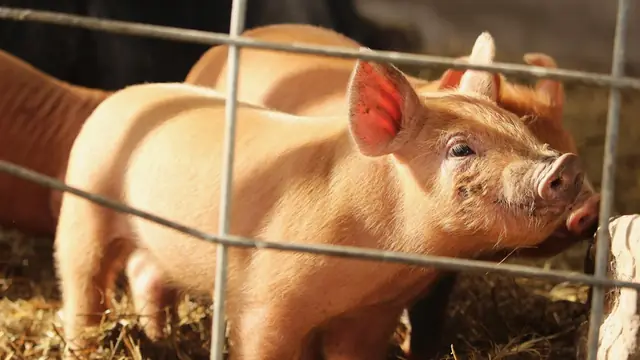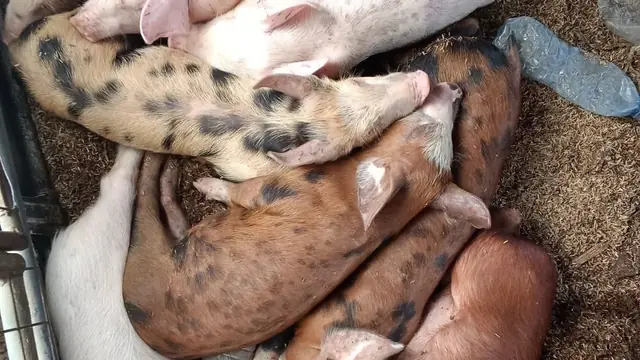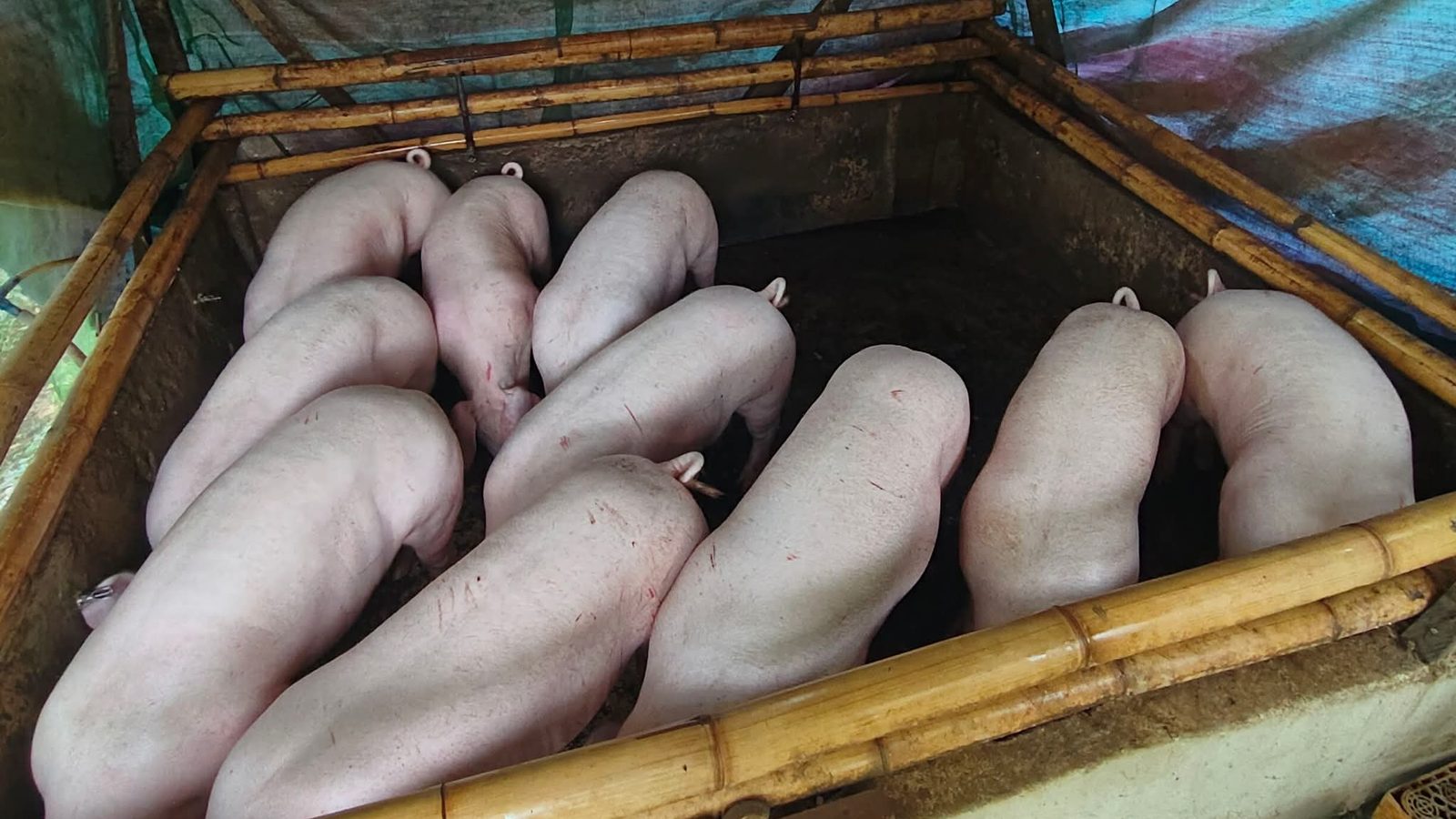
A 10-pig backyard pen costs ₱18,500 to ₱40,000 for the semi-permanent build (bamboo plus concrete floor plus GI roof) and ₱36,800 to ₱62,000 for full concrete in Cebu pricing. Give each finisher 1.5 to 2.0 m², slope the floor 3% to a drain, and design the roof for 250 kph wind. Cheaper shortcuts cost more later.
Free Tool
Pen Space Calculator
Get the exact floor area for your herd, sized to PH tropical conditions.
What a Philippine Pig Pen Must Solve
Philippine ambient temperatures of 28–36°C are consistently above the pig's thermoneutral zone (roughly 18–25°C, and thermoregulation kicks in past that). Relative humidity of 70–85% makes evaporative cooling less effective. These two factors, combined with high rainfall, typhoon risk, flooding, and dense residential , mean Philippine pig housing must solve five problems simultaneously:
- Heat reduce effective pen temperature to protect feed intake and growth
- Drainage and dryness prevent wet floors that cause respiratory disease, hoof problems, and pathogen buildup
- Waste management handle manure and effluent without polluting neighbors or the water table
- Biosecurity control movement of people, vehicles, and pests to reduce disease entry risk
- Weather resistance withstand typhoons, heavy rain, and flooding that can destroy a season's investment overnight
Everything in pen design follows from these five constraints.
The 7 Most Common Construction Mistakes
Before getting into the build, these are the errors that experienced farmers see repeatedly in Philippine backyard piggeries:
- Building on flood-prone land. The cheapest lot is often the lowest lot. One flood destroys months of work and risks disease outbreak.
- No concrete floor. Earth floors cannot be disinfected between batches. Parasites and pathogens survive in soil for months. This single shortcut causes more disease than any other.
- Pen too small. Crowding 5 finishers into a space meant for 2 causes tail biting, respiratory disease, and FCR 0.3–0.5 points worse than properly spaced pigs.
- Solid walls all the way up. Full CHB walls with no ventilation openings trap heat and ammonia. Pigs eat 20–40% less in an enclosed pen during the Davao dry season.
- No floor slope. Without a 3% slope toward the drain, wash water and urine pool permanently. Flies, mosquitoes, odor, and disease follow.
- No isolation pen. When disease hits and you have no isolation pen, you lose the whole batch instead of one pig.
- No plan for expansion. Building the first pen in the center of the lot, then having nowhere to expand without demolishing what you already built.
Local farmer tip:
"Ayaw og dali-dali ug tukod. Planoha una sa dili pa mopalit og materyal, ang sayop sa sugod, mahal ug ayo."
Don't rush the build. Plan before buying materials, mistakes at the start are expensive to fix.
Step 1: Site Selection
Before purchasing materials, location determines long-term success or failure.
Regulatory Setback Requirements
| From | Minimum distance | Authority |
|---|---|---|
| Your own house/kitchen | 10 meters | DA-BAI housing guidelines |
| Nearest neighbor's structure | 25 meters (recommended) | DA-BAI; varies by LGU ordinance |
| Water source (well, creek, spring) | 50 meters minimum | DENR and local water regulations |
| Public road | 10–15 meters | Biosecurity best practice |
| Nearest other pig farm | 500 meters+ | BAI biosecurity protocol |
| School, church, or public place | 50 meters minimum | LGU-dependent; check your ordinance |
In dense barangay settings, common in Cebu, Mandaue, and Davao City residential areas the 25-meter setback is often not achievable. Most LGUs tolerate small-scale backyard operations (fewer than 10 pigs) at closer distances if waste management is adequate. Operations over 10 heads typically require a formal environmental compliance certificate from the municipal/city ENRO (Environment and Natural Resources Office).
Visayas note: Cebu City and Mandaue have stricter backyard livestock ordinances than most Mindanao LGUs. In dense Cebu barangays, the practical limit for legal operation is 3–5 pigs with a registered closed waste system. Davao City's ENRO is more permissive of backyard operations in residential-agricultural zones (many areas of Davao del Norte, Davao del Sur) provided waste management is documented.
Neighbor Relations: Prevent Problems Before They Start
Odor complaints are the #1 cause of LGU enforcement actions against backyard piggeries. A single persistent complainant can shut down your operation. If you are building in a tight residential setting where conventional concrete-and-drain pens will smell no matter what, look at the odorless pig pen using KNF deep litter, an indigenous-microorganism bedding system that absorbs urine and ammonia at the source so the pen does not smell, and flies do not breed.
Before building:
- Talk to the barangay captain and present your plan. Get written clearance.
- Inform immediate neighbors. Show them your waste management plan.
- Plant buffer vegetation, banana, madre de cacao (kakawate), or , around the piggery perimeter to act as odor and visual screens.
During operation:
- Manage waste daily. The pen that smells is the pen that generates complaints.
- Feed at reasonable hours, not 4:30 AM when pigs squeal and wake the neighborhood.
- Maintain records of vaccinations and vet visits. This shows the LGU you are operating responsibly.
Site Characteristics
Elevation and flood risk: Raise the pen floor at least 60–100 cm above the highest recorded flood level in your area. If you don't know the flood history, ask older neighbors. Never build in a flood-prone area. Flooding a pig pen is a biosecurity catastrophe. Every pathogen in the floodwater enters your operation at once.
Slope: A natural 2–5% slope toward your drainage outlet means minimal floor grading work and self-draining pen floors. Flat sites require carefully designed concrete floor slopes. More expensive, but doable.
Wind direction: Position the pen downwind of your house and downwind of neighboring residences. In the Visayas, prevailing winds shift between northeast (November–April dry season) and southwest (June–October wet season). Check your barangay's prevailing wind direction. A simple ribbon tied to a pole for a week tells you everything.
Shade: Existing mature trees to the west and southwest reduce afternoon sun load on the roof by 3–5°C effective pen temperature. This is free, permanent cooling that no building material can replicate at the same cost. Protect existing trees when siting the pen. If no trees exist, plant fast-growing perennials, malunggay, madre de cacao, ipil-ipil, or , on the west and south sides. At 1–2 years growth, they provide meaningful shade.
Soil stability: Loose or sandy soils require deeper strip footings for concrete-block walls. Most Visayas and Mindanao lowland soils (clay, silty clay, volcanic deposits) are adequate with standard 150mm concrete strip footings.
Step 2: Pen Sizing: The Most Common Mistake
Crowded pigs are sick pigs that grow slowly. Stocking density is directly correlated with respiratory disease incidence, aggressive behavior (tail biting, ear biting), and FCR.
Space Requirements by Pig Type and Phase
| Pig type | Absolute minimum | Recommended | Notes |
|---|---|---|---|
| Weaner, 8–25 kg | 0.6 m² | 1.0 m² | Group up to 10–12 per pen |
| Grower, 25–60 kg | 0.9 m² | 1.3 m² | |
| Finisher, 60–100 kg | 1.5 m² | 2.0 m² | Maximum 10–12 per pen |
| Gestating sow | 1.8 m² | 2.5 m² | Individual pen preferable |
| Farrowing sow + litter | 4.5 m² | 6.0 m² | Separate farrowing crate or pen |
| Boar | 6.0 m² | 8.0 m² | Always separate |
| Isolation/sick pen | 2.0 m² minimum | 3.0–4.0 m² | Required. Build this before first pig arrives |
Local farmer tip:
"Kung puno kaayo ang kulungan, mag-away-away ang baboy ug dili motubo. Mas maayo pa ug gamay ang gidaghanon pero hayang."
If the pen is too packed, the pigs will fight and won't grow. Better to have fewer pigs with enough space.
Total Pen Area for Common Herd Sizes
| Pigs | Type | Recommended area | Example dimensions |
|---|---|---|---|
| 1 | Finisher | 2.0 m² | 1.5 m × 1.5 m |
| 5 | Finisher | 10 m² | 4.0 m × 2.5 m |
| 10 | Finisher (1 pen) | 20 m² | 5.0 m × 4.0 m |
| 10 | Finisher (2 pens of 5) | 20 m² | Two 4.0 m × 2.5 m pens |
| 20 | Finisher (2 pens of 10) | 40 m² | Two 5.0 m × 4.0 m pens |
Isolation pen: Build a minimum 2 m × 2 m isolation pen at least 10 meters from the main pen, ideally downwind, with its own drainage and dedicated tools. If you have to share tools between the isolation pen and the main herd, the pen serves no biosecurity function.
Step 3: Materials: Concrete vs Semi-Permanent vs Bamboo
Construction material choice is a long-term capital decision, not just an upfront cost decision. Consider your planned operating duration before deciding.
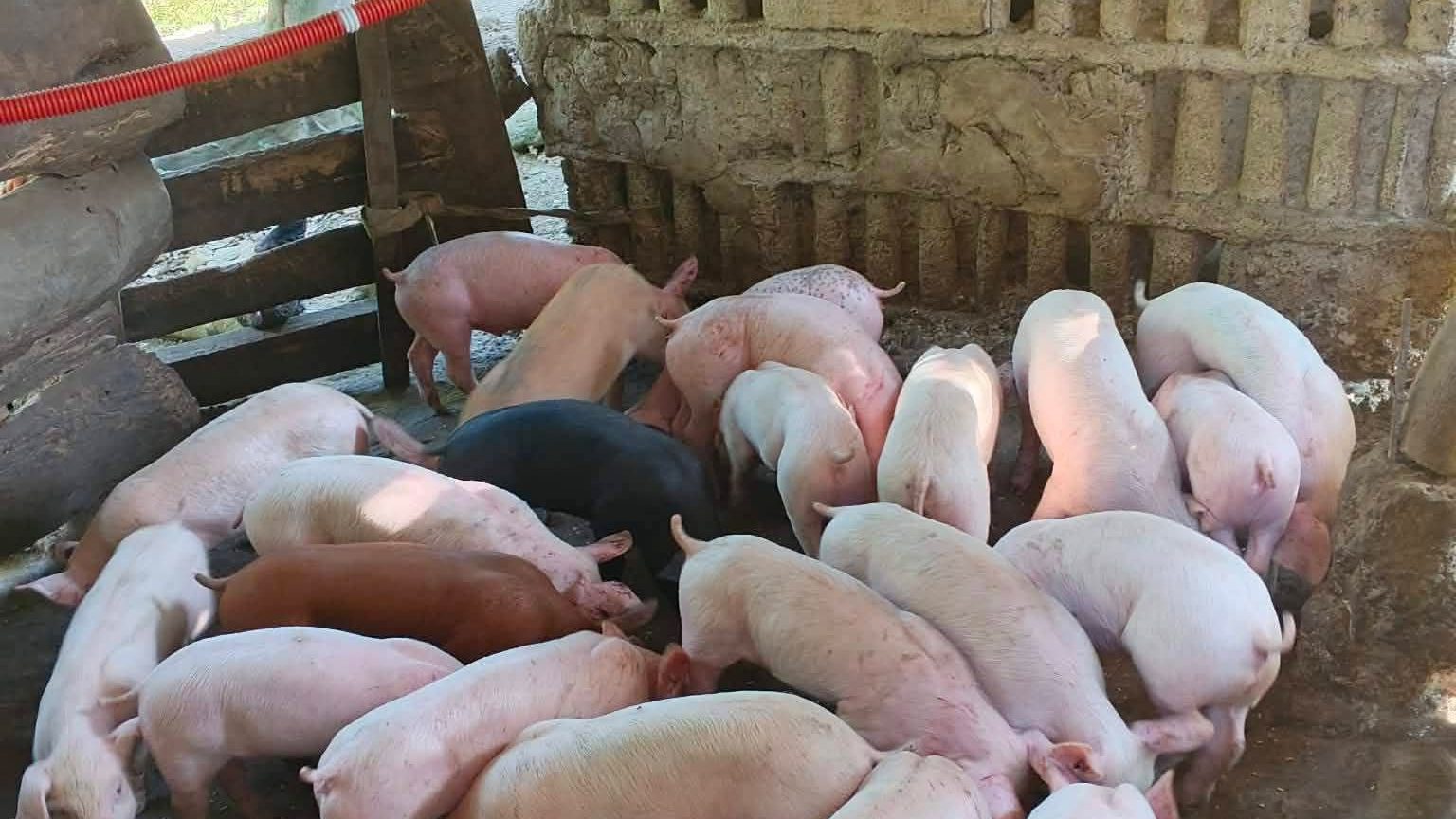
Materials Cost Ranges: Visayas and Mindanao
Material prices vary by island and province. These estimates are based on Q1 2026 hardware store prices in Cebu, Davao City, Cagayan de Oro, and Tacloban.
Note: Davao and Mindanao typically have 5–15% lower hardware prices than Cebu and Luzon for hollow blocks, cement, and GI sheets, due to lower shipping costs from Mindanao producers.
Option A: Full Concrete (Hollow Block + Concrete Floor + GI Roof)
Best for operations planning to run 5+ years at 10+ pigs per batch.
| Component | Specification | Cebu estimate | Davao/Mindanao estimate |
|---|---|---|---|
| Foundation | 150mm concrete strip footing | ₱3,500–₱5,500 | ₱3,000–₱5,000 |
| Walls (hollow block, CHB) | 150mm × 400mm CHB, 1.2m height | ₱9,000–₱15,000 | ₱8,000–₱13,000 |
| Concrete floor | 100mm, 3% slope, smooth finish | ₱5,500–₱9,000 | ₱5,000–₱8,000 |
| Roof framing | G.I. purlins or hardwood | ₱4,500–₱7,000 | ₱4,000–₱6,500 |
| Roof cladding | Corrugated GI sheet, 0.4mm | ₱6,500–₱10,500 | ₱5,500–₱9,500 |
| Concrete feed trough | Cast-in-place | ₱1,800–₱3,000 | ₱1,500–₱2,500 |
| Nipple waterers (PVC, 2 units) | — | ₱500–₱900 | ₱450–₱800 |
| Drainage channel + septic lagoon | 2m³ two-chamber | ₱5,500–₱11,000 | ₱4,500–₱9,500 |
| Total, 10-pig pen | ₱36,800–₱61,900 | ₱32,000–₱54,800 | |
| Lifespan | 15–25 years |
Option B: Semi-Permanent (Bamboo Frame + GI Sheet + Concrete Floor)
Practical starting point for most small farmers.
| Component | Cebu estimate | Davao/Mindanao estimate |
|---|---|---|
| Bamboo posts and frame | ₱1,800–₱3,500 | ₱1,500–₱3,000 |
| GI sheet walls (above concrete base) | ₱4,500–₱7,500 | ₱3,500–₱6,500 |
| Concrete floor (80mm, sloped) | ₱4,000–₱6,500 | ₱3,500–₱6,000 |
| GI roof + framing | ₱5,500–₱9,000 | ₱4,500–₱8,000 |
| Steel mesh dividers | ₱2,500–₱4,500 | ₱2,000–₱4,000 |
| GI or concrete feeder | ₱900–₱1,800 | ₱800–₱1,500 |
| Waterer | ₱800–₱1,500 | ₱700–₱1,300 |
| Drainage | ₱2,500–₱5,500 | ₱2,000–₱5,000 |
| Total, 10-pig pen | ₱22,500–₱39,800 | ₱18,500–₱35,300 |
| Lifespan | 5–8 years (replace bamboo as needed) |
Option C: Bamboo (Minimum Viable)
Lowest cost, highest risk. The earth floor is the critical weakness.
| Component | Cost (all regions) |
|---|---|
| Bamboo posts, walls, roof | ₱2,500–₱5,000 |
| Nipa or bamboo roofing | ₱1,500–₱3,000 |
| Earth floor + gravel | ₱600–₱1,500 |
| Bamboo feeder | ₱300–₱600 |
| Hose waterer | ₱200–₱400 |
| Total | ₱5,100–₱10,500 |
| Lifespan | 2–3 years |
The non-negotiable: Even in the lowest-budget build, the concrete floor is worth the investment. A ₱4,000–₱6,000 concrete floor in an otherwise bamboo pen is the single highest-return construction investment you can make. For a detailed comparison of flooring materials and their impact on pig health, see best flooring for pig pens in the Philippines. Concrete allows:
- Complete disinfection between batches (pathogens cannot survive in concrete if properly cleaned)
- Effective drainage without muddy wallowing
- Hoof health (wet, muddy earth floors cause hoof rot and lameness)
- Easier manure scraping
Everything else can be bamboo. The floor should be concrete.
Cost-Saving Tips from Experienced Farmers
- Recycled hollow blocks from demolition jobs cost 50–70% less than new. Inspect for cracks.
- Used GI sheets from building renovations, available at junk shops for ₱100–₱150/sheet vs ₱300+ new. Check for rust holes.
- Coconut lumber for posts and framing, cheaper than hardwood, widely available in Visayas. Treat the buried portion with used motor oil or tar.
- Cut tires in half for feed troughs and water bowls. Free or nearly free.
- Bayanihan organize construction as a community work exchange. You provide food and drinks; neighbors provide labor. Common practice in rural Visayas and Mindanao.
- Hire a mason only for concrete work (floor slab, CHB walls, troughs). Owner-build the rest.
- Pour the floor slab for two pens during your first pour, even if you're only building one pen now. The marginal cost of a larger slab during the first pour is much less than demolishing and re-pouring later.
Step 4: Concrete Floor: Getting It Right
The floor is where your pig lives 24 hours a day. Getting the surface finish wrong causes either injuries (too rough) or falls (too smooth).
Surface Finish
After pouring and leveling, drag a stiff broom across the wet concrete in straight lines. This creates a broom finish, textured enough for pig hooves to grip but smooth enough to scrub clean during disinfection.
Do not steel-trowel the floor to a polished finish. Wet, polished concrete is dangerously slippery. Do not use exposed aggregate either, it's too rough, causes hoof injuries, and harbors bacteria in the pits.
Specifications
- Thickness: 100mm (4 inches) minimum. Thinner slabs crack under pig weight and cleaning pressure.
- Slope: 3% toward the drain channel. For a 5m long pen floor, that means 15cm total drop from back wall to drain.
- Control joints: Cut joints every 2–3 meters to control cracking. Pigs will exploit cracks, making them worse.
- Curing: Keep the concrete wet for at least 7 days after pouring. In Philippine heat, uncured concrete is weak concrete. Cover with wet burlap sacks or banana leaves and rewet twice daily.
Local farmer tip:
"Ayaw og tikasa ang semento pagkahuman, hulata ug pito ka adlaw, basaha adlaw-adlaw. Ang salog nga walay tambal, mabuak dayon."
Don't rush the curing. Wait seven days, wet it daily. Uncured concrete cracks fast.
Step 5: Drainage Design: The Most Under-Engineered Part
Poor drainage is the #1 construction failure in Philippine backyard piggeries. It causes:
- Permanently wet floors → respiratory disease, hoof problems
- Standing water → mosquito breeding, leptospirosis risk
- Manure pooling → flies, odor, neighbor complaints, LGU violations
- Pathogen survival between batches
Floor Slope
Minimum 3% slope toward the drain channel. That means 3cm drop per 1 meter of floor length.
For a 5m long pen floor: total drop = 15cm from back wall to drain channel. This is substantial. Plan the concrete pour with string lines and a level.
In Davao and Eastern Visayas, where typhoon-season rain can be intense, 4% floor slope is preferred to handle peak water load.
Drain Channel Design
- Width: minimum 200mm (20cm)
- Depth: 150mm (15cm) at the feeder end, sloping to 250mm (25cm) at the lagoon inlet
- Cover: removable 50mm concrete slabs or galvanized steel grating for cleaning access
- Not a gap in the floor edge a properly formed channel, centered under the pen's drip line
Waste Collection Options
| System | Construction cost | Ongoing management | Best for |
|---|---|---|---|
| Two-chamber settling lagoon | ₱5,000–₱12,000 | Low (pump once per batch | Most backyard operations |
| Biogas digester (floating drum) | ₱15,000–₱30,000 | Low (produces cooking gas | Farms with gas needs; DA subsidy available |
| Composting bay (raised concrete) | ₱2,500–₱6,000 | Medium (turn weekly | Farms with garden or crops |
| Vermicomposting system | ₱4,000–₱8,000 | Medium (earthworms process waste | Premium organic fertilizer production |
For 5–10 pigs, a two-chamber settling lagoon (total 3–4 m³ capacity) handles one batch volume between clean-outs. The settled solids from the first chamber are scooped at batch end and applied to vegetable gardens or crop rows, excellent organic fertilizer. For a complete guide on converting pig waste into usable compost and vermicompost, see pig manure composting in the Philippines.
Biogas option: A small-scale biogas digester for 10 pigs costs ₱15,000–₱30,000 for a plastic tubular design (2–5 year lifespan) or ₱30,000–₱80,000 for a fixed-dome digester (15–25 year lifespan). Either produces enough cooking gas for 3–5 hours daily, saving ₱500–₱1,000/month on LPG. The DOST-ITDI has promoted the low-cost plastic tubular design at ₱5,000–₱15,000 for small operations.
Government assistance for biogas and facilities: The DOST SETUP (Small Enterprise Technology Upgrading Program) provides technology intervention packages of up to ₱3 million for small livestock farms, structured as 60% grant and 40% counterpart. This can cover biogas digesters, feed mixing equipment, water systems, and other infrastructure. Apply through DOST Provincial or Regional Offices. DOST Region 7 (Cebu) and DOST Region 11 (Davao) are confirmed active. The DA also has subsidy programs for biogas through the Philippine Biogas Alliance.
Davao context: Davao City and most Davao del Norte municipalities have specific barangay-level composting programs. Pig manure compost qualifies for the DA organic fertilizer subsidy program in Region XI, registered farms can apply for 50kg bags of government-subsidized organic fertilizer in exchange for participating in the program.
Step 6: Ventilation: The Most Important Design Decision
Hot pigs eat less and grow slower. This is not a minor effect:
- At 30°C ambient: feed intake reduced ~5%
- At 35°C ambient: feed intake reduced ~20–25%
- At 38°C effective temperature inside a closed pen: feed intake reduced 40%+
A poorly designed, enclosed pen in Davao del Norte during the dry season (March–May, daily highs 34–38°C) can reduce pig growth by 15–25% purely from heat stress. That is a ₱2,000–₱4,000 per pig loss in feed efficiency and extended grow-out time.
Design Principles for Philippine Climate
Open-sided walls: The pen wall above 0.8m height should be open steel mesh (welded wire), bamboo slats with spacing, or vertical GI louvers. Not solid concrete or hollow block. Pigs throw off a lot of body heat, and it needs somewhere to go.
The lower 0.6–0.8m of wall should be solid (concrete or CHB) to contain pigs, block ankle-level wind chill (pigs are sensitive to drafts at floor level, even in heat), and provide structural rigidity.
Ridge ventilation: A gap of 15–25cm at the roof peak (ridge vent) creates a chimney effect. Hot air rises and exits at the top, drawing cooler air in through the open side walls. This single feature can reduce pen temperature by 3–5°C compared to a hip roof with no ridge vent.
Roof orientation: Align the pen's long axis east–west so the large roof face faces north and south rather than full east and west solar exposure. This reduces peak solar heat load by 20–30%.
Roof pitch: Minimum 25° pitch. Steeper is better for both ridge ventilation and typhoon wind resistance.
Ceiling height: Minimum 2.4m at the eaves. 3.0m at the ridge. Hot air stratifies above the pigs. Higher ceilings keep the pig-level air cooler. For maximum ventilation benefit, aim for 3.5m at the ridge.
Roof insulation: GI roofing conducts heat badly. Under direct sun, interior temperature can be 5–8°C above ambient. Options to reduce this:
- Coconut coir board or insulation board under the GI sheets (₱80–₱150/m²)
- PE foam with reflective foil backing (₱60–₱120/m²)
- A simple nipa or coconut leaf ceiling under the GI creates an air gap that acts as a heat buffer, nearly free in rural areas
- Minimum 30cm air gap between any ceiling material and the roof acts as a thermal buffer
Wet season in Visayas: Eastern Visayas (Leyte, Samar) experiences heavy, prolonged rainfall November–January. Ensure roof overhangs extend at least 0.8m, ideally 1.0–1.5m, beyond the open side walls to prevent rain intrusion. Pigs in wet, rain-soaked pens during the northeast monsoon are susceptible to pneumonia even when ambient temperatures drop to 24–26°C.
Active Cooling Systems
Pigs have no sweat glands. In the March–May dry season when Philippine temperatures regularly hit 33–38°C, passive ventilation alone may not be enough for finisher-weight pigs.
What works:
- Wet the concrete floor 2–3 times daily during peak heat (11 AM–3 PM). Pigs lie on the wet surface and cool through contact. Cheapest and most effective method.
- Drip cooler / sprinkler line: A PVC pipe with small holes mounted 2m above the pen, connected to the water supply. Run 5 minutes on / 30 minutes off. More effective than continuous spraying and uses less water.
- Box fan or wall-mounted fan: Even a single fan per pen makes a big difference in evaporative cooling when combined with floor wetting. Estimated cost: ₱300–₱800/month in electricity for one fan.
- Shallow wallow: A 1m wide concrete trough running the length of the pen, 2.5–10cm deep, where pigs soak. Change water daily.
Feed timing in hot weather: Shift 60–70% of the daily ration to early morning (5–6 AM) and evening (5–6 PM) when temperatures are cooler. Pigs eat more when it's cool, and digesting feed generates metabolic heat, you want that heat generation happening at night, not midday.
Step 7: Typhoon-Resistant Design
The Philippines averages 20+ typhoons per year. Visayas and Eastern Mindanao are directly in the typhoon belt. A lost roof means lost pigs. Exposed animals panic, injure themselves, and develop pneumonia from rain exposure.
Design Wind Speed: What the Building Code Requires
The National Structural Code of the Philippines (NSCP 2015) specifies minimum design wind speeds by zone. The Visayas and Eastern Mindanao are directly in the typhoon belt:
- Visayas/Mindanao typhoon belt: Design for minimum 250 kph wind speed
- Eastern Visayas (Leyte, Samar): Design for 300+ kph lessons from Typhoon Yolanda (2013) and Odette (2021)
Buildings that survived Yolanda and Odette shared common features: reinforced concrete frames with tie-beams, hip roofs, continuous roof strapping, and properly embedded anchor bolts.
Structural Features That Survive Typhoons
- Roof trusses bolted, not just nailed. Use J-bolts embedded in concrete posts or through-bolts on steel posts. Cost: ₱15–₱25 per bolt, but saves the entire roof.
- Typhoon strapping (hurricane clips) at every truss-to-wall connection. Galvanized steel straps connecting purlins to trusses, and trusses to posts. ₱15–₱25 per strap.
- Ring beam / tie beam: Pour a continuous reinforced concrete beam on top of all walls, with minimum 4 pcs 10mm rebar. This is non-negotiable, it ties the walls together so the roof can be bolted to a rigid structure.
- 30-degree roof pitch steep enough to shed rain but not so steep that wind catches it.
- Hip roof design resists wind better than gable roofs. If using a gable roof, install diagonal wind bracing.
- Use minimum Gauge 24 GI sheets (thicker than standard Gauge 26). Secure with tek screws (self-drilling) at 6-inch intervals. These hold far better than standard roofing nails in high wind.
- C-purlins (steel) preferred over wood. Minimum 2"×3" C-purlins at 2-foot spacing.
- CHB walls grouted every 3rd cell with vertical rebar at corners and every 1.2m.
- Limit roof overhang to 18 inches maximum wider overhangs create uplift in strong winds. Use an internal gutter for rain management instead.
Have a recovery plan: Know where to evacuate animals if a super typhoon is forecast. Some Visayan farmers pre-arrange with neighbors on higher ground.
Step 8: Rat-Proofing and Biosecurity Design
Since ASF arrived in the Philippines in 2019, rat-proofing is no longer about comfort, it's about survival. Rats mechanically carry ASFV on their feet and fur between farms. They contaminate feed with urine and feces. Research confirms ASF virus survives in feed ingredients with half-lives of 9–14 days.
Physical Barriers (Build These Into the Structure)
- Concrete perimeter wall at least 60cm high with no gaps at the base. Fill all mortar joints in CHB walls.
- Welded wire mesh (gauge 16 or heavier, 12mm openings or smaller) on all ventilation openings. Standard chicken wire is too thin. Rats chew through it.
- Metal flashing around posts and pipes where they enter the building. Rats climb bamboo and wood; smooth metal they cannot grip.
- Concrete apron (50–60cm wide) around the outside of the pen. Rats cannot burrow through 10cm-thick concrete.
- Rat guards on feed storage posts: Cone-shaped galvanized iron sheets, at least 45cm diameter, mounted at 1m height on elevated storage platforms.
Management Practices
- Never leave feed in the trough overnight. Uneaten feed is a rat invitation.
- Store all feed in sealed metal drums with lids not sacks on the ground.
- Remove tall grass and brush within 3–5 meters of the piggery.
- Use bait stations (locked, tamper-proof) along walls outside the pen. Never use loose poison where pigs or children can access it.
Entry Point Design
- Single entry point with footbath. Force all entries through disinfection.
- Footbath: Concrete tray 1m long × path width × 10–15cm deep. Use 0.5% bleach solution (sodium hypochlorite), 2% caustic soda, or commercial disinfectant (Virkon S). Change solution every 2–3 days; daily in wet season.
- Boot washing station before the footbath. Boots must be washed clean first. Muddy boots neutralize the disinfectant.
- Dedicated farm footwear that never leaves the farm. A covered bench or shelf at the entrance where you change into farm boots.
- No visitors from other pig farms without full disinfection. No swill feeding. No new pigs without 30-day quarantine.
Local farmer tip:
"Sukad sa ASF, ang ilaga mao na ang pinaka-delikado sa kulungan. Kung makasulod ang ilaga, makasulod pod ang sakit."
Since ASF, rats are the most dangerous thing near the pen. If rats can get in, disease can get in too.
Step 9: Simple Layout for 10 Pigs
A practical layout for a 10-pig grow-out operation with isolation pen, suitable for a site with 10m × 8m available land area:
       ← 10 meters →

  ┌─────────────────────────────────┐  ↑
  │         ROOF (E-W ridge)        │  8
  │  ┌─────────┬────────┐  ┌──────┐ │  m
  │  │  PEN 1  │  PEN 2 │  │ ISO  │ │  ↓
  │  │  5 pigs │ 5 pigs │  │  PEN │ │
  │  │ 5×2.5m  │ 5×2.5m │  │ 2×2m │ │
  │  │         │        │  │      │ │
  │  │[feeder] │[feeder]│  │      │ │
  │  └────┬────┴────┬───┘  └──┬───┘ │
  │  drain channel   drain channel  │
  │       └──────────┘              │
  │               ↓ slope ↓         │
  │  ┌──────────────────────────┐   │
  │  │  SETTLING LAGOON (3 m³)  │   │
  │  └──────────────────────────┘   │
  │  [footbath]  ← entry            │
  └─────────────────────────────────┘
Key dimensions:
- Two grow-out pens: 5m × 2.5m = 12.5 m² each (2.5 m²/pig, above recommended minimum)
- Isolation pen: 2m × 2m = 4 m², separate drain to its own bucket (not main lagoon)
- Roof ridge east–west, open side walls on south and north faces
- Footbath at single entry point. Force all entries through disinfection
- 3-meter service corridor on one side for access, feed delivery, and animal loading
Designing for Future Expansion
Build the first pen at one end of the lot, not the center. Future pens are added in a row, sharing walls.
- Install the main drainage canal along the full planned length, not just under the first pen. Retrofitting drainage is the most expensive expansion mistake.
- Oversize the water line: Run a 1-inch main pipe even if you only need ½-inch now. Adding tees later is easy; upgrading the main pipe is not.
- Build the end wall of your first pen as a removable partition, not a permanent exterior wall. When you expand, you open this wall to connect to the next pen.
- Plan the footbath/entry area at the front. As you add pens, all should be accessed through the same biosecurity entry.
Step 10: Feeders and Waterers
Feeders: Concrete troughs built into the pen wall, 200–250mm wide, 150mm deep, 300–350mm of trough length per pig. A 5-pig pen needs 1.5m of trough. Smooth the concrete surface so cleaning is easy and no feed traps form.
For wet feeding (cooked rice bran mixes, cassava slurry), use removable GI troughs that can be removed, scrubbed, and sun-dried daily.
Cost-saving option: Used tires cut in half make serviceable feeders and waterers. Bolt or wire them to the wall at pig shoulder height. The curved bottom prevents feed from being pushed out. Free or nearly free.
Waterers: A pig at finisher phase drinks 8–15 liters of water per day, and up to 20 liters in Davao's dry season at 35°C ambient. Water restriction reduces feed intake and raises FCR faster than almost any other single factor.
- Nipple drinkers (PVC, stainless, or brass): ₱200–₱400 each, one per 5 pigs. Keeps pen floor dry. Reduces water waste by 60–70% compared to open troughs. Replace annually in hard-water areas (white mineral scale blocks the nipple mechanism).
- Open water bowl with float valve: ₱500–₱1,200. Needs cleaning every 2 days. Algae and feces contamination common in open bowls.
- Water tank: Elevate a 200–500L GI or plastic tank for gravity-feed. In areas with unreliable water supply (common in some Mindanao upland barangays), a 500L tank provides 3 days' reserve for 10 finisher pigs.
Water Supply for Areas With Unreliable Service
Many rural Mindanao and Visayas communities have intermittent water supply. Solutions:
- Rainwater harvesting: Rule of thumb: 1 sq.m. of roof area captures approximately 1 liter per 1mm of rainfall. A 50 sq.m. roof in Cebu (average 1,500mm/year) captures roughly 75,000 liters/year, more than enough for a 10-pig operation. A gutter-to-tank system (1,000–2,000L polyethylene tank at ₱5,000–₱15,000) with a first-flush diverter (₱500–₱1,500 DIY from PVC fittings) costs ₱6,000–₱17,000 total.
- Shallow well with manual pump (jetmatic): ₱3,000–₱8,000 for the pump plus ₱2,000–₱5,000 for the well casing. Effective up to 7–8 meters depth.
- Deep well with solar pump: For deeper water tables. A basic solar panel + submersible pump system costs ₱25,000–₱40,000 but eliminates ongoing electricity costs.
Water quality: In Eastern Visayas and parts of Mindanao, groundwater can have elevated iron or sulfur content. High-iron water suppresses palatability. Pigs drink less, eat less, grow slower. If your pigs consistently seem to not drink enough, have the water tested (free at most provincial agriculture offices). The fix is a simple iron filter on the water line.
Step 11: Electricity: What You Actually Need
A backyard piggery does not strictly require electricity, but it helps in specific situations:
| Need | Equipment | Monthly cost | Notes |
|---|---|---|---|
| Nighttime monitoring | LED bulb (5–10W) | ₱30–₱60 | Essential for farrowing sows |
| Piglet warming | 100W heat lamp | ₱200–₱400 | First 2 weeks; use 50W after day 14 |
| Water pumping | Electric or solar pump | ₱100–₱300 | If using deep well |
| Cooling fan | Box fan per pen | ₱300–₱800 | Optional but highly beneficial March–May |
| Feed grinding | Hammer mill | Varies | Optional. Can use toll milling at ₱1–₱2/kg |
Total estimated monthly electricity for a 10-pig operation: ₱300–₱800.
Off-grid alternatives:
- A 100W solar panel + battery + inverter (₱8,000–₱15,000) powers LED lights, charges a phone, and runs a small fan.
- For piglet warming without electricity, use a deep bedding of dry rice hulls (60–90cm deep) which generates mild warmth through microbial decomposition. A creep box lined with old sacks and rice hulls also works.
Permits and Registration
LGU registration for backyard livestock is required and strongly recommended. Most municipal and city veterinary offices register backyard pig raisers free of charge.
The permits you need depend on your scale:
| Permit | Where to get it | Cost |
|---|---|---|
| Barangay Clearance | Barangay Hall | ₱100–₱500 |
| Municipal/City Business Permit | Mayor's Office | ₱500–₱3,000 (varies by LGU) |
| Sanitary Permit | Municipal Health Office | Varies |
| Zoning Clearance | Municipal Planning Office | Varies |
| DA Registration | City/Municipal Agriculture Office | Free |
For backyard operations (1–20 heads), the barangay clearance and DA registration are typically sufficient. Operations above 20 heads require the full set.
Benefits of registration:
- Access to subsidized vaccines (hog cholera vaccine free or at cost through registered backyard programs)
- Eligibility for DA livelihood grants, INSPIRE swine repopulation program, and SURE recovery program
- Access to free or subsidized veterinary consultation
- Eligibility for ASF compensation programs if outbreak occurs
- PCIC livestock insurance enrollment (premium may be fully subsidized, as low as ₱150–₱400 per head)
- Access to DOST SETUP technology grants (up to ₱3 million, 60% grant. See below)
- TESDA offers free or subsidized Animal Production (Swine) NC II training courses
Environmental compliance:
| Scale | Requirement | Process |
|---|---|---|
| Backyard (1–20 heads) | Generally exempt from ECC. Some LGUs require CNC. | Apply at EMB Regional Office or LGU ENRO |
| Small commercial (21–100 heads) | Certificate of Non-Coverage (CNC) | Submit project description to EMB; 2–4 weeks |
| Medium (100–1,000 heads) | ECC via Initial Environmental Examination (IEE) | Submit IEE to EMB; 30–60 days |
| Large (1,000+ heads) | ECC via full Environmental Impact Statement (EIS) | EIS Review; 90–120 days |
Check your specific municipality's ordinance, some Cebu and Davao City barangays have stricter thresholds. Contact EMB Region 7 (Cebu) at (032) 254-0000 or EMB Region 11 (Davao) at (082) 234-1466.
Waste management legal reality: Under RA 9275 (Philippine Clean Water Act), discharging untreated animal waste into waterways is prohibited. Violations carry fines of ₱10,000–₱200,000 per day. Even for backyard operations, having a settling lagoon, composting bay, or biogas system is not just good practice, it protects you legally.
Local farmer tip:
"Pag-rehistro sa imong baboy sa munisipyo, libre ra. Pero kung wala ka'y rehistro, wala pod ka'y makuha kung maabot ang ASF."
Register your pigs at the municipal office, it's free. But without registration, you get nothing if ASF hits.
Bisaya / Cebuano
Sakto nga kulungan sa baboy: unsa ang kinahanglan gyud
Ang pinaka-importante (ayaw palakton sa imong budget):
-
Concrete salog bisan unsa ang imong material sa pader ug bubong, kinahanglan concrete ang salog. Sayon og limpyo, dili mahimong basa, ug makalikay og sakit. Cebu: ₱4,000–₱6,500 / Davao: ₱3,500–₱6,000 para sa 10 ka baboy nga kulungan.
-
Drainage ang salog kinahanglan moslope (3 cm drop per metro) padulong sa drain. Basta adunay tubig nga naghugpong sa salog, ibutang sa imong isip na adunay problema.
-
Bukas ang pader sa ibabaw dili pulos solid nga CHB. Ang ibabaw nga bahin sa pader (gikan 0.8m pataas) kinahanglan mesh o bamboo kacing-kacing para adunay hangin. Sa Davao dry season (Marso–Mayo), ang kulungan nga walay ventilation mopamenos og 20–40% sa pagkaon sa baboy, mao kana ang imong kita nga mapulong.
-
Isolation pen kinahanglan nimo ni bago moabot ang unang baboy, dili human. Minimum 2m × 2m, layu sa main pen.
-
Proteksyon sa ilaga sukad sa ASF, kinahanglan welded wire mesh (gauge 16, gamay ang buho) sa tanan nga abli. Ang chicken wire dili igo. Makutkot sa ilaga.
Presyo alang sa 10 ka baboy:
| Option | Cebu | Davao |
|---|---|---|
| Full concrete | ₱36,800–₱62,000 | ₱32,000–₱55,000 |
| Semi-permanent (bamboo + concrete salog + GI) | ₱22,500–₱40,000 | ₱18,500–₱35,000 |
| Puro bamboo | ₱5,100–₱10,500 | Same |
Para sa nahaunang pagsulay: Ang semi-permanent option (bamboo + concrete salog + GI bubong) maayong sugod. ₱18,500–₱40,000 depende sa imong lugar. Dawata ang concrete salog bisag mahimo pang bamboo ang uban.
Sa Davao: Ang imong ENRO o DA-RFO XI pwede magbulig og organic fertilizer program para sa imong pig manure, dagdag nga kita.
Tabang sa gobyerno: Ang DOST SETUP program naghatag og hangtod sa ₱3 milyon (60% grant) para sa gamay nga livestock farms, lakip ang biogas, feed mixing equipment, ug water systems. Pangutan-a ang DOST Regional Office sa imong lugar. Ang TESDA nag-offer pod og libre nga Animal Production (Swine) NC II training.
Bahin sa baha ug bagyo: Kung naa ka sa Visayas o Eastern Mindanao, ang imong kulungan kinahanglan makaya ang 250+ kph nga hangin (NSCP 2015). Gamita ang Gauge 24 GI sheets (baga), tek screws (dili ordinaryo nga pako), ug ring beam sa ibabaw sa pader. Ang mga nakabuhi sa Yolanda ug Odette: reinforced concrete, hip roof, ug hurricane clips sa matag truss.
Gamiton ang Pen Space Calculator para makalkula ang gikinahanglan nga espasyo para sa imong herd.
Total Project Budget
| Item | Budget (semi-perm) | Mid-range | Full concrete |
|---|---|---|---|
| Pen construction (Davao / Mindanao) | ₱18,500–₱35,300 | ₱35,000–₱45,000 | ₱32,000–₱55,000 |
| Pen construction (Cebu / Visayas) | ₱22,500–₱39,800 | ₱38,000–₱50,000 | ₱36,800–₱62,000 |
| Drainage + waste system | ₱2,000–₱5,000 | ₱5,000–₱8,000 | ₱8,000–₱12,000 |
| Feeders + waterers | ₱1,500–₱3,000 | ₱2,500–₱4,000 | ₱3,500–₱5,500 |
| Tools + initial disinfectants | ₱1,800–₱3,000 | ₱2,500–₱3,500 | ₱2,500–₱3,500 |
| Total construction (Mindanao) | ₱23,800–₱46,300 | ₱45,000–₱60,500 | ₱46,000–₱76,000 |
First-batch operating cost (10 pigs, Davao scenario): ~₱95,000–₱107,000
Total investment for a first-time operator (semi-perm, Davao): ~₱120,000–₱155,000 to have a complete, functional 10-pig operation on day one. Amortized over 5 batches: pen cost ₱4,760–₱9,260 per batch, or ₱476–₱926 per pig.
Tools
- Pen Space Calculator calculate the exact floor area needed for your herd size
- Profit Simulator see where housing cost fits in your total batch economics
Related Articles
- Pig Farming Profit: 10 Pigs where housing cost fits in the full economics
- Pig Diseases Philippines what good pen design prevents
- Best Pig Breeds Philippines space and housing needs vary by breed
- Biogas digester ROI payback math on plastic balloon vs concrete fixed-dome systems
- Pig manure composting closing the loop on waste output
- Pig water systems nipple drinkers, water budgets, and bowl placement
- Odorless pig pen — KNF deep litter the litter system that eliminates the smell complaint from neighbours
- LGU permits and piggery regulations which clearances you actually need before pouring concrete
- Best flooring for the pig pen concrete vs slatted vs deep-bedding cost and biosec trade-offs
- Housing & Farm Setup topic cluster — the full set of pen-design and biosec-build guides
Sources: DA Bureau of Animal Industry swine housing technical standards, DA Region 8 Hog Raising Investment Guide, PIGS (Profitable Innovative Growing System) guidelines, UPLB College of Agriculture and Food Technology swine production manual, BAI Environmental Management Bureau guidelines for livestock waste, DENR DAO 2003-30 and amendments (ECC/CNC thresholds), RA 9275 Philippine Clean Water Act waste discharge provisions, RA 9003 Ecological Solid Waste Management Act, National Structural Code of the Philippines (NSCP 2015) wind speed zones, DOST SETUP program guidelines (confirmed active Region 7 and Region 11), DOST-ITDI biogas digester technology, pig333.com ASF biosecurity research, hardware price surveys in Cebu City, Mandaue, Davao City, Tagum, Cagayan de Oro, and Tacloban (Q1 2026), PCIC livestock insurance premium guidelines (RA 10000), field measurements from DA-assisted backyard piggery construction projects in Region 7 and Region 11.