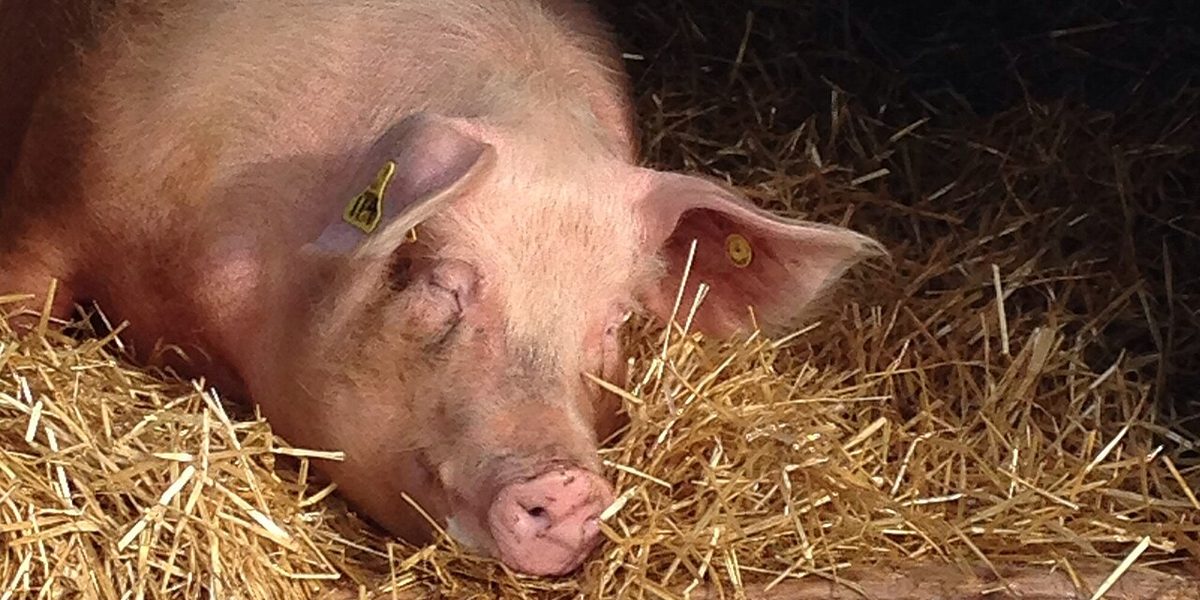
The standard Philippine commercial pig is a three-way cross. Nobody publishes a breed breakdown of what gets slaughtered, so ignore anyone who quotes you a share, but the parent stock the big breeders sell (Landrace and Large White F1 gilts, Duroc boars) only makes sense as this cross (INFARMCO). The liempo at the palengke, the sinigang at the carinderia, the lechon baboy at fiesta -- that pork almost certainly came from a Landrace x Large White dam bred to a Duroc terminal sire. This is the hybrid. Know its economics and your piggery makes money. Ignore them and you bleed feed costs.
At a Glance
| Trait | Three-Way Cross (LW x LR) x Duroc |
|---|---|
| Market Weight | 90-110 kg liveweight |
| Days to Market | 145-165 days from birth |
| Average Daily Gain (ADG) | 700-900 g/day |
| Feed Conversion Ratio (FCR) | 2.6-3.0 |
| Dressing Percentage | 74-78% |
| Lean Meat Percentage | 55-62% |
| F1 Dam Litter Size | 11-14 piglets born alive |
| Heterosis Advantage | +5-10% growth rate, +10-15% litter size |
| Carcass Backfat | 18-22 mm at P2 |
| Estimated Breakeven | P159-181/kg liveweight depending on scale (producer groups put the national cost of production at P180-190/kg in October 2026, Daily Tribune) |
The numbers above assume quality genetics from a certified multiplier farm, standard commercial feeds, and competent management. Cut corners on any of those three and the FCR drifts toward 3.5+, which destroys your margin.
Who Is This Breed For?
The three-way cross hybrid is built for one purpose: efficient conversion of feed into lean pork at scale. It is the right choice if:
- You are raising 10 or more head per batch for the commercial market
- You sell to traders, wet markets, meat shops, or institutional buyers who pay by liveweight or carcass weight
- You want predictable performance: uniform growth, uniform market dates, uniform carcass quality
- You have access to commercial feeds (B-MEG, Vitarich, Thunderbird, or equivalent)
- You have or can build housing with proper ventilation, drainage, and pen divisions
It is not the right choice if you are targeting the premium lechon trade (consider Native or Native x Duroc crosses), if you cannot commit to commercial-grade feeds, or if your total budget for a batch is under P60,000. Hybrids on garbage feeds perform worse than native pigs on local feeds, because you pay for genetics that never express their potential.
If you are still weighing whether the three-way commercial hybrid is right for your scale and market channel, my best pig breeds for Philippine small farmers guide lays the eight breeds side by side so you can match genetics to where you actually sell.
Batch Economics at Scale
This is where most new farmers get it wrong. They look at the selling price and the piglet cost and assume everything in between is profit. It is not. Feed is about 57% of pig operating cost (PIDS). The 60-70% figure you see quoted everywhere comes from a feed-tariff advocacy statement covering poultry and swine together; 70% is an upper bound, not a pig benchmark. Still the biggest single line by far, which is why the feed math below decides whether you eat.
10-Head Batch (Backyard-Commercial)
| Item | Cost per Head | Total (10 head) |
|---|---|---|
| Piglet (F1 hybrid, 8-10 kg) | P6,500 | P65,000 |
| Feed (starter through finisher, ~260 kg at ~P36.50) | P9,500 | P95,000 |
| Vaccines + meds | P450 | P4,500 |
| Utilities (water, electric) | P300 | P3,000 |
| Labor (partial, family) | P500 | P5,000 |
| Mortality allowance (5%) | P860 | P8,600 |
| Total Production Cost | P18,110 | P181,100 |
| Revenue at 100 kg x P172.44/kg (PSA, Q2 2026) | P17,244 | P172,440 |
| Net at P172.44/kg | -P866 | -P8,660 |
| Revenue at 100 kg x P150/kg (DA, August 2026) | P15,000 | P150,000 |
| Net at P150/kg | -P3,110 | -P31,100 |
On 10 head you lose money at both prices: about P866 a head at PSA's last official quarter (P172.44/kg, Q2 2026) and about P3,110 a head at the DA's August 2026 figure of P150/kg (Manila Times). Read that again. Your cost lands near P181/kg, and producer groups put the national cost of production at P180-P190/kg in October 2026 (Daily Tribune). Neither price covers it. At 10 head you have no cost advantage to hide behind, so this batch only pays if you sell above the commodity rate, to a lechonero or a direct buyer, or the price recovers before your pigs are ready.
50-Head Batch (Small Commercial)
| Item | Cost per Head | Total (50 head) |
|---|---|---|
| Piglet (volume discount) | P6,000 | P300,000 |
| Feed (bulk pricing, ~255 kg at ~P35) | P8,900 | P445,000 |
| Vaccines + meds | P400 | P20,000 |
| Utilities | P250 | P12,500 |
| Hired labor (1 worker) | P1,200 | P60,000 |
| Mortality allowance (4%) | P670 | P33,500 |
| Total Production Cost | P17,420 | P871,000 |
| Revenue at 100 kg x P172.44/kg (PSA, Q2 2026) | P17,244 | P862,200 |
| Net at P172.44/kg | -P176 | -P8,800 |
| Revenue at 100 kg x P150/kg (DA, August 2026) | P15,000 | P750,000 |
| Net at P150/kg | -P2,420 | -P121,000 |
At 50 head, you start seeing the scale advantage: bulk feed pricing, lower per-head labor cost, and the ability to negotiate piglet prices. Cost drops to about P174/kg. At PSA's P172.44 that is roughly break-even, P176 a head short. At the DA's P150 it is a P121,000 hole on the batch. Better than 10 head, and still not a business at today's commodity price.
100-Head Batch (Commercial)
| Item | Cost per Head | Total (100 head) |
|---|---|---|
| Piglet (direct from multiplier) | P5,500 | P550,000 |
| Feed (mill-direct, ~250 kg at ~P34) | P8,500 | P850,000 |
| Vaccines + meds | P380 | P38,000 |
| Utilities | P200 | P20,000 |
| Labor (2 workers) | P900 | P90,000 |
| Mortality allowance (3%) | P465 | P46,500 |
| Total Production Cost | P15,945 | P1,594,500 |
| Revenue at 100 kg x P172.44/kg (PSA, Q2 2026) | P17,244 | P1,724,400 |
| Net at P172.44/kg | P1,299 | P129,900 |
| Revenue at 100 kg x P150/kg (DA, August 2026) | P15,000 | P1,500,000 |
| Net at P150/kg | -P945 | -P94,500 |
At 100 head, the economics can work. At PSA's P172.44 you clear about P1,299 a head, P129,900 a batch, so roughly P260,000 a year on two batches. At the DA's P150 the same batch loses P94,500. Notice what is actually doing the work. It is not the price. You get the same commodity price everyone else gets. It is the cost: about P159/kg against the P180-P190/kg producer groups quote for the industry. Scale is the margin, and right now even scale only survives at the official number, not the DA's August one.
Sa Bisaya
Feeding Program
The hybrid's genetic potential means nothing without a feeding program that unlocks it. A pig with 700 g/day ADG genetics on a 500 g/day feeding program is a wasted investment.
Phase Breakdown with Current Costs
| Phase | Age (days) | Weight Range | CP% | Feed/Day | Days | Total Feed | Cost/kg | Cost per Phase |
|---|---|---|---|---|---|---|---|---|
| Pre-starter | 7-21 | 2-6 kg | 22% | Ad lib | 14 | 3 kg | P45 | P135 |
| Starter | 21-56 | 6-22 kg | 20% | Ad lib | 35 | 25 kg | P40 | P1,000 |
| Grower | 56-112 | 22-60 kg | 16-18% | 2.5-3 kg | 56 | 150 kg | P37 | P5,550 |
| Finisher | 112-154 | 60-100 kg | 14-16% | 3-4 kg | 42 | 80 kg | P35 | P2,800 |
| Total | ~147 days | ~258 kg | P9,485 |
Prices above are B-MEG or equivalent premium brand. As of 12 July 2026, premium grower and finisher sells at P34.90-38.20/kg, which is P1,747 to P1,910 per 50 kg bag, so the P37 grower and P35 finisher above sit in the middle of the market. That is not a bargain, that is the going rate. Feed has climbed P1-2/kg through 2026 and no miller has announced a rollback. Corn is half to two-thirds of the formulation and its tariff was not cut (EO 62 stands to 2028), so do not plan a batch on the assumption that cheaper feed is coming. Value lines (Thunderbird and similar) sit a few pesos per kilo under the premium brands and can shave maybe P800-1,200 per head off feed cost, but expect FCR to drift 0.2-0.4 points higher, which eats most of the saving.
Local Feed Alternatives
For farms in agricultural areas, partial feed substitution can reduce costs 15-25%. Read my detailed feed economics guide for formulations.
- Copra meal (P14-16/kg): substitute up to 15% of grower/finisher ration. Limit in starter due to high fiber.
- Rice bran (darak, first class) (P16-18/kg): up to 20% of grower ration. Ensure freshness; rancid darak causes diarrhea.
- Corn-soy-premix (CSP) mixing: if you have a hammer mill and access to yellow corn at P18-20/kg and imported soybean meal at P28-30/kg, a CSP mix with vitamin-mineral premix can produce grower feed at P24-26/kg. Requires nutritionist formulation and consistent ingredient quality.
- Camote tops and root crops: supplemental only for hybrids. You cannot drive 800 g/day ADG on camote tops. Use as enrichment, not as a cost-saving strategy.
Water
Often overlooked, always critical. A finishing pig drinks 8-12 liters per day. Restrict water and feed intake drops immediately. Nipple drinkers should flow at 1.5-2 liters per minute. Check flow rates weekly. Clogged nipples are the silent profit killer in many piggeries.
Contract Growing vs Independent
This is the biggest strategic decision for a new commercial farmer. Both paths can work. Both can fail.
Contract Growing
Under contract growing, an integrator (Monterey/San Miguel Foods, CPF Philippines, Foremost Farms) provides the pigs, feeds, vaccines, medicines, and technical support. You provide the housing, utilities, labor, and daily management. You are paid a growing fee per kilogram of weight gain.
Typical integrator terms (2025-2026):
| Item | Detail |
|---|---|
| Growing fee | P8-12/kg liveweight gain |
| Pigs provided | 8-10 kg weanlings |
| Target market weight | 95-105 kg |
| Target growing period | 120-130 days |
| Feed provided | Integrator's own brand |
| Mortality threshold | 3-4% (excess charged to grower) |
| FCR target | 2.8-3.2 (penalties above threshold) |
| Payment cycle | 7-14 days after pullout |
Advantages:
- No working capital needed for pigs, feed, and meds (the integrator fronts 80% of production cost)
- Guaranteed market: the integrator buys every pig
- Technical support and veterinary backup
- Predictable income per batch
Disadvantages:
- You do not own the upside. When pork prices spike, the integrator captures the margin
- Growing fees have been flat for years while labor and utility costs rise
- Strict facility requirements (housing specs, ventilation, pen size)
- You absorb mortality and FCR risk on someone else's genetics and feed
- Some contracts include exclusivity clauses
Realistic income: A 500-head contract grower with good performance earns P200,000-350,000 per batch (net of utilities and labor), two batches per year. It is a stable but modest living.
Independent Growing
You buy your own piglets, your own feed, and sell to your own buyers. Higher risk, higher reward.
Advantages:
- You capture the full margin when prices are good
- Freedom to choose genetics, feeds, and market timing
- No exclusivity restrictions
- You build your own buyer relationships (your real moat)
Disadvantages:
- You front 100% of working capital, about P1.6M for a 100-head batch at current feed prices
- Full price risk, and right now there is no buffer. Producer groups put cost of production at P180-P190/kg (October 2026) against PSA's last official P172.44 and the DA's August P150, so the average independent farm is already under water
- No veterinary safety net, so you hire your own vet
- You handle marketing and logistics
When Does Each Make Sense?
Start with contract growing if:
- You have good housing but limited working capital (under P500K liquid)
- You are new to commercial-scale pig farming and want to learn operations
- You want stable income with low financial risk
Go independent if:
- You have P1.6M+ working capital for your first batch
- You have existing buyer relationships (traders, meat shops, institutional)
- You have at least 2-3 years of pig farming experience
- You can stomach a bad batch that loses money
The hybrid path: Many successful commercial farmers start with contract growing for 3-5 batches, learn operations, build cash reserves, then transition to independent growing with established relationships. This is the lowest-risk path to building a real piggery business.
Sa Bisaya
Sourcing Quality Genetics
The three-way cross is only as good as the parent lines behind it. A cheap piglet from unknown genetics will underperform a well-bred piglet by 15-25% on every metric: ADG, FCR, lean percentage. That cost difference compounds over 150 days of feeding.
Major Multiplier Farms in the Philippines
| Farm | Genetics | Location | Notes |
|---|---|---|---|
| INFARMCO (International Farms Corp.) | Own Philippine-bred Landrace and Large White; F1 gilts through Lexus Multifarm | Office in Mandaluyong; farm sites not published | Says it holds the largest pure Landrace and Large White nucleus herd in PH (INFARMCO) |
| Family Farms Inc. | Topigs Norsvin | Batangas, Pangasinan | Dutch genetics, strong dam lines |
| Golden Harvesta | Genesus | Bulacan | Canadian genetics program |
| PIC Philippines | PIC direct | Batangas | Premium pricing, top-tier genetics |
| CPF Philippines | CPF proprietary | Nationwide | Tied to contract growing program |
| Foremost Farms | Mixed (DanBred, others) | Tarlac, Bulacan | Also contract growing integrator |
What to Look For When Buying Piglets
- Source certification: Buy from BAI-accredited multiplier farms or swine breeders associations. Ask for breeding records and performance data of the parent stock.
- Health status: Piglets should be vaccinated for Mycoplasma and classical swine fever (CSF) before delivery. Ask for the vaccination certificate. Check for clear eyes, clean skin, active behavior, and no coughing.
- Uniformity: Within a batch, piglets should be within 1-2 kg of each other. High variation in starting weight leads to high variation in market weight, which makes batch management difficult.
- Weight at purchase: 8-10 kg weanlings are standard. Buying at 20-25 kg (starter pigs) costs more per head but skips the weaning transition. I have not found a Philippine figure for how much that cuts losses, so I will not quote one. Worth it for first-time growers.
- Transport stress: Piglets transported more than 4 hours need 3-5 days of recovery with electrolytes and reduced feed before normal feeding programs begin.
Artificial Insemination (AI) vs Natural Service
If you are maintaining your own F1 sows and breeding to a Duroc boar:
- AI with purchased semen: P300-500 per dose, 2 doses per breeding. Gives access to top-tier Duroc genetics without maintaining a boar. Requires trained inseminator and proper semen handling (16-18C storage, use within 72 hours of collection).
- Natural service (own boar): Higher upfront cost (P40,000-80,000 for a quality Duroc boar) but lower per-breeding cost. One boar services 15-20 sows per year. Using one boar too long risks inbreeding, so rotate boars every 18-24 months.
- Recommendation for small operations: AI is almost always better. The genetics are superior, the cost per litter is lower, and you avoid the feed and housing cost of maintaining a boar.
Health and Biosecurity
Commercial hybrids are high-performance animals that need preventive care. An outbreak at scale is catastrophic.
Vaccination Program
| Vaccine | Primary Dose | Booster | Notes |
|---|---|---|---|
| Mycoplasma hyopneumoniae | Day 7-10 | Day 28 | Non-negotiable for commercial operations |
| CSF (classical swine fever) | Day 42-45 | Day 90 | Government-subsidized through LGU |
| Porcine Circovirus (PCV2) | Day 21-28 | None | Single dose; reduces wasting syndrome |
| PRRS | Pre-breeding (gilts) | Quarterly (sows) | Herd-dependent; consult vet on strain |
| Parvovirus | Gilts before 1st breed | Annual | Prevents mummified piglets |
| E. coli | Sows, 2 wks pre-farrow | Each pregnancy | Protects neonatal piglets via colostrum |
ASF: The Existential Threat
African Swine Fever has not been eradicated, and anyone telling you it is over is not watching the Visayas. BAI's latest national bulletin, dated 9 October 2026, counts 226 active barangays across 24 provinces. The count bottomed at 6 barangays in 4 provinces on 22 May 2026, then rose with every bulletin to a peak of 293 barangays in 31 provinces on 24 September.
Since late June 2026 the Visayas has been back in it. San Enrique in Negros Occidental was confirmed on 23 June, with 1,902 pig deaths province-wide by 25 June, not all of them from ASF. Barotac Viejo in Iloilo followed on 29 June, its first case in four years. Bacolod and La Libertad in Negros Oriental confirmed on 1 July. Capiz red-zoned five LGUs and shut its border to pork on 24 June, and Cebu banned Negros pigs and pork on 7 July under EO 39. By September ASF was confirmed inside Cebu province itself (Ginatilan, then three Cebu City barangays, per the Daily Tribune). ASF kills 100% of infected pigs. There is no treatment.
BAI cleared the AVAC ASF LIVE vaccine for commercial sale on 2 September 2026, for fatteners only, sold through accredited veterinary outlets, and the DA is seeking ₱1 billion in the 2027 budget to subsidise it for backyard raisers (DA). It does not cover breeding stock and it does not replace biosecurity, which stays the main defense on every farm.
Non-negotiable ASF biosecurity measures:
- Perimeter fence: physical barrier preventing contact with outside pigs, wild animals, and unauthorized personnel
- Footbath and clothing change: every person entering the production area
- No swill feeding: never feed kitchen waste containing pork or pork products
- Vehicle disinfection: feed trucks, buyer trucks, and personal vehicles do not enter the farm proper
- All-in/all-out by room: never mix batches of different ages in the same airspace
- Downtime between batches: minimum 7 days empty, cleaned, and disinfected
- Sentinel monitoring: if a pig dies unexpectedly, isolate the pen immediately and call your provincial veterinarian. Do not wait.
Read my ASF recovery guide for detailed protocols and the latest updates on vaccine availability.
All-In/All-Out Protocol
This is not optional for commercial hybrid operations. It is the foundation of disease control.
- Fill each room or building with pigs of the same age within a 7-day window
- No additions to the group after filling
- Market the entire group within a 14-day window
- Clean, disinfect, and dry the room for at least 7 days (14 days preferred)
- Then refill with the next batch
Continuous-flow systems (mixing ages in the same building) create a perpetual disease cycle. Every new group of piglets encounters pathogens shed by older pigs. Medication costs spiral. Growth rates decline. This is the single most common management failure in Philippine piggeries.
Regional Intelligence
Central Luzon Pig Belt (Bulacan, Pampanga, Tarlac, Nueva Ecija)
This is the heart of Philippine commercial pig production. Advantages: proximity to Metro Manila market (highest pork demand), dense network of feed suppliers and veterinary services, established trader relationships, and the highest concentration of multiplier farms. Disadvantage: land costs are high, environmental regulations are tightening (DENR effluent standards), and competition for buyers is intense. One thing to unlearn: Central Luzon does not command a farmgate premium anymore. PSA's March 2026 regional figures put it mid-pack at P178.41/kg, behind Cordillera (P208.88) and Eastern Visayas (P206.70). And nowhere reaches the DA's P210/kg minimum farmgate price. No region has, in any month PSA has published.
CALABARZON (Batangas, Laguna, Cavite, Rizal, Quezon)
The second-largest cluster. Batangas is particularly strong in genetics (several multiplier farms) and has good road access to Metro Manila. Laguna and Cavite face urban encroachment. Piggeries there are being pushed further from population centers. Quezon province has room for expansion but logistics costs are higher.
Western Visayas (Iloilo, Negros Occidental)
Growing commercial production, historically more oriented toward native pigs and native crosses for the lechon market. The shift toward hybrids is accelerating as feed supply chains improve. Iloilo City provides a solid local market. Negros Occidental has large agricultural land availability.
Mindanao (Davao, South Cotabato, Bukidnon)
The expansion frontier. Land is cheap, corn is locally available (Bukidnon is the corn capital), and labor costs are lower than Luzon. The challenges: distance from the Metro Manila premium market, less developed cold chain infrastructure, and periodic ASF flare-ups in some areas. However, local demand in Davao City and General Santos is growing. Contract growing operations from major integrators are expanding here.
Cebu and Central Visayas
Historically the native pig capital, but commercial hybrid operations are growing to serve the institutional market (hotels, restaurants, fast food chains). The lechon industry still prefers native or native crosses, creating an interesting dual market. Some Cebu farms run both: hybrids for volume, natives for premium lechon.
Financing Your Operation
Commercial pig farming requires real capital. Here are the government and institutional financing options available now:
| Program | Lender | Interest Rate | Max Loan | Notes |
|---|---|---|---|---|
| SWINE Program | LandBank | 3% p.a. fixed for 3 years at the 2021 launch, repriced yearly after (DOF) | Varies | Ask for the current rate |
| SWINE R3 | DBP (Dev. Bank of PH) | Not published; ask DBP | Up to 70% of project cost for private firms, 100% for LGUs (Philstar, 2021) | Up to 10 years incl. 2-year grace; breeder, wean-to-finish and consolidated farms, not backyard |
| Agri-Negosyo (ANYO) | DA-ACPC | 2% p.a. plus service fee up to 3.5% (ACPC) | P300K (individual) | Through ACPC partner lenders; RSBSA-registered; up to 5 years |
| Microfinance | Various MFIs | 18-24% p.a. | P150K | No collateral, but expensive |
The LandBank SWINE program was the cheapest money on offer at its 2021 launch terms; check what it charges today before you compare. Prepare a detailed business plan with batch economics (use the tables above as a starting point), proof of farm ownership or lease, and attend their agricultural lending orientation. Processing takes 30-60 days.
For a deep dive on financing options for swine operations, see my guide on building a profitable pig farm.
Common Mistakes
1. Buying Cheap Genetics, Then Feeding Premium Feed
Spending P4,000 on an unregistered piglet from an unknown source, then spending P9,500 on B-MEG feeds over 5 months. The genetics cap the pig's performance at an FCR of 3.5, so you are paying premium feed prices for mediocre results. Either buy quality genetics and feed them properly, or accept backyard-level performance. Do not mix premium inputs with discount genetics.
2. Skipping the Starter Phase
Some farmers buy 8 kg weanlings and immediately put them on grower feed to "save money." The crude protein in grower feed (16-18%) is insufficient for a 8-15 kg pig that needs 20% CP. Growth stalls for 2-3 weeks, the pig never fully recovers, and you lose 5-10 days to market. The P1,000 you spend on starter feed returns P2,000+ in faster growth and better FCR during the grower-finisher phase.
3. Overcrowding Pens
The recommendation for finishing hybrids is 0.9-1.0 square meters per pig. Many farmers pack 20 finishers into a 12 sqm pen (0.6 sqm each). The result: increased aggression, tail biting, reduced feed intake, 10-15% slower growth, and higher respiratory disease incidence. You "save" on housing cost but lose far more in reduced performance and increased medication.
4. Selling at the Wrong Weight
Hybrid pigs hit their most efficient FCR window between 80-100 kg. Below 80 kg, you have not recovered your fixed costs (piglet, starter feed, vaccines). Above 110 kg, FCR deteriorates rapidly as the pig deposits more fat and less lean. The sweet spot for most markets is 95-105 kg liveweight. Selling a 75 kg pig because you "need cash" means you lost money on that pig even if the per-kilo price looks fine.
5. No Record-Keeping
You cannot manage what you do not measure. At minimum, track: date pigs arrived, starting weight, feed consumption per week, any mortality or treatment, and final market weight and price. These records tell you your real FCR, cost per kg gain, and margin instead of the theoretical numbers from a breed guide. After three batches with good records, you will know exactly where your money goes and where to optimize.
FAQ
Magkano ang hybrid na piglet ngayon? Three-way cross piglets from multiplier farms are quoted at P5,500-8,500 per head at 8-10 kg, depending on volume, genetics program and your area; backyard litters sell lower, around P3,000-4,000. F1 gilts for breeding are P18,000-32,000 at 90-100 kg. No breeder publishes a price list, so get a written quote. Prices are higher in Q4 (pre-holiday restocking season) and lower in Q1-Q2.
Pwede ba mag-breed ng hybrid para ibenta ang piglets? Three-way cross pigs are terminal. They go to market, not into the breeding herd. If you want to produce your own piglets, maintain F1 gilts (Landrace x Large White) and breed them to a Duroc boar or use Duroc AI semen. The offspring are the three-way cross hybrids you sell as market pigs.
How long before I get my money back from a batch? From piglet purchase to market sale, expect 5-5.5 months. Add 2-3 weeks for cleaning and preparation between batches. Realistically, you run two batches per year on a single facility. Your initial capital is tied up for 6 months before the first revenue comes in, so plan your cash flow accordingly.
Ano ang pinaka-okay na feed brand para sa hybrid? B-MEG (San Miguel) is the market leader with the widest distribution. Vitarich and Thunderbird are solid alternatives. For budget operations, locally milled corn-soy-premix feeds can cut costs 20-30% but require a nutritionist to formulate correctly. The "best" feed is the one that delivers an FCR of 2.6-2.8 at your farm. Track it, do not guess. For more on feed economics, read my feed cost analysis.
Is contract growing worth it in 2026? Yes, if you have good housing but limited capital. Growing fees have not kept pace with inflation, so the per-batch income is modest (P200K-350K net for 500 head). But the zero working capital requirement and guaranteed market make it an excellent entry point. Think of it as paid training. Graduate to independent growing when you have the capital, experience, and buyer network.
Kumusta na ang ASF? Safe na ba mag-alaga ng baboy? Depends where you are, and right now the Visayas is not safe. BAI's latest national bulletin (9 October 2026) counts 226 active barangays across 24 provinces, up from a low of 6 on 22 May. The resurgence started in the Visayas in late June: Negros Occidental, Iloilo, Negros Oriental, with Capiz and Cebu putting on pork and pig entry bans in early July, and ASF confirmed inside Cebu province in September. The AVAC vaccine has been on commercial sale since 2 September 2026, but for fatteners only, through accredited veterinary outlets. "Safe" therefore depends entirely on your biosecurity. Farms with proper perimeter fencing, footbaths, all-in/all-out protocols, and no swill feeding have operated continuously through the ASF era without a single case. Farms without biosecurity remain vulnerable. The virus has not disappeared, it is waiting for the next gap in your defenses. Read my full ASF recovery era guide.
Saan may pinakamura at magandang hybrid piglets? Central Luzon (Bulacan, Tarlac, Pampanga) has the densest concentration of multiplier farms and the most competitive pricing. Batangas is also strong. For Visayas and Mindanao buyers, check if INFARMCO, Family Farms, or CPF have satellite distribution in your area. Shipping piglets long distances adds stress and mortality risk. Wherever you end up buying, run the piglet inspection checklist on the litter before any money changes hands.
Can I mix hybrid pigs with native pigs in the same farm? You can house them on the same property but never in the same pen or building. Hybrids and native pigs have completely different nutritional requirements, growth rates, and management needs. Mixing them in the same pen leads to bullying (hybrids are larger and more aggressive), uneven feed consumption, and management chaos. Separate buildings, separate feeding programs, separate record-keeping.
Sa Bisaya