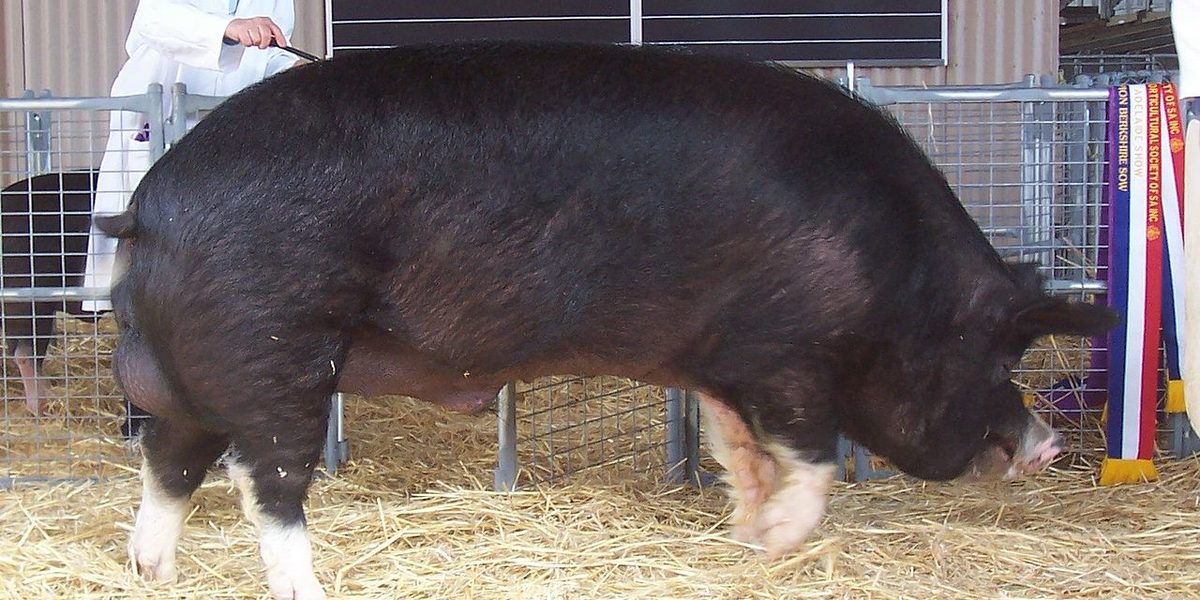
Straight talk: the Berkshire is not a mainstream breed in the Philippines. You will not find Berkshire genetics at your provincial AI center. You will not see Berkshire-sired finishers rolling through the Balintawak wet market. This is a heritage breed. In Japan it is called "Kurobuta" (literally "black pig") and sold as a premium named breed. Here it occupies a very specific niche in Philippine pig production.
That niche is growing. A handful of Visayas and Metro Manila restaurants now source heritage pork for specialty lechon and charcuterie. Farmers who can supply consistently are building direct relationships at negotiated prices. Nobody publishes a heritage pork price series in the Philippines, so the premium is whatever you and your buyer put in writing, and the cost table below tells you the floor. But Berkshire only works if you understand the economics, secure your buyers before you invest, and accept that this is a premium play rather than a volume business.
At a Glance
| Trait | Value | Notes |
|---|---|---|
| Mature Weight (Boar) | 130–160 kg | Smaller frame than Duroc or Large White |
| Mature Weight (Sow) | 120–140 kg | Compact, well-muscled build |
| Litter Size | 8–10 piglets | Moderate (not a prolific maternal breed) |
| Days to Market (85–95 kg) | 160–185 days | Slower than commercial hybrids |
| Feed Conversion Ratio | 3.0–3.4 | Higher than Duroc (2.7–3.0), lower than Native (3.5+) |
| Dressing Percentage | 72–76% | Good carcass yield for a heritage breed |
| Intramuscular Fat (IMF) | 3.5–5.5% | Comparable to Duroc, superior to all white breeds |
| Average Daily Gain | 600–750 g/day | Under Philippine conditions, with quality feed |
| Backfat Thickness | 14–20 mm | Moderate fat cover suited to lechon |
| Coat Color | Solid black with white points | White on face, feet, and tail tip (the breed's signature) |
Who Is This Breed For?
Premium lechon operators who market heritage or specialty lechon. Berkshire pork has a distinct flavor profile: darker meat, richer taste, excellent fat distribution. If you sell lechon at P600–P800/kg (retail) and your customers care about what breed is on the spit, Berkshire gives you a legitimate story and a product that backs it up.
Heritage pork marketers building a brand around provenance and quality. Restaurants in Cebu, Makati, BGC, and Davao increasingly seek named-breed pork for menu differentiation. "Kurobuta pork" on a menu signals a premium named breed to diners who know the term.
Farmers with direct-to-restaurant sales channels. This is the critical requirement. If you do not have a buyer willing to pay the premium before you invest in Berkshire genetics, do not invest. The breed cannot compete at commodity prices.
This breed is NOT for you if:
- You sell through wet market traders or viajeros at standard farmgate prices
- Your operation depends on fast turnover and volume throughput
- You do not have cold chain or direct delivery capability to end buyers
- You are looking for a drop-in replacement for Duroc or commercial hybrids
If you are still working out which breed fits your operation, my best pig breeds for Philippine small farmers guide compares all eight breeds side by side, with realistic backyard ADG and FCR numbers and the market channels each one actually fits.
Sa Bisaya
Economics: The Honest Numbers
Berkshire economics only work with a premium. Here is the math, using 2025–2026 Philippine prices.
Production Cost per Head (Weaning to Market at 90 kg)
| Cost Item | Amount (PHP) |
|---|---|
| Weanling purchase (if sourcing Berkshire piglet) | P8,000–P15,000 |
| Feed (280–340 kg total, blended rate ~P31/kg) | P8,680–P10,540 |
| Vaccines & vet care | P800–P1,200 |
| Housing depreciation (per head) | P500–P800 |
| Labor (per head share) | P800–P1,200 |
| Mortality reserve (5% of the lines above) | P940–P1,440 |
| Total production cost | P19,720–P30,180 |
That weanling cost is the killer. When you can find Berkshire piglets in the Philippines, they cost P8,000–P15,000, roughly 2–5x what a commercial weanling costs (P3,000–P4,000). If you breed your own sows, the piglet cost drops significantly, but you need to acquire foundation stock first. For the standard commercial-breed economics that this premium model has to outperform, see my 10-pig backyard profit guide.
Revenue Scenarios
| Scenario | Price/kg (live) | Revenue at 90 kg | Margin per Head |
|---|---|---|---|
| Commodity, PSA Q2 2026 national average | P172.44/kg | P15,520 | Negative P4,200–P14,660 |
| Commodity, DA August 2026 figure | P150/kg | P13,500 | Negative P6,220–P16,680 |
| Moderate premium (breed-aware buyer) | P230–P260/kg | P20,700–P23,400 | Negative P9,480 to P3,680 |
| Full heritage premium (restaurant direct) | P280–P350/kg | P25,200–P31,500 | Negative P4,980 to P11,780 |
| Lechon-grade whole pig (dressed, per head) | P14,000–P22,000/head | P14,000–P22,000 | Varies |
Each margin is the revenue range minus the full cost range: the worst case pairs the low price with a P30,180 pig, the best case pairs the high price with a P19,720 one. The message is clear: at commodity prices, you lose money on every Berkshire pig. At a moderate premium you only make money if your cost sits near the bottom of the band, which in practice means breeding your own weaners; buy a P15,000 piglet and even P260/kg leaves you short. Full heritage pricing with direct sales is the only scenario that clears on most of the cost band, and a high-cost pig can still lose about P5,000 at its bottom end.
Comparison with Native Pigs
Native pigs occupy a similar premium niche but with different economics:
| Factor | Berkshire | Native |
|---|---|---|
| Growth rate | 600–750 g/day | 200–400 g/day |
| Days to market | 160–185 | 240–365 |
| Feed cost per kg gain | P93–P106 | P63–P84 (cheaper feeds) |
| Sourcing difficulty | Very hard | Easy (every province) |
| Market story | "Kurobuta / heritage breed" | "Traditional / lechon de leche" |
| Price premium | Negotiated; no published series | Negotiated; no published series |
Native pigs are easier to source, cheaper to feed, and command equal or higher premiums in the lechon market. Berkshire's advantage is faster growth and a different brand story. "Kurobuta" appeals to the fine-dining segment that may not respond to "native pig." Both can coexist in a diversified heritage pork operation.
Feeding Program
Berkshire pigs perform best on high-energy diets that support their marbling genetics. Underfeed them and you waste the breed's defining trait. The feeding program is similar to Duroc, with slightly higher total consumption due to the longer finishing period.
Phase 1: Pre-Starter (Birth to 21 days)
| Parameter | Target |
|---|---|
| Crude Protein | 22% |
| Feed Type | Creep pellet, ad libitum from Day 7 |
| Feed Brand Example | B-MEG Pre-Starter, ~P36–P44/kg |
| Target Weight at 21 days | 5–7 kg |
| Total Feed Consumed | 2–3 kg |
| Cost per piglet | P72–P132 |
Berkshire piglets are slightly smaller at birth than Duroc or Large White, typically weighing 1.0–1.3 kg. Early creep feeding is important to get them growing.
Phase 2: Starter (21–56 days / 7–20 kg)
| Parameter | Target |
|---|---|
| Crude Protein | 20% |
| Feed per Day | Ad lib, transitioning to 0.5–0.9 kg/day |
| Feed Brand Example | B-MEG Starter, ~P33/kg |
| Total Feed Consumed | 16–25 kg |
| Cost per pig | P528–P825 |
Phase 3: Grower (56–120 days / 20–55 kg)
| Parameter | Target |
|---|---|
| Crude Protein | 16–18% |
| Feed per Day | 1.8–2.5 kg |
| Feed Brand Example | B-MEG Grower, ~P32/kg |
| Total Feed Consumed | 100–140 kg |
| Cost per pig | P3,200–P4,480 |
Berkshires deposit intramuscular fat steadily through the grower phase. Do not restrict energy intake during this period. You are building the marbling that justifies the premium price.
Phase 4: Finisher (120–185 days / 55–90 kg)
| Parameter | Target |
|---|---|
| Crude Protein | 14–16% |
| Feed per Day | 2.5–3.5 kg |
| Feed Brand Example | B-MEG Finisher, ~P30/kg |
| Total Feed Consumed | 150–185 kg |
| Cost per pig | P4,500–P5,550 |
Total Feed Cost Summary
| Phase | Feed (kg) | Cost (PHP) |
|---|---|---|
| Pre-Starter | 2–3 | P72–P132 |
| Starter | 16–25 | P528–P825 |
| Grower | 100–140 | P3,200–P4,480 |
| Finisher | 150–185 | P4,500–P5,550 |
| Total | 268–353 kg | P8,300–P10,987 |
At an FCR of 3.0–3.4, Berkshire consumes roughly 10–15% more feed per kg of gain than Duroc-sired hybrids. That difference must be recovered through the price premium. For the underlying ration math (corn, copra meal, premix), see my pig feed formulation guide, the same formula scales for Berkshire if you swap in heritage-pace ADG figures.
Health & Biosecurity
Berkshire-Specific Advantages
Berkshire has two traits that work in its favor under Philippine conditions:
-
Sun tolerance. The solid black coat with dense melanin provides excellent protection against tropical UV radiation. Berkshire handles outdoor and semi-outdoor housing far better than Landrace, Large White, or even Pietrain. For small-scale operations without fully enclosed housing, this is a meaningful advantage.
-
General hardiness. As a heritage breed, Berkshire has retained more disease resistance than intensively selected commercial lines. They tend to be calmer in temperament (less stress-related mortality during transport) and more resilient to environmental variation. This does not mean you can skip biosecurity. It means the breed is more forgiving when conditions are imperfect.
Vaccination Schedule
Follow the same vaccination protocol as commercial breeds. Berkshire pigs are susceptible to all the same diseases.
| Vaccine | Timing | Notes |
|---|---|---|
| Mycoplasma | Day 7, booster Day 28 | Prevents enzootic pneumonia |
| CSF (classical swine fever) | Day 45, booster Day 90 | Mandatory in PH |
| Circovirus (PCV2) | Day 21–28 | Standard in commercial operations |
| Parvovirus | Gilts before first breeding | Prevents mummified piglets |
| Erysipelas | Annually (boars and sows) | Heritage breeds may have slightly higher susceptibility |
| E. coli | Sows, 2 weeks pre-farrowing | Protects neonatal piglets |
African Swine Fever (ASF)
Berkshire pigs have zero resistance to ASF, and neither does any other breed. Given the high replacement cost of Berkshire stock (you cannot just buy new piglets from the local feed store), losing animals to ASF is financially devastating. The ASF zoning, AVAC vaccine status, and 1-7-10 outbreak protocol are covered in my ASF recovery-era pig farming guide. It is required reading before you invest in heritage stock. Biosecurity must be airtight:
- Zero swill feeding unless thoroughly cooked (30 minutes at rolling boil)
- Vehicle and personnel disinfection at farm entry, with no exceptions
- Quarantine all new stock for 30 days minimum
- Perimeter fencing to prevent contact with free-range and feral pigs
- Dedicated footwear and clothing for farm workers
Sourcing Berkshire Genetics in the Philippines
This is the hardest part. Sourcing purebred Berkshire genetics in the Philippines is difficult and expensive.
Current Availability
| Source Type | Availability | Notes |
|---|---|---|
| BAI-accredited multiplier farms | Very limited | A few farms have imported Berkshire bloodlines; check BAI registry |
| Private breeders (Visayas, Luzon) | Scattered | Small-scale breeders experimenting with heritage pork; network through farmer groups |
| AI doses (imported semen) | Possible but rare | Select importers may carry Berkshire semen; contact the American Berkshire Association for leads |
| Live imports | Expensive, regulatory hurdles | BAI import permits required; quarantine period; minimum viable order makes this impractical for small operators |
Practical Sourcing Strategy
-
Network first. Join heritage pig farmer groups on Facebook and attend DA-sponsored livestock expos. The heritage pork community in the Philippines is small, and word of mouth is how you find stock.
-
Consider Berkshire crosses as a starting point. A Berkshire x Native or Berkshire x Duroc cross retains much of the meat quality while being easier to source. Some Visayas breeders maintain Berkshire-cross lines specifically for the lechon market.
-
AI over live boars. If you can source Berkshire semen (even frozen doses from overseas), you can breed Berkshire-sired pigs from existing sows without the cost and biosecurity risk of importing a live boar. Frozen semen requires specialized AI equipment and training, but it is the most accessible path for most farmers.
-
Plan for a closed herd. Once you have Berkshire genetics, protect them. The replacement difficulty means losing your breeding stock is not just a financial hit. The stock may be impossible to replace quickly. Maintain at least two unrelated boar lines (or AI dose sources) to avoid inbreeding.
Sa Bisaya
Meat Quality: The Kurobuta Advantage
The reason anyone considers Berkshire despite the sourcing difficulty and premium economics comes down to one thing: meat quality.
Berkshire pork is characterized by:
- High intramuscular fat (3.5–5.5%): comparable to Duroc, significantly higher than Landrace (2.0–3.0%) or Large White (1.5–2.5%)
- Darker meat color: pH decline post-slaughter is slower, producing darker, more flavorful pork with better water-holding capacity
- Finer muscle fiber: results in more tender texture
- Distinct flavor: described as "sweeter" and "nuttier" than commercial pork; this is the trait the Kagoshima kurobuta brand is built on
For Filipino cooking, these traits translate directly:
- Lechon: Even fat distribution under the skin + intramuscular marbling = crispy skin and moist, flavorful meat. Berkshire lechon holds its quality better than commercial pork lechon, which dries out faster after roasting.
- Liempo and inihaw: Marbling keeps the meat juicy over charcoal. Less shrinkage, more flavor.
- Charcuterie and longganisa: The darker meat and higher fat content produce superior cured products, which matters for the growing artisan food scene in Metro Manila and Cebu.
Berkshire vs. Duroc for Premium Pork
| Trait | Berkshire | Duroc |
|---|---|---|
| IMF | 3.5–5.5% | 3.5–5.0% |
| Meat color | Darker, richer | Medium red-brown |
| Growth rate | 600–750 g/day | 750–900 g/day |
| FCR | 3.0–3.4 | 2.7–3.0 |
| Sourcing in PH | Very difficult | Easy (all multiplier farms) |
| Market recognition | "Kurobuta" brand potential | "Duroc" known to buyers |
| Temperament | Calm, docile | Active, occasionally aggressive |
Duroc is the practical choice for 95% of operations. Berkshire is for the 5% who have secured a buyer willing to pay for the brand and flavor difference, and who can navigate the sourcing challenge.
Common Mistakes
1. Trying to Compete at Commodity Prices
This is the most common and most expensive mistake. Berkshire pigs cost more to acquire, grow slower, and consume more feed per kg of gain than commercial hybrids. If you sell at the commodity rate alongside Duroc-sired finishers (P172.44/kg was PSA's last national average, for Q2 2026, and the DA put August 2026 at P150/kg), you lose money on every head. Berkshire is a premium breed that requires premium pricing. If you cannot command at least P250/kg live, do not raise Berkshire.
2. Not Securing a Buyer Before Investing
Do not buy Berkshire breeding stock and then look for a buyer. The market for heritage pork exists but it is small and relationship-driven. Talk to lechon operators, restaurant chefs, and specialty meat shops first. Get at least an informal commitment before you spend P50,000–P100,000 on foundation stock. A pig without a buyer is just an expensive pet.
3. Expecting Commercial-Scale Production
Berkshire is not a breed you scale to 500 sows. The genetics pool in the Philippines is too shallow, the sourcing too difficult, and the premium market too small to absorb large volumes. Think 5–20 sows producing 80–200 finishers per year for a curated set of buyers. This is artisan production, not industrial farming.
4. Neglecting the Brand Story
If you raise Berkshire and sell it as generic "black pig," you are throwing away the breed's biggest asset. Document your genetics, photograph your operation, tell the Kurobuta story. Your buyers (chefs, lechon operators, food-conscious consumers) are paying for the story as much as the product. Build a brand. Use social media. Invite buyers to the farm. The breed's heritage and rarity are marketing assets.
5. Poor Genetic Management
With a shallow gene pool in the Philippines, inbreeding is a real risk. If you start with one boar line and breed daughters back to the same sire, performance degrades within 2–3 generations: smaller litters, weaker piglets, reduced growth rates. Maintain at least two unrelated boar lines, use AI from different sources, and keep pedigree records. This is not optional for heritage breed conservation.
FAQ
Asa ko makapalit og Berkshire pig sa Pilipinas? No single reliable source exists. Your best options are networking through heritage pig farmer groups, contacting BAI for their list of accredited multiplier farms with imported bloodlines, and reaching out to specialty breeders in Central Luzon and the Visayas. Some importers may have frozen Berkshire semen available. For international leads, contact the American Berkshire Association. Expect to wait and pay a premium.
What is Kurobuta pork? Kurobuta is the Japanese name for Berkshire pork, literally meaning "black pig." In Japan, Kagoshima Prefecture's Berkshire-descended pigs are sold under the "Kurobuta" name as a regional premium (Wikipedia, Kagoshima Berkshire). I could not find a published price multiple against ordinary pork, so I will not quote one. The term is increasingly used in Philippine fine-dining menus to signal heritage, premium pork. If you raise Berkshire in the Philippines, "Kurobuta" is a powerful marketing term.
Berkshire ba o Duroc ang mas maayo para sa lechon? For pure meat quality, they are very close. Both have excellent marbling (3.5–5.5% IMF). Duroc grows faster, is far easier to source, and your buyers already know the name. Berkshire's advantages are darker meat, slightly finer texture, and the "Kurobuta" brand story. For most lechon operators, Duroc or Duroc x Native is the practical choice. For premium lechoneros who market heritage breed lechon at P700–P800/kg, Berkshire offers genuine differentiation.
Can I cross Berkshire with Native pigs? Yes, and this is a promising combination. Berkshire x Native F1 pigs combine the heritage meat quality and marbling of Berkshire with the heat tolerance, disease resistance, and low-input adaptability of Native pigs. The cross produces a lechon-sized pig (45–65 kg liveweight) with exceptional flavor. Growth is slower than pure Berkshire but faster than pure Native. This cross may be the most practical way to use Berkshire genetics in the Philippines.
How does Berkshire compare to Hampshire? Hampshire is a lean, muscular breed built on almost the opposite philosophy from Berkshire. Hampshire produces low-fat, high-lean carcasses (IMF 1.5–2.5%), while Berkshire prioritizes marbling and flavor. For the Philippine market, which values fat for lechon and inihaw, Berkshire's profile is more desirable. Hampshire suits operations targeting lean pork for processed products.
Magkano ang purebred Berkshire piglet? If you can find them, expect P8,000–P15,000 per weanling. That is roughly 2–5x the P3,000–P4,000 a commercial hybrid weanling costs. Foundation breeding stock (gilts and boars) can run P25,000–P60,000 per head depending on bloodline documentation and source. These prices reflect scarcity, not a standardized market. Negotiate based on what is available.
Is Berkshire suitable for the Philippine climate? Yes. It handles heat better than most commercial breeds. The solid black coat provides excellent UV protection (no sunburn issues like Landrace or Large White), and the breed has good heat tolerance for a European-origin pig. Berkshire handles semi-outdoor and free-range systems well, which aligns with the low-infrastructure reality of many Philippine farms. Provide shade and water access, and Berkshire will manage Philippine heat without the stress issues you see in Pietrain or heavily muscled white breeds.