The all-in cash cost to raise one pig from weaner to market weight in the Philippines runs ₱13,000 to ₱16,500 for backyard operations and ₱14,300 to ₱19,400 for commercial setups in 2026. Feed alone accounts for about 57% of that figure, per PIDS. Below is the full itemized breakdown so you can estimate costs for your specific situation.
Free Tool
Pig Profit Simulator
Plug in your weaner cost, feed prices, and farmgate price to project profit per head.
Monthly Feed Cost Per Pig (Quick Answer)
A growing pig in the Philippines costs roughly ₱1,600-₱2,850 per month in feed alone, depending on growth stage:
| Growth stage | Pig weight | Feed intake/month | Cost/month (₱35-₱38/kg) |
|---|---|---|---|
| Starter | 8-25 kg | 25-30 kg | ₱900-₱1,150 |
| Grower | 25-60 kg | 45-55 kg | ₱1,600-₱2,100 |
| Finisher | 60-100 kg | 65-75 kg | ₱2,300-₱2,850 |
Across the full 4.5-5 month grow-out, total feed cost averages ₱9,200-₱11,000 per pig (250-300 kg at ₱36.69/kg). Backyard farms that mix copra meal, rice bran, or kitchen scraps into the ration can shave 15-30% off these monthly figures without slowing growth, provided protein stays at 16-18% during the grower phase.
Master Cost Table: Weaner to Market Weight (Per Head)
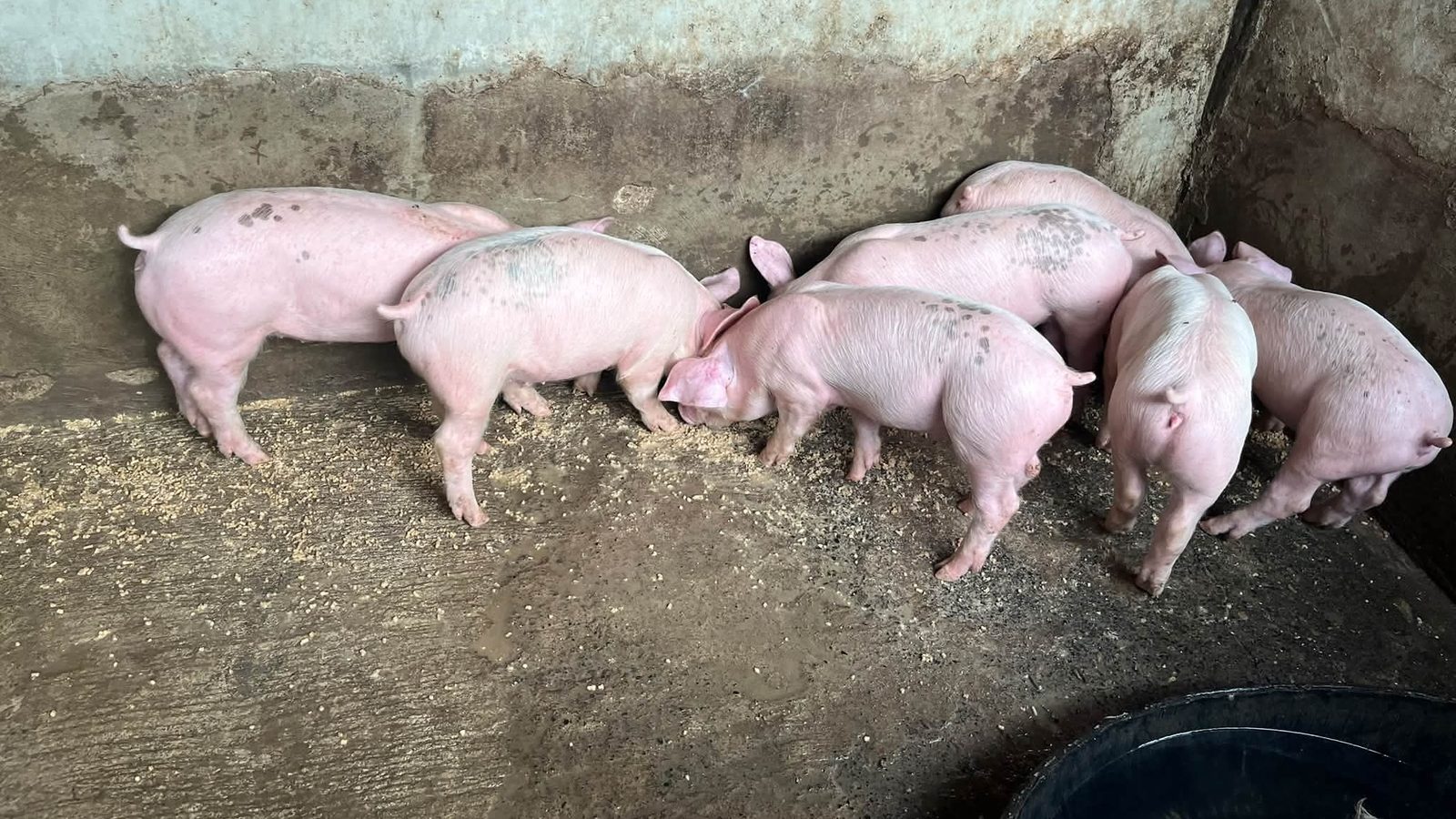
This table covers the full cycle from acquiring an 8-12 kg weaner piglet to selling a 90-100 kg market pig over approximately 4-5.5 months.
| Cost Item | Backyard Estimate | Commercial Estimate | Notes |
|---|---|---|---|
| Weaner piglet (8-12 kg) | ₱3,000 - ₱4,000 | ₱3,500 - ₱5,000 | ~₱3,500 typical for a Landrace x Large White cross; Duroc-sired runs higher. See best age to buy piglets |
| Feed, starter to finisher (8-100 kg) | ₱9,200 - ₱11,000 | ₱9,500 - ₱11,200 | Backyard: 250-300 kg @ ₱36.69/kg (12 Jul 2026 premium mean). Commercial: priced by phase at list, with pricier starter |
| Vaccines and medications | ₱300 - ₱500 | ₱300 - ₱600 | CSF (classical swine fever), deworming, vitamins |
| Housing (amortized per head) | ₱300 - ₱700 | ₱500 - ₱1,500 | Pen depreciation over 5-10 year life |
| Utilities (water, electricity) | ₱200 - ₱300 | ₱200 - ₱500 | Cooling, lighting, water system |
| Labor (amortized per head) | Family labor | ₱300 - ₱600 | Commercial: hired caretaker share |
| Total per head | ₱13,000 - ₱16,500 | ₱14,300 - ₱19,400 |
Backyard operations save on labor (family-run) and housing (simpler structures), but typically have worse FCR and higher mortality, which can offset those savings. Commercial setups spend more upfront but achieve better feed efficiency and uniformity. Honestly, most backyard farmers in the Visayas land somewhere in the middle of these ranges, around ₱13,000-₱14,000 per head. Note that the per-head numbers above are cash operating costs only. The one-time CAPEX (pen, septic, deep well, biosecurity, generator, permits) is a separate budget that most first-timers underestimate by ₱150,000 to ₱500,000. See hidden pig farm startup costs for the 12 categories most plans miss.
Feed Cost Detail by Growth Phase
Feed is the largest cost component. Here is what to expect per phase using commercial pre-mixed feeds at July 2026 prices.
| Growth Phase | Weight Range | Feed Needed | Days | Price/50 kg Sack | Sacks Needed | Cost |
|---|---|---|---|---|---|---|
| Pre-Starter | 8 - 15 kg | 10 - 14 kg | 12 - 18 | ₱2,000 - ₱2,300 | 0.2 - 0.3 | ₱400 - ₱560 |
| Starter | 15 - 25 kg | 20 - 28 kg | 18 - 25 | ₱1,900 - ₱2,200 | 0.4 - 0.6 | ₱760 - ₱1,230 |
| Grower | 25 - 60 kg | 90 - 108 kg | 40 - 55 | ₱1,750 - ₱1,910 | 1.8 - 2.2 | ₱3,150 - ₱4,200 |
| Finisher | 60 - 100 kg | 130 - 150 kg | 45 - 55 | ₱1,750 - ₱1,900 | 2.6 - 3.0 | ₱4,550 - ₱5,700 |
| Total | 250 - 300 kg | 115 - 153 | 5.0 - 6.1 | ₱8,900 - ₱11,700 |
Priced phase by phase at bag list prices the cycle lands at ₱8,900-₱11,700, a little wider than the ₱9,200-₱11,000 headline because starter bags cost more per kilo and the phase ranges do not all hit their ends together. The headline band, 250-300 kg at the ₱36.69/kg July 2026 premium mean, is the one this site uses everywhere. A re-check on 17 October 2026 found the Suregrow grower and finisher bags unchanged at the same retailer.
Major commercial feed brands in the Philippines include B-MEG (San Miguel), Thunderbird, Vitarich, Sarimanok, Pilmico (Aboitiz), and Cargill. Premium grower runs ₱1,750-₱1,910 per 50 kg sack as of 12 July 2026, or ₱34.90-₱38.20/kg, with finisher at the low end of that band. Prices vary by 10-15% across regions. Feed in Mindanao (Davao, Bukidnon) tends to run ₱50-100/sack cheaper than in Metro Manila or Cebu because of proximity to corn and copra sources. Buying in bulk (by the pallet) typically saves another ₱50-100 per sack on top of that.
If you are in a corn-producing area like Bukidnon or Isabela, mixing your own grower/finisher ration with local corn and copra meal can cut feed costs by 20-30%. See cheapest way to feed pigs and alternative feeding systems for formulas.
For a more detailed analysis of feed economics and locally mixed rations, see The Real Cost of Pig Feed in the Philippines.
Vaccines and Medication Checklist
A basic health program for grow-out pigs in Philippine conditions:
| Item | When | Cost per Head | Notes |
|---|---|---|---|
| Classical swine fever vaccine | Day 1 and booster at 45 days | ₱40 - ₱80 | Required. Often labeled "CSF" or "swine fever" on the vial |
| Iron dextran injection | Day 3 (if from own sow) | ₱15 - ₱25 | Prevents piglet anemia. Not needed if buying weaners already treated |
| Deworming (ivermectin/fenbendazole) | Day 30 and Day 75 | ₱30 - ₱60 | Two rounds minimum for grow-out |
| Vitamins (B-complex, ADE) | Monthly or as needed | ₱40 - ₱80 | Stress periods, post-vaccination |
| Antibiotic reserve | As needed | ₱50 - ₱200 | Respiratory or enteric disease. Consult vet |
| Wound spray / antiseptic | As needed | ₱20 - ₱40 | Tail biting, pen injuries |
| Total health program | ₱195 - ₱485 |
Vaccinate before or on the day of arrival. Stressed weaners that skip vaccination are the highest-risk group for classical swine fever outbreaks. One outbreak in a 10-head batch can wipe your entire ₱150,000 investment in days.
See how to inject pigs for proper technique.
Breakeven Calculation
Once you know your total cost per head, calculating breakeven is straightforward:
Breakeven ₱/kg = Total Cost / Target Market Weight
| Scenario | Total Cost | Target Weight | Breakeven ₱/kg | Profit/head @ ₱172.44 (PSA Q2 2026) | Profit/head @ ₱150 (DA, Aug 2026) |
|---|---|---|---|---|---|
| Backyard (low cost, mixed feed) | ₱11,900 | 95 kg | ₱125 | ₱4,482 | ₱2,350 |
| Backyard (average) | ₱14,000 | 95 kg | ₱147 | ₱2,382 | ₱250 |
| Commercial (average) | ₱16,500 | 100 kg | ₱165 | ₱744 | -₱1,500 (loss) |
| Commercial (high cost) | ₱19,400 | 100 kg | ₱194 | -₱2,156 (loss) | -₱4,400 (loss) |
Two profit columns, because there are two prices and averaging them is not honest. ₱172.44 is PSA's official Q2 2026 national average, still the latest PSA has published (July-September are due 6 November 2026). ₱150 is what the DA said the national liveweight price was in August 2026. The gap is ₱22.44/kg, or about ₱2,100-₱2,200 a head.
That ₱194/kg breakeven on the high-cost commercial row is the one to stare at, because it sits above both. At the official price that farm loses ₱2,156 a head; at the DA's August figure it loses ₱4,400. Even the average commercial farm is losing money at ₱150. The low-cost backyard farm at ₱125/kg breakeven is still clearing something. That spread, not the average, is what decides who is still raising pigs after a price shock.
At ₱150/kg, a backyard operation with good management and some local-feed mixing clears roughly ₱250-₱2,350 per head; at ₱172.44 it was ₱2,400-₱4,500. Pure commercial-feed setups are under water at either price. Producer groups put the national cost of production at ₱180-₱190/kg as of October 2026, so the average farm in this country is selling well below its own cost, by ₱30-₱40/kg at the DA's figure. Family labor and a paid-off pen are what keep a backyard raiser on the right side of that line. Barely. The key variable is feed cost. A ₱2/kg rise in feed price adds roughly ₱500-₱600 to total cost per head. If feed price volatility is what worries you most, contract growing with an integrator shifts that risk to Monterey, CPF, or a co-op in exchange for a fixed grower fee of ₱400-₱950 per head.
Farmgate prices move fast, and they are lower than most guides admit. PSA had liveweight at ₱191.51/kg in Q3 2025, ₱182.83 in Q4 2025, ₱176.03 for Q1 2026 and ₱172.44 for Q2 2026 (Apr ₱174.00, May ₱171.56, Jun ₱171.76), the latest it has published. After June the price collapsed: the DA put the national figure at ₱150/kg in August 2026, and industry data had Luzon at ₱153.72 and the Visayas and Mindanao at ₱131.66. The ₱210/kg target agreed on 4 Nov 2025 is industry-agreed and DA-backed but not enforceable, and no month of the national series has reached it since it was set; a few regions have in a few months (the Cordillera, BARMM, Central Visayas, Metro Manila). It is not a floor you will be paid, so do not build a budget on it. The regional order is not what people assume either: in June 2026, the newest regional month published, the top prices were Cordillera at ₱224.10 and Central Visayas at ₱208.73, while Central Luzon sat sixth at ₱181.05, Negros at ₱166.29, and SOCCSKSARGEN last at ₱141.98. There is no dependable Luzon premium. Check your own province before you trust any national average. Today's figures sit on the state of the industry dashboard, and the monthly series behind them is downloadable as household farmgate; for the regional read see the liveweight price by region guide; for breed-specific numbers see crossbreed pig prices.
For more on breakeven analysis, see Pig Farming Breakeven Calculator.
Free Tool
Break-Even Price Calculator
Plug in your total cost and target market weight to get your exact breakeven price per kg, the price below which you actually lose money on a sale.
10-Head Batch Example
Here is what a small backyard operator raising 10 pigs per batch might expect:
| Item | Per Head | 10-Head Batch |
|---|---|---|
| Weaners | ₱3,500 | ₱35,000 |
| Feed (all phases) | ₱9,200 | ₱92,000 |
| Vaccines/meds | ₱350 | ₱3,500 |
| Housing (amortized) | ₱500 | ₱5,000 |
| Utilities | ₱200 | ₱2,000 |
| Total investment | ₱13,750 | ₱137,500 |
| Revenue (95 kg @ ₱172.44/kg, PSA Q2 2026) | ₱16,382 | ₱163,818 |
| Gross profit | ₱2,632 | ₱26,318 |
| Mortality adjustment (5%) | -₱8,191 (0.5 head lost) | |
| Net profit (after mortality) | ₱18,127 | |
| Revenue (95 kg @ ₱150/kg, DA August 2026) | ₱14,250 | ₱142,500 |
| Gross profit | ₱500 | ₱5,000 |
| Mortality adjustment (5%) | -₱7,125 (0.5 head lost) | |
| Net result (after mortality) | -₱2,125 (loss) |
This is priced twice, and neither price is the ₱210 target. At ₱172.44/kg, PSA's latest official quarter, the batch makes roughly ₱18,100 on ₱137,500 over about 5 months, a 13% per-cycle return. At ₱150/kg, the DA's national figure for August 2026, the same batch loses about ₱2,100 once the half-pig mortality is counted. That is where the market has been since mid-2026, so the honest headline for a new batch today is a small loss, not a small profit. Note also that even the ₱172.44 version only works because the cost per head is ₱13,750, or ₱145/kg, with no family labour costed. The national cost of production is ₱180-₱190/kg. Run your costs up to that and a ₱150 sale loses ₱3,000-₱4,000 a head. For the full profit picture, scenario by scenario, with risk, financing, and the upside cases, pig farming profit for 10 pigs is the dedicated breakdown; this article stays focused on the cost side. For absentee-owner line items see the real cost of a pig farm for OFW investors, and for CAPEX recovery time see pig farm payback period.
The catch: you need close to ₱140,000 upfront for a 10-head batch, and revenue arrives only at the end. That's about 5 months of spending before you see a single peso back. One disease outbreak can wipe the batch. If you cannot afford to lose the entire investment, start with 3-5 heads first.
Most first-time farmers I talk to underestimate this cash flow gap.
Magkano Puhunan? Capital Needed by Scale
The cost-per-head figures assume the pen and water system already exist. If you're starting from zero, the upfront capital is a separate, bigger number, and it's the one most "magkano puhunan sa baboyan" searches actually want.
| Scale | Operating cost/batch | One-time setup (pen, water, biosecurity) | Realistic total to start |
|---|---|---|---|
| 3 heads (test batch) | ₱40,000-₱48,000 | ₱15,000-₱40,000 | ₱55,000-₱88,000 |
| 5 heads | ₱65,000-₱80,000 | ₱25,000-₱60,000 | ₱90,000-₱140,000 |
| 10 heads | ₱130,000-₱160,000 | ₱50,000-₱120,000 | ₱180,000-₱280,000 |
| 20 heads | ₱260,000-₱320,000 | ₱120,000-₱250,000 | ₱380,000-₱570,000 |
The setup range is wide on purpose: a bamboo-and-GI-sheet backyard pen is a fraction of a concrete pen with a deep well and proper septic. The full tier-by-tier breakdown is in magkano puhunan sa baboyan: capital tiers, and the line items first-timers forget are in hidden pig farm startup costs. No capital? DA SAAD's free piglet program and DSWD SLP seed capital are the two routes backyard raisers actually use.
Cost by Target Sell Weight (80 vs 90 vs 100 kg)
Feeding a pig past 90 kg gets more expensive per kilo, because FCR worsens as the pig matures. Whether the extra weight pays depends on farmgate price the day you sell.
| Sell weight | Total cost/head | Cost/kg | Revenue @ ₱150/kg (DA, Aug 2026) | Profit/head |
|---|---|---|---|---|
| 80 kg | ₱11,800-₱13,400 | ₱148-₱168 | ₱12,000 | -₱1,400 to ₱200 |
| 90 kg | ₱13,000-₱14,800 | ₱144-₱164 | ₱13,500 | -₱1,300 to ₱500 |
| 100 kg | ₱14,400-₱16,400 | ₱144-₱164 | ₱15,000 | -₱1,400 to ₱600 |
At ₱150 every weight band sits around break-even before labour, and the extra kilos barely change the answer, because the cost per kilo of the last 10 kg is about what the buyer pays for it. In a normal market the sweet spot for most backyard crosses is 90-100 kg. Below 80 kg you haven't spread the fixed weaner cost over enough kilos; past 105-110 kg the feed-per-kilo cost climbs faster than the extra revenue unless you have a lechon buyer paying a premium for a bigger pig.
How Sensitive Is This to Feed Price?
Feed is about 57% of pig operating cost (PIDS), so a feed price swing moves your whole budget. Feed has climbed ₱1-₱2/kg through 2026 and no miller has announced a rollback. Corn is 50-65% of the formulation and the proposed corn tariff cut is still pending at the Tariff Commission, so do not budget for feed getting cheaper.
| Feed price | Feed cost/head (275 kg) | All-in cost/head | Breakeven @ 95 kg |
|---|---|---|---|
| ₱32/kg (good self-mix blend) | ₱8,800 | ₱12,500 | ₱132/kg |
| ₱37/kg (typical commercial, mid-2026) | ₱10,175 | ₱13,875 | ₱146/kg |
| ₱40/kg (premium plus island freight) | ₱11,000 | ₱14,700 | ₱155/kg |
An ₱8/kg difference in feed price is roughly ₱2,200 per head, or ₱22,000 across a 10-head batch. That is why farmers in corn-and-copra areas who self-mix have a structural edge, and why the feed economics deep-dive is worth a full read before you scale.
Run Your Own Numbers
Every operation is different. Feed prices, weaner source, mortality rate, and local market price determine actual profit. These tools allow modeling for specific conditions:
- Profit Simulator: input costs and see projected profit per head and per batch
- Feed Calculator: estimate feed consumption and cost by growth phase
- Break-even Calculator: the minimum farmgate price that covers your costs
- FCR Calculator: track your actual feed conversion, the lever that moves cost most
Sources: PSA farmgate price of pigs for slaughter (₱191.51/kg liveweight Q3 2025, ₱182.83 Q4 2025, ₱176.03 Q1 2026, ₱172.44 Q2 2026, the latest published), DA national liveweight ₱150/kg for August 2026 (The Manila Times, 28 Sep 2026), industry data on the August split, Luzon ₱153.72 and Visayas+Mindanao ₱131.66 (BusinessMirror, 8 Sep 2026), cost of production ₱180-₱190/kg (Daily Tribune, 2 Oct 2026; BusinessMirror, 9 Oct 2026), ₱210/kg floor, Nov 2025 (PNA), non-enforceable (Philstar, 21 Sep 2026) and never met by the national average since it was set. Feed share of operating cost from PIDS. July 2026 feed pricing cross-checked against B-MEG, Vitarich, and Sarimanok distributor lists. Farmgate figures verified 16 October 2026.
Bisaya / Cebuano
Pila gyud ang gasto sa pagpadako og usa ka baboy?
Kung commercial cross (LW x Landrace), 100% commercial feed:
| Gasto | Kantidad |
|---|---|
| Weaner (8-12 kg) | ₱3,000-₱4,000 |
| Feeds (starter + grower + finisher) | ₱9,200-₱11,000 |
| Bakuna + dewormer | ₱300-₱500 |
| Tubig, kuryente, quicklime | ₱200-₱300 |
| Tangkal (amortized) | ₱300-₱700 |
| Total | ₱13,000-₱16,500 |
Kung mixed feeding (commercial concentrate + darak + copra meal): Mahimo ka makatipig og ₱2,000-₱3,000 matag ulo sa feeds. Ang total mogamay ngadto sa mga ₱10,000-₱14,500. Pero kinahanglan ka mahibalo sa tamang ratio, dili basta-basta lang isagol.
Pila ang ganansya? Kung ibaligya sa 95 kg ug ang opisyal nga farmgate ₱172.44/kg (PSA, Q2 2026, ang pinakabag-o, dili ₱210), ang revenue ₱16,382. Kung ang gasto ₱13,750, ang ganansya mga ₱2,632 matag ulo. Sa 10 ka baboy, mga ₱18,100 sa usa ka batch (mga 5 ka bulan), human na ang mortality. Pero sumala sa DA, ₱150/kg na lang ang nasudnon nga presyo niadtong Agosto 2026. Sa ₱150, ₱14,250 ra ang revenue, ₱500 ra ang ganansya matag ulo, ug kung ihapon ang mortality, lugi og mga ₱2,100 ang 10 ka baboy. Hinumdumi, ang gasto sa pag-alima sa nasod ₱180 hangtod ₱190 kada kilo. Kung mosaka ang imong gasto ngadto ana, lugi ka og ₱3,000 hangtod ₱4,000 matag ulo.
Ang pinaka-common nga sayop: dili pag-track sa tinuod nga gasto. Daghan og mag-uuma moingon "mga ₱12,000 siguro ang gasto" pero wala sila kabalo kung ₱12,000 ba o ₱16,000. Ang kalainan niini ₱4,000 matag ulo, o ₱40,000 sa 10 ka baboy. Mao na ang kalainan sa profitable ug break-even.
Buhata kini: Pagkahuman sa imong sunod batch, ilista ang TANAN nga gasto. Matag sako sa feeds, matag bakuna, matag bayad sa kuryente. Pagkahuman, i-divide sa gidaghanon sa baboy nga nabaligya. Mao na ang imong tinuod nga cost per head. Gamita ang Profit Simulator aron makita ang posible nga kita sa imong sunod nga batch.
Related reading:
- Pig Feed Consumption Chart by Weight: daily intake and total feed per phase
- The Real Cost of Pig Feed: detailed feed economics with brand comparison
- Cheapest Way to Feed Pigs: budget feeding strategies
- Best Age to Buy Piglets for Fattening: weaner selection guide
- Sow vs Fattener: which earns more?: 30x profit differential math at scale
- OWWA EDLP loan for OFW piggery: ₱100k to ₱2M financing at 7.5%
- Production Cycle Framework: production cycle management
- Crossbreed Pig Price Philippines: current farmgate prices by breed and region
- Maggot wound and flystrike treatment: how a ₱2,000 wound becomes a ₱15,000 carcass if ignored
For the full set of money and profitability articles, see the Money & Profitability topic cluster.
Sources: PSA Farmgate Price of Pigs for Slaughter (₱191.51/kg Q3 2025; ₱176.03/kg Q1 2026; ₱172.44/kg Q2 2026), DA national liveweight ₱150/kg for August 2026 (The Manila Times, 28 Sep 2026), ₱210/kg floor agreed Nov 2025 (PNA), a target the PSA national series has never reached since it was set, DA-BAI Good Animal Husbandry Practices (GAHP) for Swine, PIDS Discussion Paper 2022-20 on feed cost and hog competitiveness, DA INSPIRE program. Feed pricing cross-checked against B-MEG, Vitarich, and Sarimanok distributor lists, 12 July 2026. Figures represent typical ranges and vary by location and management level.