This chart shows daily feed intake, total feed consumed, and estimated sack cost from an 8 kg weaner to 100 kg market weight for commercial crossbreed pigs raised in Philippine conditions. Use it as a baseline for planning feed purchases and budgeting.
Free Tool
Feed Cost Calculator
Punch in your herd size and feed prices for a phase-by-phase cost estimate.
Master Feed Consumption Table
Based on commercial crossbreed pigs (Landrace x Large White, Duroc crosses, or commercial hybrids) under standard Philippine management. Native pigs will consume less per day but take longer to reach market weight.
| Weight Range | Stage | Daily Intake | Days in Phase | Total Feed | Sacks (50 kg) | Cost @ ₱1,835/sack (₱36.70/kg) |
|---|---|---|---|---|---|---|
| 8 - 15 kg | Pre-Starter | 0.3 - 0.5 kg | 15 - 20 | 6 - 9 kg | 0.2 | ₱220 - ₱330 |
| 15 - 25 kg | Starter | 0.6 - 1.0 kg | 20 - 25 | 14 - 22 kg | 0.4 | ₱510 - ₱810 |
| 25 - 40 kg | Grower I | 1.2 - 1.6 kg | 20 - 25 | 28 - 36 kg | 0.6 | ₱1,030 - ₱1,320 |
| 40 - 60 kg | Grower II | 1.8 - 2.2 kg | 25 - 30 | 48 - 60 kg | 1.1 | ₱1,760 - ₱2,200 |
| 60 - 80 kg | Finisher I | 2.4 - 2.8 kg | 22 - 28 | 56 - 72 kg | 1.3 | ₱2,060 - ₱2,640 |
| 80 - 100 kg | Finisher II | 2.8 - 3.2 kg | 22 - 28 | 64 - 82 kg | 1.5 | ₱2,350 - ₱3,010 |
| TOTAL | 124 - 156 days | 216 - 281 kg | 5.1 - 5.6 | ₱7,900 - ₱10,300 |
The total growing period of 124-156 days (about 4-5 months) assumes no major health setbacks. Sick pigs or bad feed will stretch the timeline and worsen feed conversion. And every extra week costs you another sack or two.
Two things to be honest about here. First, the 216-281 kg total is the well-managed figure. Real backyard farms in Visayas and Mindanao, running FCR 3.0-3.5 instead of the controlled 2.5, land closer to 250-300 kg per pig, which is the number used across the full cost-to-raise breakdown. Plan your sack budget on 250-300 kg unless you have measured your own FCR and know it is better. Second, prices. The ₱1,835/sack (₱36.70/kg) in the table is the midpoint of what premium grower-finisher (B-MEG, VIEPro, Suregrow) actually costs: ₱1,747-₱1,910 per 50 kg bag, or ₱34.90-₱38.20/kg, checked 12 July 2026. Budget value lines run ₱1,400-₱1,700. Feed has crept up ₱1-2/kg through 2026 and no miller has announced a rollback, so treat the top of that range as the safer planning number. Verify your local sack price before you plan.
These numbers are for well-managed commercial crossbreeds with consistent feeding. Most backyard operations in Visayas and Mindanao run 15-30% above these intake figures due to feed wastage, inconsistent schedules, and mixed genetics. Industry data shows 5-15% of feed is wasted at the feeder on typical farms. If your pigs eat significantly more than this chart says, the problem is usually the feeder, not the pig.
Feed Conversion Ratio (FCR) by Breed
FCR measures how many kilograms of feed are needed to produce one kilogram of liveweight gain. Lower is better. It means more efficient conversion of feed into meat. pig333 provides detailed FCR benchmarks across different production systems worldwide.
| Breed / Type | Overall FCR | Starter FCR | Grower FCR | Finisher FCR | Notes |
|---|---|---|---|---|---|
| Native (Bisaya, etc.) | 4.0 - 5.5 | 2.5 - 3.0 | 3.5 - 4.5 | 5.0 - 7.0 | Slow growth, high finisher FCR |
| Landrace x Large White | 2.5 - 3.2 | 1.4 - 1.8 | 2.3 - 2.8 | 3.2 - 3.8 | Standard commercial cross |
| Duroc Cross | 2.3 - 3.0 | 1.3 - 1.7 | 2.2 - 2.7 | 3.0 - 3.6 | Better meat quality, good efficiency |
| Commercial Hybrid | 2.2 - 2.8 | 1.2 - 1.6 | 2.0 - 2.5 | 2.8 - 3.4 | Best FCR, requires good management |
The PH Hog Industry Roadmap 2022-2026 targets a national average FCR of 2.27 by 2026, down from a 3.19 baseline in 2020. Most backyard operations currently run 3.2-4.0 due to feed wastage, inconsistent feeding schedules, and mixed genetics.
Every 0.1 improvement in FCR across the full cycle saves ₱300-₱500 per head. That adds up fast on a 50-head batch. Native pigs sit in their own category here, covered in detail further down.
Cost Comparison at Different Feed Prices
The same 250 kg of feed at three July 2026 price points. The ₱32/kg column is budget value-line feed (Thunderbird, economy lines common in Visayas and Mindanao). The other two columns bracket premium grower-finisher (B-MEG, VIEPro, Suregrow), which sat at ₱34.90-₱38.20/kg on 12 July 2026: ₱36.70/kg is the middle of that band, ₱38.20/kg the top, which is roughly what you pay in Metro Manila and Luzon once logistics add ₱50-150 per sack. Self-mixing with local corn and copra meal in Bukidnon or Leyte lands around ₱24/kg, well below any commercial column. See pig feed formulation for actual mixing costs.
Nobody publishes a national finished-feed price in this country, which is why the ₱36.70/kg midpoint above is a dated retailer listing rather than a survey. This site keeps it as one series with the retrieval date on the row and label it for exactly what it is. The self-mix column is checkable against official figures, though: BAI prints wholesale yellow corn and copra meal every week, unbroken since January 2023, and between them they are most of what a Bukidnon or Leyte home mix costs.
| Phase | Total Feed (avg) | @ ₱1,600/sack (₱32/kg) | @ ₱1,835/sack (₱36.70/kg) | @ ₱1,910/sack (₱38.20/kg) |
|---|---|---|---|---|
| Pre-Starter + Starter | 30 kg | ₱960 | ₱1,100 | ₱1,150 |
| Grower I + II | 82 kg | ₱2,624 | ₱3,010 | ₱3,130 |
| Finisher I + II | 138 kg | ₱4,416 | ₱5,060 | ₱5,270 |
| Total (250 kg avg) | ₱8,000 | ₱9,170 | ₱9,550 |
A ₱200/sack difference in feed price adds up to roughly ₱1,000 per head. But don't just chase the cheapest sack. A cheaper feed with worse FCR can cost more in the end. Tried and tested na yan, track your actual gains before switching brands.
For a detailed comparison of commercial feeds vs locally mixed rations, see The Real Cost of Pig Feed in the Philippines.
Where Backyard Farms Actually Lose Feed
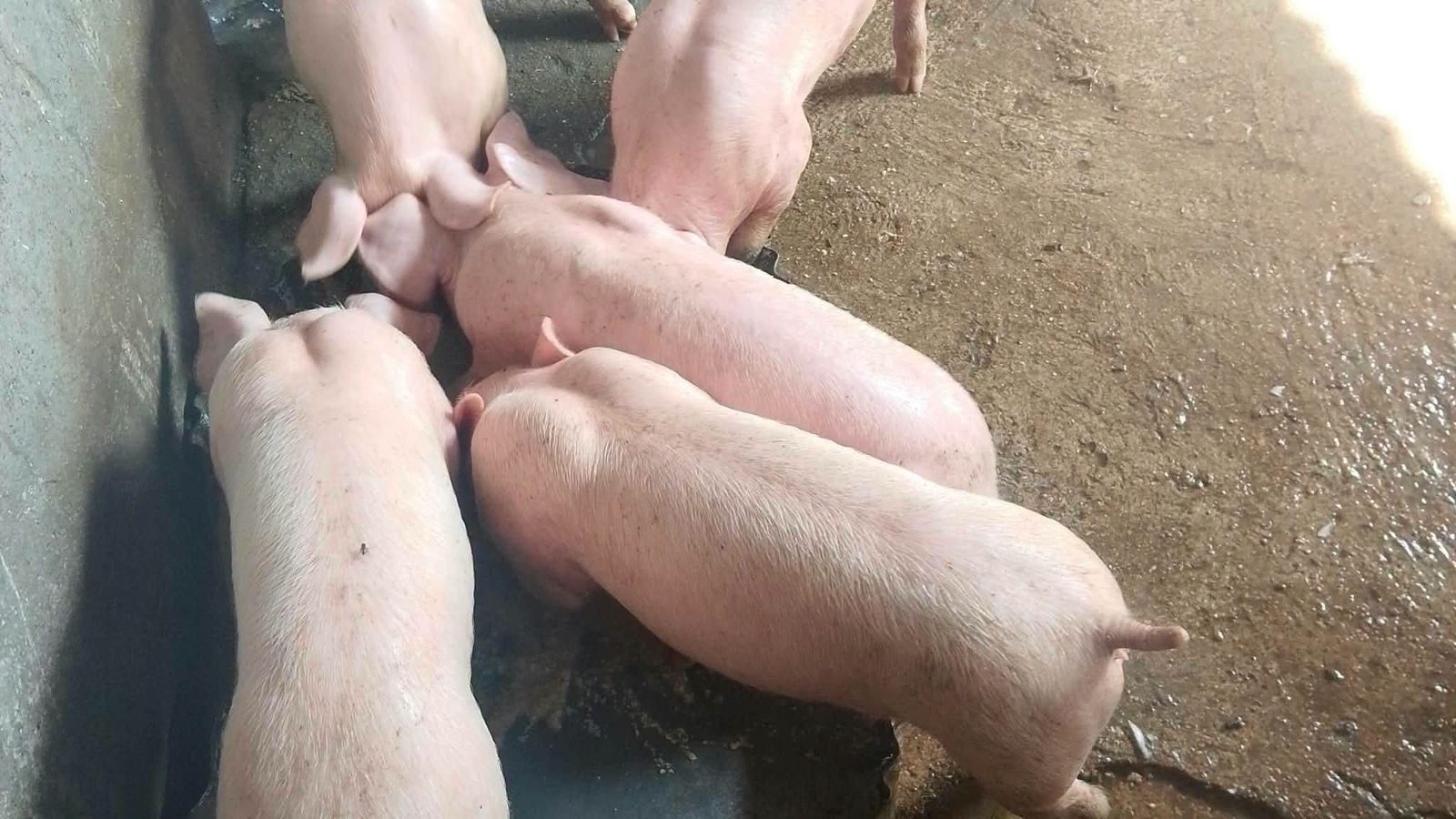
The chart numbers assume well-managed conditions. Real backyard operations often run 15-30% above expected intake, and the cause is rarely the pig. It is the feeding setup. Here is where the loss happens, ranked by how often it shows up in Cebu and Bohol farms:
| Loss Source | Typical Wastage | Fix Cost | Payback |
|---|---|---|---|
| Open trough feeders (pigs root feed onto floor) | 8-15% | ₱800-1,500 wet-and-dry feeder | 1 batch |
| Rats in feed storage | 3-8% (plus contamination) | ₱600-1,200 sealed metal drum | 1 batch |
| Eyeballing portions instead of measuring | 10-20% over-portion | ₱200 platform scale or coffee can | Immediate |
| Leftover feed left in trough overnight | 5-10% (spoils, pigs refuse) | ₱0, just clean trough daily | Immediate |
| Wet feed exposed to rain | 5-15% | ₱500-2,000 trough roof or shelter | 1-2 batches |
| Mixing the wrong ratio of starter to grower during transition | 3-5% (intake drops) | ₱0, follow 50/50 blend rule | Immediate |
The total potential here is striking. A backyard farm running all six issues at the high end is wasting roughly 40% of feed cost. On a ₱8,000-per-pig feed bill, that is ₱3,200 thrown away per head. Fixing two of the top three issues usually cuts the loss to under 10% within one batch.
Water-to-Feed Ratio: The Hidden Multiplier
Pigs need 2-3 liters of water per kilogram of dry feed consumed. Restricted water cuts feed intake within hours, and a pig that under-eats for two weeks loses growth that never fully comes back. Here is the daily water target by stage:
| Stage | Daily Feed | Daily Water Need | Common Failure |
|---|---|---|---|
| Pre-Starter (8-15 kg) | 0.3-0.5 kg | 1-2 L | Drinker height too high for piglets |
| Starter (15-25 kg) | 0.6-1.0 kg | 2-3 L | Single drinker for pen of 8+ |
| Grower I-II (25-60 kg) | 1.2-2.2 kg | 4-7 L | Algae buildup in nipple drinkers |
| Finisher I-II (60-100 kg) | 2.4-3.2 kg | 7-12 L | Drinker flow rate dropping below 1.5 L/min |
For the full daily water target by stage and the drinker setups that prevent intake crashes, see how much water pigs need per day.
Native Pig Reality Check
The master table above is for commercial crosses. On feed, native pigs are a completely different animal. Philippine native breeds (Bisaya, Berkjala, Sinirangan) typically grow at 4-5 kg per month under backyard conditions, roughly half the rate of commercial crosses. A native pig reaching 40-50 kg market weight at 8-10 months might eat 0.8-1.5 kg/day, but with an FCR of 4.0-5.5, that adds up.
The tradeoff: native pigs thrive on cheaper ingredients. Most native pig farmers in Leyte and Bohol feed primarily rice bran, copra meal, camote tops, and kitchen scraps with minimal commercial feed. Total feed cost to market might be ₱3,000-₱6,000 per head, but the pig sells at 40-50 kg, not 100 kg. Per kilo of gain, natives are less efficient. Per head invested, they can still be profitable because of the lechon premium and lower input cost.
A Simple Weekly Tracking Template
The single biggest reason backyard farms cannot tell whether they are profitable is no records. You do not need software. A notebook or a spreadsheet column works. Track these five numbers per pen per week:
- Date and pig age in weeks
- Average pig weight (random sample of 3 pigs, weighed)
- Total feed delivered to pen this week (sum of sacks, partial sacks counted by kg)
- Cost of that feed (sacks × current price)
- Notes (any sick pig, hot week, drinker repair, etc.)
After two weeks, you can calculate weekly gain and cost per kilo of gain. After a full batch you have hard FCR data. From there you can compare phases, compare brands, compare pen designs. Without it, you are guessing.
Feeding Tips for Philippine Conditions
Weigh the feed you deliver to each pen and compare it to the chart. If your pigs are consuming 20% or more above these figures, the cause is usually feeder design, water problems (a dehydrated pig under-eats then binges), or a health issue dragging down feed efficiency. Farmers can end up spending ₱2,000-3,000 more per pig than they should, and almost every time the culprit is a trough feeder letting pigs root half the feed onto the ground.
Feed twice daily at consistent times. Most Philippine commercial operations feed at 6-7 AM and 4-5 PM, and pigs on a steady schedule eat better and stress less. Avoid the hottest hours, 11 AM to 2 PM, especially in summer, since heat-stressed pigs eat less anyway. ThePigSite's heat-stress article calls eating less the pig's primary response to heat, and advises putting the ration out in the coolest periods: early morning, late afternoon or night. That is why the bigger meal belongs in the evening during the March-May heat. The same article recommends supplemental fat in the ration, because fat adds calories while producing less body heat during digestion.
When you move a pig between growth phases, mix the old and new feed 50/50 for 3-5 days. An abrupt switch causes digestive upset and a temporary intake drop you will see in the next weigh-in.
One last thing, and honestly the most overlooked: water. Pigs need 2-3 liters per kilogram of feed eaten. Restricted water is the single most common hidden cause of poor intake and bad FCR in backyard pens. Check your nipple drinkers weekly for algae, low flow, and the wrong height.
Bisaya / Cebuano
Ang feeds mao ang pinakadako nga gasto, mga 57% sa tanan nga gasto sa pag-alima (PIDS). Kinahanglan nimong mahibaw-an kung pila ang gikaon sa imong baboy matag adlaw aron dili ka masayop sa budget.
Sumada gikan 8 kg hangtod 100 kg:
Mga 216-281 ka kilo nga feeds (5-6 ka sako), mga ₱7,900-₱10,300 matag baboy sa presyo sa Hulyo 2026. Kung nag-FCR 2.5 ka, mas barato. Kung nag-FCR 3.5 ka, mas mahal og PHP 3,000+ matag baboy.
Kung sobra ang pagkaon sa imong baboy sa chart, tan-awa kini:
- Open trough feeder ba? Mausik 8-15% sa feeds kung naa-rooting sa salog. Ilisi og wet-and-dry feeder (PHP 800-1,500), bayaran ra sa usa ka batch.
- Naay ilaga sa bodega? Sealed nga drum (PHP 600-1,200), bayaran ra sa usa ka batch.
- Sukod sa portion ba o sa pakigbati lang? Coffee can o platform scale, daginot 10-20%.
- Naa pa ba feeds sa trough sa buntag? Limpyohi matag adlaw, dili magpabilin og daan.
Tubig importante kaayo:
Matag kilo nga feeds, kinahanglan og 2-3 ka litro sa tubig. Kung kulang ang tubig, magkulang og kaon, ug dili maayo og pagtubo. Tan-awa ang nipple drinker matag semana, kung naay algae o naharangan.
Record dapat:
Matag semana, sulati: petsa, average weight sa baboy (timbanga 3 ka baboy), kantidad sa feeds nga gigamit, ug gasto. Sa katapusan sa batch, mahibaw-an nimo ang tinuod nga FCR ug profit. Kung wala kay record, dili nimo masulti kung nalugi ka.
Frequently Asked Questions
How much feed does a pig eat from weaner to market weight?
A well-managed commercial cross eats about 216-281 kg from an 8 kg weaner to 100 kg (5-6 sacks). Typical backyard farms at FCR 3.0-3.5 land closer to 250-300 kg. Budget on 250-300 kg unless you have measured your own FCR.
How much does it cost to feed one pig to market in 2026?
Roughly ₱8,000-₱11,000 per head, and your FCR moves that more than your brand does. Premium grower-finisher was ₱34.90-₱38.20/kg on 12 July 2026, so 250 kg of it costs about ₱9,200 and 300 kg about ₱11,000. Budget feed (~₱32/kg) is about ₱8,000 for 250 kg. Self-mix at ~₱24/kg sits well below either.
How many sacks of feed does one pig need?
About 5-6 sacks of 50 kg for a well-managed commercial cross. With wastage and higher FCR, backyard farms often need 6-7. The finisher phase alone is roughly 2.5-3 sacks.
Why is my pig eating more than the chart says?
Usually the setup, not the pig: open trough feeders (8-15% rooted onto the floor), rats in storage, eyeballed portions, and spoiled leftover feed. Stack several and you can waste close to 40% of the feed bill.
Tools and Related Reading
- Feed Calculator (input herd size, current weights, and feed prices to get a cost estimate)
- FCR Calculator (measure your feed conversion ratio and see how it affects cost per kg of gain)
- Profit Simulator (project total cost, revenue, and profit per head)
- How Much Does It Cost to Raise a Pig? (full cost breakdown including non-feed expenses)
- The Real Cost of Pig Feed (brand comparison and FCR-to-peso math)
- Best Feed Mix for Backyard Pigs (practical mixing for small operations)
- Pig Farming Breakeven Calculator (minimum selling price analysis)
Sources
- PH Hog Industry Roadmap 2022-2026 (DA-PCAF): FCR targets and national averages
- DA-BAI Swine Feeding Guidelines: feeding standards for Philippine conditions
- pig333: Philippine swine production: industry benchmarks
- pig333: Swine nutrition: FCR and amino acid requirements
- ThePigSite: How to Farm Pigs - Feeding: daily intake by category
- Pork Information Gateway: Managing Feed Waste: feed wastage data
- Unifeeds Swine Feeding Guide: Philippine commercial feed specifications
- Agrilife Philippines: feed pricing (accessed March 2026)
- NRC Nutrient Requirements of Swine (11th ed.)
Consumption figures represent averages for commercial crossbreeds under standard management and may vary with genetics, health status, and environmental conditions.