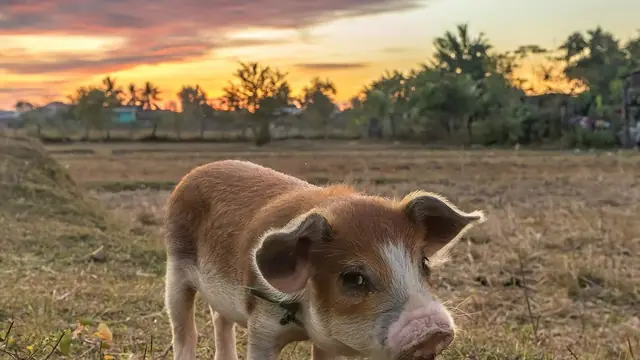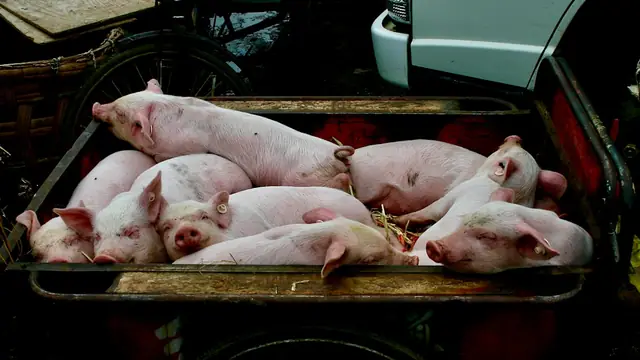
No scale on the farm? A ₱30 cloth tape and one measurement around the chest gets you within about ±4.5 kg of a finishing pig's real weight. Most backyard raisers never weigh their pigs at all, then lose ₱1,000+ per head when the viajero lowballs. You need a number for three decisions: when to sell, how much to feed, and the right medication dose from your vet.
What You Need
- A soft measuring tape (the kind used for sewing), or any string plus a ruler
- A second person to hold the pig or keep it still
- A calculator or phone
That's it. Wala'y scale, wala'y problema.
How to Measure
You need two measurements, both in centimeters.
Heart girth (Libot sa dughan). Wrap the tape around the pig's body directly behind the front legs, at the narrowest part of the chest. Pull snug but not tight. Read the circumference in centimeters.
Body length (Gitas-on). Measure along the pig's back from the base of the ears (not the snout) to the base of the tail. Keep the tape along the spine, not hanging loose.
Take each measurement three times and average them. Pigs don't stand still, and a 2 cm error on heart girth can mean a 3-4 kg difference in your estimate. Measure while the pig is eating. It keeps them calmer.
The Formula
There are two methods. Use whichever fits the pig you're measuring. Both are for improved breeds and crossbreeds (Landrace, Large White, Duroc crosses, and hybrids). Native pigs get their own formula further down.
Method 1, heart girth only (the one I use). This is the Kansas State University extension model, fitted on 100 growing-finishing pigs from 50 to 273 lb:
Weight (lb) = 10.1709 × Heart Girth (inches) − 205.75
Measure girth in inches, multiply, subtract, then divide by 2.2 for kilos. On a squirmy pig you'll only get one clean measurement anyway, and girth alone tracks weight tightly here (R² = 0.98). Honestly, this is the one most backyard farmers should default to. The lookup table below already does this math, so you don't have to touch a calculator.
Method 2, girth and length (the classic two-tape formula). The old ag-extension standard, useful as a cross-check when the girth-only number looks off:
Weight (lb) = (Heart Girth inches × Heart Girth inches × Body Length inches) ÷ 400
Working in centimeters instead? Divide by 14,400 to get kilograms directly. Not 10,840, a figure that floats around Filipino farming groups and overstates weight by roughly a third. I've seen farmers price a 72 kg pig as if it were 96 kg off that bad divisor, then get crushed when the buyer's scale tells the truth.
Worked example. A crossbreed finisher with a heart girth of 117 cm (46 in) and body length of 130 cm (51 in):
- Method 1: 10.1709 × 46 − 205.75 = 262 lb ≈ 119 kg
- Method 2: (46 × 46 × 51) ÷ 400 = 270 lb ≈ 122 kg
The two land within 3 kg of each other, which is the level of agreement you want. That pig is at market weight. At ₱172.44/kg, PSA's official Q2 2026 average, that is roughly ₱20,500 gross. Read the pricing note below before you plan around anything higher.
How accurate is this, really? The K-State model carries a 95% confidence interval of ±10 lb, about ±4.5 kg, for pigs in the 50-273 lb (23-124 kg) range. Call it ±5%. That is good enough to decide selling timing, feed rations, and dosing. It is not good enough to settle a sale to the kilo. Outside roughly 30-130 kg accuracy falls off, and for piglets under 20 kg skip the tape entirely. A ₱200-500 hanging or kitchen scale from any hardware store beats any formula at that size.
Quick Reference Table (Improved Breeds)
If math isn't your thing, use this table. Just measure heart girth and look up the approximate weight. This assumes typical body proportions for commercial crossbreeds.
| Heart Girth (cm) | Estimated Weight (kg) | Value at ₱172.44/kg (PSA Q2 2026) | Value at ₱150/kg (DA, Aug 2026) |
|---|---|---|---|
| 65 | 25 | ₱4,311 | ₱3,750 |
| 70 | 34 | ₱5,863 | ₱5,100 |
| 75 | 44 | ₱7,587 | ₱6,600 |
| 80 | 53 | ₱9,139 | ₱7,950 |
| 85 | 62 | ₱10,691 | ₱9,300 |
| 90 | 71 | ₱12,243 | ₱10,650 |
| 95 | 80 | ₱13,795 | ₱12,000 |
| 100 | 89 | ₱15,347 | ₱13,350 |
| 105 | 98 | ₱16,899 | ₱14,700 |
| 110 | 107 | ₱18,451 | ₱16,050 |
| 115 | 116 | ₱20,003 | ₱17,400 |
Computed straight from the Kansas State University heart-girth regression (Method 1 above): 100 pigs, 50-273 lb, r² = 0.98, ±4.5 kg at 95% confidence. Girths converted from cm to inches. Values rounded to the nearest kg.
A word on those peso columns. The first uses ₱172.44/kg, PSA's national average for Q2 2026 and the last official quarter; PSA has not yet published July to September (its next update is due 6 November 2026). The second uses ₱150/kg, the national liveweight price the DA said for August 2026 (Manila Times, 28 September 2026). That is a trade-reported figure, not PSA, but it is the closer read of what a buyer is offering this season. Both are well off the ₱214.52 peak of June 2025. The ₱180-190/kg SINAG quoted in May 2026 is history now; do not price a pig on it.
You will still see ₱210/kg quoted everywhere. That is the DA minimum farmgate price set in November 2025, an industry-agreed, DA-backed target that nobody can enforce. The national average has not reached it in any month since it was set. Four regions have: the Cordillera (5 months), BARMM (2), Central Visayas (2) and Metro Manila (1). It is not a floor under your sale. Do not build a budget on it.
The harder number: producer groups put cost of production at ₱180-190/kg in October 2026. At the ₱172.44 PSA recorded for Q2 2026, the average farm was already selling for less than the pig cost to raise; at the DA's ₱150 for August it is losing ₱30-40 on every kilo. That is exactly why the tape matters. When there is no margin left, a 7 kg lowball is not a rounding error, it is money straight out of a loss you are already taking. Pull current regional prices before you sell, because the spread between provinces is wider than the margin.
For Native Pigs: Use a Different Formula
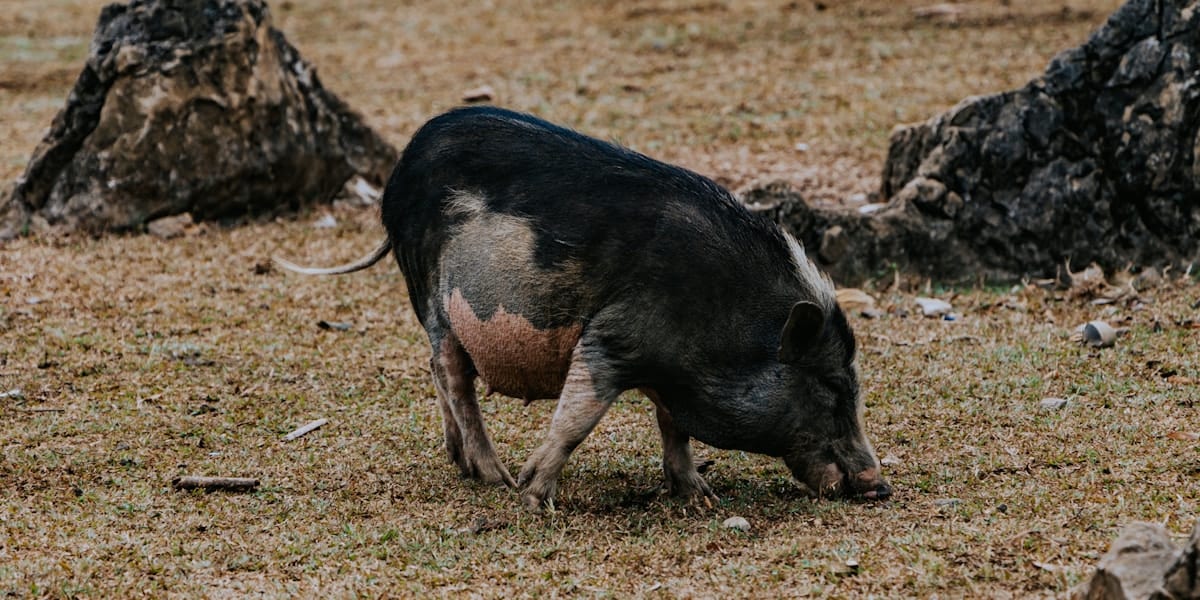
Both formulas above were fitted on improved Western breeds. Philippine native pigs (the black biik you see roaming yards in the Visayas and Mindanao) are shorter and rounder, so the standard math overestimates them by 15-20%. A study published in the Philippine EJournals measured 54 native pigs from 20 to 50 kg and fitted this:
Weight (kg) = -46.32 + (0.83 × Heart Girth cm) + (0.27 × Body Length cm)
Example: A native pig with heart girth 70 cm and body length 60 cm:
-46.32 + (0.83 × 70) + (0.27 × 60) = -46.32 + 58.1 + 16.2 = 28.0 kg
That model explains 92% of the weight variation in the sample (R² = 0.92, statistically significant at p of 0.05). It only validated on pigs between 20 and 50 kg, so for a bigger native or a fattened crossbred-native, treat the result as a rough guide and lean on the visual check below.
Common Mistakes That Throw Off Your Estimate
- Measuring over the front legs instead of behind them. Heart girth goes right behind the legs, at the narrowest point. Measuring on top of the legs adds 5-8 cm and overestimates weight by 10+ kg.
- Measuring a pig that just ate or drank. A full gut adds 2-4 kg. Measure before the morning feeding for the most consistent result.
- Letting the tape hang loose. Snug, not tight. You should be able to slip one finger under the tape.
- Using the improved breed formula on native pigs. Native pigs are shorter and stockier. The standard formula can overestimate their weight by 15-20%. Use the Philippine native formula above.
- Not averaging multiple measurements. One reading is a guess. Three readings averaged is an estimate. Bahala ka kung usa ra, pero ayaw reklamo kung mali.
When a Tape Measure Isn't Enough
This method works for most backyard situations, but invest in a proper scale if:
- You sell more than 10 pigs per year. A hanging platform scale costs ₱3,000-8,000 and pays for itself fast. Even a 3 kg underestimate on 10 pigs costs you ₱5,173 per batch at PSA's Q2 2026 ₱172.44/kg, or ₱4,500 at the DA's August ₱150/kg.
- You dose medications by weight. Antibiotics and dewormers have narrow dosing windows. Off by 10 kg, you underdose (doesn't work) or overdose (wastes money, risks toxicity). See how to inject pigs for proper technique and dosage calculations.
- Viajeros keep underestimating your pig's weight. "Mga 80 kilos ra na" when your tape says 95 kg. At PSA's Q2 2026 ₱172.44/kg that's about ₱2,587 you just lost (₱2,250 at the DA's August ₱150/kg). Having your own scale, or at least a documented tape estimate written down with a date, gives you something to push back with.
Use the break-even calculator and profit simulator once you have weight estimates for your batch.
A Visual Cross-Check Before the Buyer Comes
The tape gives you a number. Your eyes confirm it's sane. Run this quick body-condition read on a finishing pig and see if it agrees with the formula:
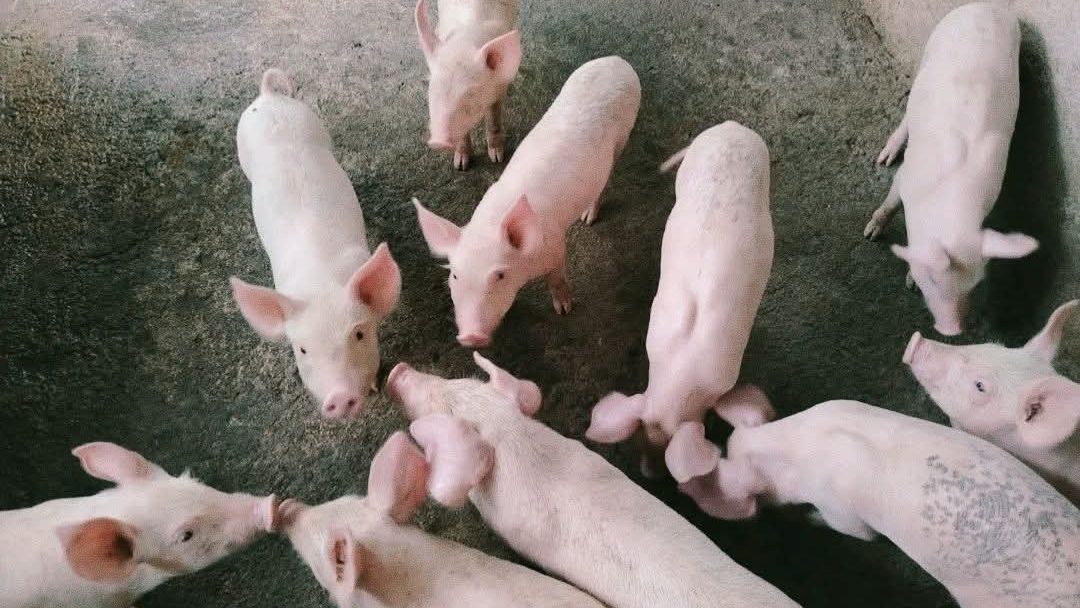
- Backbone and hip bones invisible, body looks like a filled sack: condition is good, the pig is likely 85 kg or more. Tape should agree.
- Backbone faintly visible, slight tuck behind the ribs: still growing, expect 60-80 kg on the tape.
- Hip bones and spine clearly showing: the pig is thinner than its frame suggests. The tape can read high here because girth picks up frame, not finish. Trust the lower end.
If the tape says 95 kg but the pig looks ribby and narrow over the ham, something is off, usually a girth measurement taken too far forward, over the shoulder. Re-measure right behind the front legs. This eyeball step has saved me from pricing a half-finished pig as a market pig more than once.
Why Accurate Weight Matters for Your Bottom Line
In Cebu and Davao, viajeros (livestock traders) routinely lowball weight estimates by 5-10 kg per pig. On a 95 kg pig at ₱172.44/kg, a 7 kg underestimate costs you ₱1,207. Across a 10-pig batch, that is ₱12,071 gone because you did not bring a tape measure. Producer groups put cost of production at ₱180–190/kg in October 2026 (Daily Tribune), above that price, so that ₱12,071 is not a haircut on your profit. It deepens a loss you may already be taking.
One honest caveat that cuts the other way. A pig held off feed and water, or hauled a long distance before weighing, genuinely loses weight, the gut empties and the animal dehydrates. K-State's own validation found show pigs averaging 16 lb (about 7 kg) below their tape estimate after transport and feed withdrawal. So if the buyer weighs at their end after a truck ride, expect a real shrink of a few kilos. Measure at home, on full feed and water, and document that as your baseline. The argument to have is about the gap beyond normal shrink, not shrink itself.
Take your own measurement before the buyer arrives. Write it down with the date. If their estimate is more than 5 kg below yours after accounting for shrink, you have grounds to negotiate or walk away. Most farmers I talk to in Leyte and Bohol just accept whatever the viajero says because they have no number of their own. Don't be that farmer.
If you want to track growth over time instead of just sale day, the feed consumption chart shows expected weights by age so you can tell whether your pigs are on track or falling behind the ration you're paying for.
Free Tool
FCR Calculator
Once you have a tape-measure weight, drop in the kilos of feed eaten in that period to see your real feed conversion ratio. That single number tells you whether your batch is on track or quietly bleeding margin.
Bisaya / Cebuano
Para sa mga mag-uuma: Unsaon pagtimbang sa baboy nga walay scale
Duha ka sukod ang kinahanglan:
- Libot sa dughan (heart girth): sukda ang libot sa lawas sa baboy luyo sa atubangan nga mga tiil, sa pinakapino nga bahin sa dughan
- Gitas-on (body length): sukda gikan sa likod sa dalunggan hangtod sa gamot sa ikog
Para sa improved breeds (Landrace, Large White, Duroc cross): sukdang ang libot sa dughan sa pulgada, dayon: Timbang (lb) = 10.17 x heart girth (inches) minus 205.75. Bahina sa 2.2 para makuha ang kilo. O gamita lang ang lamesa sa ibabaw, mas sayon.
Para sa native nga baboy (itom nga biik): Timbang (kg) = -46.32 + (0.83 x heart girth cm) + (0.27 x body length cm). Para ni sa baboy nga 20 hangtod 50 kg lang.
Tip: Sukda tulo ka beses, kuhaa ang average. Mas sakto kung sukdon samtang nagkaon ang baboy ug wala pa madala sa merkado. Estimate ra ni, dili scale. Pagdala gihapon ug tape kung mopalit ang viajero.