Your pig has been eating for months, but it is still small. Your neighbor's pig, bought the same week, is already twice the size. What is going wrong?
"Kung gamay kaayo mokaon ang baboy, naa gyud problema." (If the pig eats very little, there is definitely a problem.)
Slow growth in Philippine backyard pigs almost always comes down to one of five causes. Most are fixable once you identify them. We've seen farmers correct a single issue and watch their pigs gain 30–50% faster within a month.
Expected Growth Rates
Before diagnosing a problem, know what is normal:
| Breed Type | Expected Daily Gain | Monthly Gain |
|---|---|---|
| Native pig | 0.15–0.25 kg/day | 4.5–7.5 kg/month |
| Native × commercial cross | 0.35–0.50 kg/day | 10–15 kg/month |
| Commercial breed (backyard fed) | 0.55–0.75 kg/day | 17–22 kg/month |
These are realistic backyard numbers, not the controlled-farm figures you see in feed company brochures. Commercial farms push 0.85–0.95 kg/day, but backyard conditions in the Philippines rarely get there because of heat, feed quality, and parasite load. If your pig is gaining well below the range for its breed type, work through the causes below.
Every month of delayed growth costs you roughly ₱1,800–₱2,800 in extra feed at 2026 prices. A pig that takes 6 months instead of 4 to reach market weight does not just eat more. It also ties up your pen space, your capital, and your labor. Slow growth is the most expensive problem in backyard pig farming because it stays invisible until you do the math.
Cause #1: Internal Parasites
This is the most common cause of slow growth in Philippine backyard pigs. Tried and tested na: deworm first, ask questions later.
Roundworm (Ascaris suum) is the main offender. Controlled studies put the damage at roughly a 10% drop in daily gain and about a 13% loss in feed conversion in growing pigs (Vlaminck et al., 2014). The MSD Veterinary Manual notes adult worms "may appreciably decrease the growth rate of young pigs," and pig333's health section documents the same subclinical loss that never shows up as obvious sickness. Heavy mixed infections push the loss higher. Prevalence in Philippine backyard herds runs 25–60%, so most untreated pigs carry some burden.
Signs:
- Pot belly with a thin body
- Rough, dull hair coat
- Visible worms in feces (large, white, 15–30 cm)
- Coughing (larval migration through the lungs)
- Eating normally but not gaining weight
Fix: Deworm with ivermectin (₱25–₱55 per pig) or albendazole (₱15–₱25 per pig), then repeat every 3–4 months. Deworm the sow 2 weeks before farrowing to cut piglet transmission. Even if deworming only recovers a tenth of lost growth, a ₱50 dose pays for itself many times over in saved feed.
See how to deworm pigs in the Philippines for products, dosing, and schedules.
Cause #2: Poor Feed Quality or Quantity
Pigs need to eat about 3–4% of their body weight daily in feed. A 50 kg pig should eat 1.5–2.0 kg per day. If it eats less than that, or the feed is short on protein, growth stalls.
Common feed problems:
- Kitchen scraps only. Scraps are inconsistent and usually low in protein. Pigs on scraps alone grow at roughly half the rate of properly fed pigs. This is still common in rural Leyte, Bohol, and parts of Mindanao.
- Rancid rice bran. Rice bran stored more than 2 weeks in Philippine heat goes rancid. Pigs refuse it or eat less. If the darak smells sour or looks gray, throw it out.
- No protein source. Corn and rice bran give energy but not enough protein. Without copra meal (₱13–₱17/kg in Visayas as of early 2026), fish meal, or soybean meal, pigs grow slowly instead of building muscle.
- Not enough feed. Under-feeding to save money costs more, because it stretches the grow-out period. A pig eating 1.5 kg/day instead of 2.0 kg/day saves about ₱18/day on feed but loses ₱35–₱55/day in growth value.
Fix: Feed a balanced ration with 14–16% protein for growers. A home-mixed grower ration in Cebu or Davao runs about ₱22–₱25/kg, against ₱33–₱40/kg for commercial finisher and grower pellets at 2026 prices. Both halves of that comparison move under you. BAI's wholesale copra meal price has traded between roughly ₱7 and ₱20 a kilo since January 2023, and the premium feed listing we keep is a single dated retailer price, not a national average, because there is no national average to keep. See best feed mix for backyard pigs and the feed formulation guide for practical formulas.
Cause #3: Heat Stress
Philippine daytime temperatures routinely reach 30–37°C. Pigs cannot sweat. Above their comfort zone, they voluntarily cut feed intake by roughly 90–106 grams per day for every degree the temperature climbs (Pig Site, citing growing-pig trials).
At 35°C, a finishing pig may eat 500+ grams less per day than at 25°C. Over a month that is around 15 kg of feed not eaten, and it translates straight into slower growth.
Signs:
- Open-mouth breathing (panting)
- Constantly seeking wet areas
- Eating less, especially during the hottest part of the day
- Skin feels hot to the touch
Fix:
- Provide shade. Direct sun on a pig pen is the worst possible setup.
- Ensure 24-hour water access. Pigs drink 30–50% more in heat.
- Sprinkle water on the pig or the pen floor during peak heat.
- Feed during the cooler parts of the day, early morning and late afternoon.
- Improve ventilation. Open-sided pens catch more airflow.
During Philippine summer (March to May), shift the bigger feeding to early morning (5–6 AM) or late afternoon (5–6 PM). Pigs eat 10–15% less during peak heat hours. Adding 1–2% coconut oil to the ration raises caloric density without bulk, so the pig gets the same calories in less feed volume. Price that addition before you commit to it: coconut oil is the most volatile line BAI tracks by a wide margin, and it has doubled and halved inside the life of the series, so a ration leaning on it is exposed to the copra market rather than the grain market. Clean, constant water matters as much as feed in the hot months.
Cause #4: Chronic Disease
Subclinical infections, the diseases that do not make a pig visibly sick but quietly reduce appetite and nutrient absorption, are common in backyard herds. ThePigSite's diagnostic guides cover how to spot these hidden growth robbers.
Common culprits:
- Chronic respiratory infection (mild cough, slight nasal discharge)
- Mange (constant itching means stress means less eating)
- Subclinical scours (soft stool, not full diarrhea)
- Stomach ulcers (from finely ground feed or stress)
Fix: Have a veterinarian examine any pig growing well below expected rates despite good feeding. Municipal vet consultations are usually free for registered farmers. Nutritional deficiencies can also stall growth, so check pig vitamins and supplements if your ration may be missing key micronutrients.
Cause #5: Overcrowding and Stress
Overcrowded pigs fight more, eat less, and get sick more often. Stress hormones directly suppress growth.
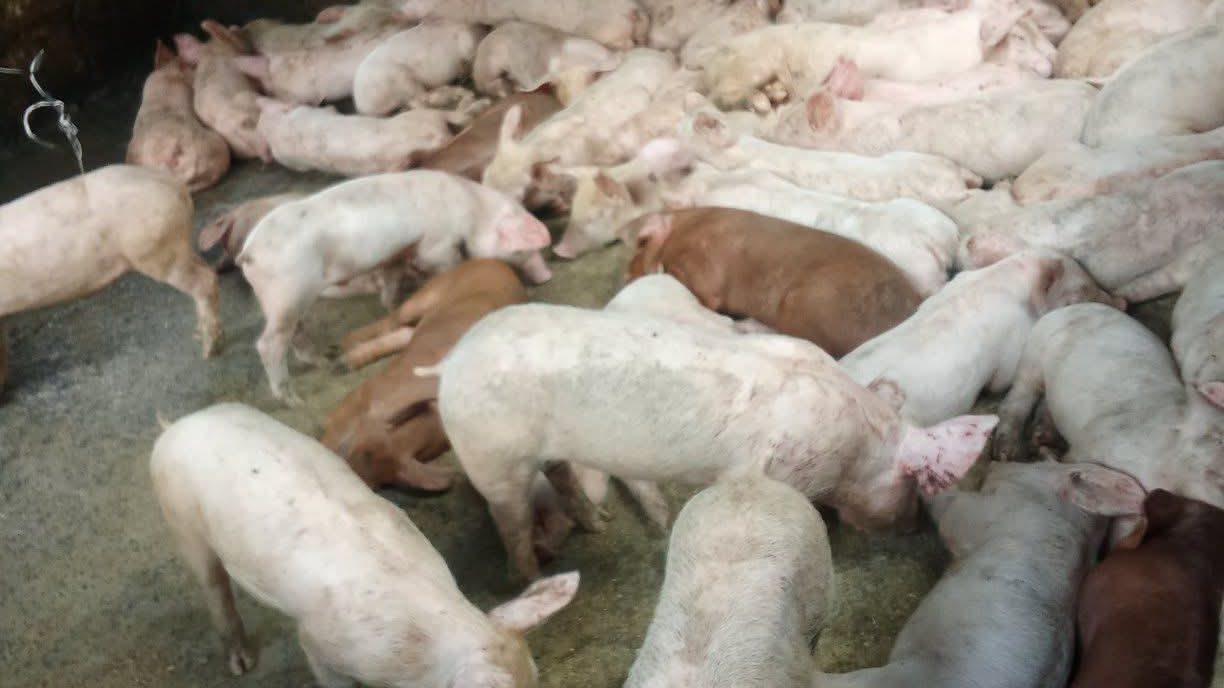
The recommended floor space is 0.8–1.0 sq.m per finishing pig. Five pigs in a 2m × 2m pen works out to 0.8 sq.m each, which is the absolute minimum. Aim for 1.0 sq.m or more.
Fix: If your pigs are competing hard for feed, fighting, or carrying bite wounds on ears and tails, they need more space or smaller groups.
Free Tool
Pen Space Calculator
Check your stocking density against DA-BAI tropical space standards.
A Quick Diagnostic Checklist
When your pig is not gaining weight, work through this in order:
- When was the last deworming? More than 3 months ago means deworm now.
- Is the pig eating its full ration? If not, check feed quality and heat stress.
- Does the feed have adequate protein? Just corn or scraps means you need to add a protein source.
- Is there shade and water 24 hours a day? If not, fix it immediately.
- Is the pig coughing, scratching, or scouring? If yes, call a veterinarian.
- How many pigs per pen? If overcrowded, separate or expand.
Bisaya / Cebuano
Para sa mga mag-uuma
Ngano dili motubo ang baboy? Lima ka rason:
- Ulod. Mao ni ang pinaka-kasagaran. Naka-menos og 10 ngadto sa 15 porsyento sa tubo. Pa-deworm kada 3 ngadto sa 4 ka bulan.
- Sayop nga pagkaon. Kinahanglan og protina sama sa copra meal ug fish meal, dili lang darak ug mais.
- Init kaayo. Kung sobra sa 30°C, mokunhod og kaon ang baboy. Butangi og landong ug presko nga tubig.
- Sakit. Bisan dili makita, ang gamay nga sakit makapahinay sa tubo. Padalha sa vet.
- Puno kaayo ang tangkal. Kung mag-away ang baboy, dili kaayo mokaon.
"Ang baboy nga kalmado mokaon ug mopahulay, mao'y labing paspas motambok." (The calm pig that eats and rests well gains weight fastest.)
Related Reading
- Why did my pig stop eating? covers diagnosing sudden feed refusal.
- How to deworm pigs covers products, dosing, and schedule.
- Signs your pig is sick covers when slow growth means disease.
- Complete feed formulation guide helps you get the protein balance right.
- Pig feed consumption chart shows how much your pig should eat.
- Pig vitamins and supplements covers micronutrient deficiencies.
- FCR Calculator measures your feed conversion ratio.
- Pen Space Calculator checks your stocking density.
Sources
- MSD Veterinary Manual: Ascaris suum in Pigs covers Ascaris impact on growth rate.
- pig333: Pig Health covers subclinical disease and growth performance.
- ThePigSite: Diagnostic Guides covers disease identification.
- CDC: About Ascaris in Pigs covers prevalence and lifecycle.
- Vlaminck et al., 2014, Veterinary Parasitology: Ascaris suum effects on fattening pig performance (~10% daily gain, ~13% feed conversion loss).
- FAO Farmer's Handbook on Pig Production: tropical feeding and deworming schedules.