Walk into any agri-vet store in the Philippines and you'll see shelves of "pampalusog" (health supplements) for pigs: vitamin B complex, growth boosters, appetite stimulants, mineral premixes, products that promise faster growth. It's confusing and expensive if you buy everything.
"Dili lang mais ug tubig, kinahanglan pod og bitamina ang baboy." (Not just corn and water, pigs need vitamins too.)
True. But you don't need everything on the shelf. Most of it is marketing. Here's what backyard pigs actually need versus what you can skip.
The Three Essentials
If you're mixing your own feed (rice bran, copra meal, corn, greens), these three supplements cover the critical gaps. If you're buying commercial feed (B-MEG, Thunderbird, Vitarich, Suregrow), these are already included. Skip straight to the injectable vitamins section.
1. Vitamin-mineral premix
The most important supplement. Provides vitamins A, D, E, B-complex, and trace minerals (zinc, manganese, selenium, copper) that local feed ingredients lack. Without premix, your pigs will grow, but slower and with weaker immunity. PCAARRD's swine feeding bulletins consistently list premix as the single most impactful additive for home-mixed rations.
Mixing rate: 2-3 kg per metric ton of feed, or about 2-3 grams per kilogram of mixed feed. For a small batch of 50 kg, that's roughly 100-150 grams of premix.
Provimi (Cargill) and several local manufacturers supply pig premixes to Philippine agri-vet stores. Cost adds only about ₱0.50-1.50 per kilogram of finished feed. That's maybe ₱150-450 extra for the entire grow-out of one pig. Cheap insurance.
2. Salt (sodium chloride)
Pigs need salt for appetite, electrolyte balance, and proper metabolism. A pig with salt deficiency will lick walls, drink urine, and eventually lose appetite entirely. We've seen this more than once in backyard farms around Cebu where farmers mix their own feed but forget salt.
Mixing rate: 3-5 grams per kilogram of feed (0.3-0.5%). For 50 kg of feed, add 150-250 grams of ordinary table salt or rock salt. Costs almost nothing.
3. Limestone or dicalcium phosphate (DCP)
Provides calcium and phosphorus for bone development. Especially important for breeding sows and growing piglets. Crushed eggshells (dried and ground fine) are a free alternative, tried and tested na among backyard farmers.
Mixing rate: 10-15 grams per kilogram of feed (1-1.5%). For 50 kg, add 500-750 grams.
| Supplement | Rate per kg of Feed | Cost per kg of Feed | Cost per 50 kg Batch | Notes |
|---|---|---|---|---|
| Vitamin-mineral premix | 2-3 g | ₱0.50-1.50 | ₱25-75 | Non-negotiable for home-mixed |
| Salt | 3-5 g | ₱0.05-0.10 | ₱2.50-5 | Table salt or rock salt |
| Limestone / DCP | 10-15 g | ₱0.10-0.20 | ₱5-10 | Or free if using crushed eggshell |
| Total | ₱0.65-1.80 | ₱32.50-90 | Adds ₱150-450 per pig total grow-out |
How to Mix Into Feed
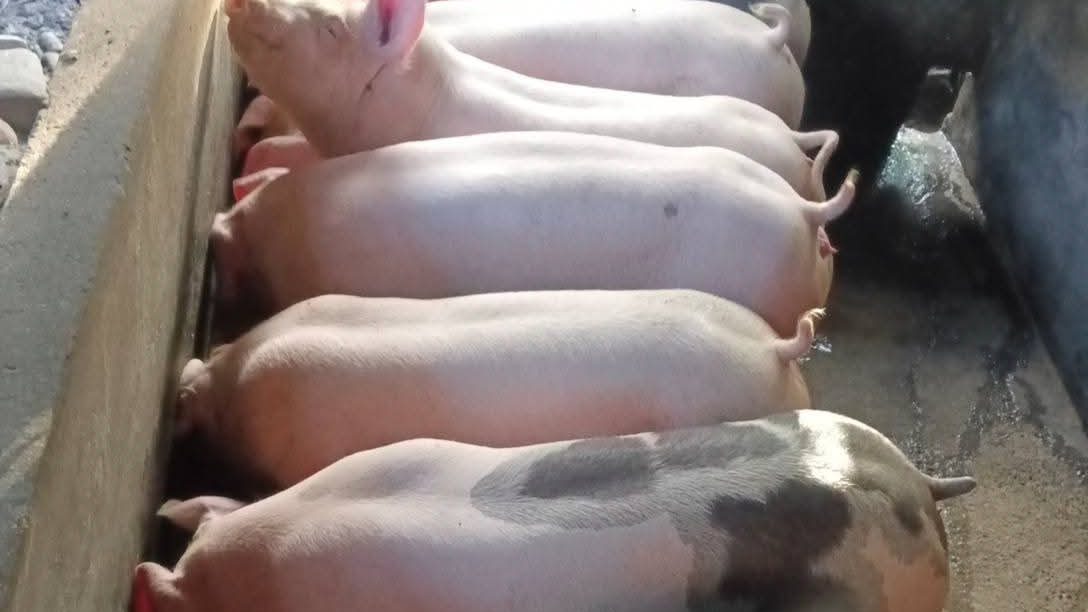
The key is even distribution. Vitamins concentrated in one spot means some pigs get too much and others get none.
- Measure out your premix, salt, and limestone for the batch
- Mix these three together in a small container first (this is your "pre-mix")
- Spread your main feed (darak, corn, copra meal) on a clean concrete floor or in a large basin
- Sprinkle the pre-mix over the feed while folding and mixing. Like making bibingka batter
- Mix thoroughly for 3-5 minutes. The goal is uniform color throughout
"Isagol sa feeds, ayaw ibubo sa usa ka lugar." (Mix into the feed, don't just pour in one spot.)
If you have a hammer mill for grinding corn, mix the supplements into the last batch of grinding. The mill does the mixing for you.
Injectable Vitamins: When They Actually Help
These are situational, not daily supplements. The feed premix handles daily vitamin needs. Injectables are for specific situations where a pig needs a quick boost.
| Product | Common Brands | When to Use | Dosage |
|---|---|---|---|
| Vitamin B complex injection | Bexan SP (UNAHCO), Porcibex (Viddavet) | Sick pig recovering, poor appetite | 2-3 mL IM, once |
| ADE injection (Vitamins A, D, E) | Various (agri-vet stores) | Breeding sows, 2 weeks before farrowing | 5 mL IM |
| Vitamin C (ascorbic acid) | Powder form | Extreme heat stress days | 1 g per liter of drinking water |
| Iron dextran | Jectran Premium (UNAHCO), Iron-Vet (Viddavet), Daviron Plus | Piglets at day 3 | 1-2 mL IM |
Iron dextran at day 3 is the one injectable that's genuinely non-negotiable for piglets. BAI Administrative Order No. 41 (Code of Practice for Welfare of Pigs) requires that all piglets born and raised indoors receive iron supplement within 3 days. Piglets are born with very low iron stores and sow milk doesn't have enough. Without it, they develop anemia, grow poorly, and some die. For a full walkthrough, see iron injection for piglets.
B-complex injections (Bexan SP is the one you'll see most often at agri-vet stores) are useful for pigs recovering from illness or with poor appetite. They're not a growth booster for healthy pigs. If a pig is eating normally, don't waste money on B-complex injections.
UNAHCO (Univet) is the biggest swine supplement brand in the Philippines. Their product line covers most of what a backyard farmer needs: Jectran (iron), Bexan (B-complex), Vetracin (antibacterial), Electrogen (electrolytes), Latigo (dewormer). Ask your local agri-vet store what's in stock. Viddavet is another reliable option with lower prices on some products.
What About Vetracin?
Vetracin Gold is one of the most popular products at Philippine agri-vet stores, but it's not a vitamin supplement. It's an antibacterial (doxycycline + tiamulin) combined with vitamins and probiotics. It treats and controls swine pneumonia, neonatal scours, post-weaning diarrhea, and swine dysentery.
Don't use Vetracin as a routine supplement. It contains antibiotics, and overuse contributes to antibiotic resistance. Use it when your pig is actually sick, following the label dosage, or on a vet's recommendation. If you're looking for a general vitamin boost, Bexan or a feed premix is what you want, not Vetracin.
What You Do NOT Need
- "Miracle growth boosters" sold by unlicensed sellers online. Often sugar water or diluted B-complex at 5x markup. If it promises 30% faster growth with no scientific backing, skip it
- Human multivitamins. Wrong formulations, wrong ratios, missing trace minerals pigs need
- Excessive fat-soluble vitamins (A, D, E, K). These accumulate in the body and can be toxic. Follow premix label rates exactly. More is not better
- Probiotics for healthy pigs. Useful after antibiotic treatment or during stress (weaning, transport). But if your pigs are healthy and growing well, don't spend on daily probiotics. Honestly, most of them do fine without it
Common Mistakes
- No premix in home-mixed feed. The most common mistake. Your pigs will survive on darak and corn, but they'll grow 15-20% slower and get sick more often. The ₱150-450 per pig in premix cost saves you thousands in extra feed days
- Overdosing fat-soluble vitamins. Follow the label. A farmer in Tarlac we talked to was adding 3x the recommended premix rate thinking more is better. His pigs got vitamin A toxicity (skin lesions, poor growth). The vet bill cost more than a year of proper premix
- Buying injectable vitamins for healthy pigs. Injectables are for recovery, not routine. A healthy pig eating balanced feed with premix has no need for B-complex shots
- Forgetting salt. Costs ₱5 per 50 kg batch. Salt-deficient pigs eat poorly and grow slowly. Just add it
Tools
- Feed Calculator: include supplement costs in your total feed estimate
- FCR Calculator: track whether your supplement program is actually improving conversion
- Profit Simulator: model supplement costs against growth improvements
Sources
- BAI Administrative Order No. 41, S. 2000: Code of Practice for Welfare of Pigs (iron supplementation requirement)
- DOST-PCAARRD Swine Industry Strategic Plan (feeding technology bulletins)
- UNAHCO: 10 Must-Know Supplements for Piglets
- pig333: Swine Nutrition (micronutrient roles in swine growth)
- FAO Farmer's Handbook on Pig Production
Related
- Best feed mix for backyard pigs: complete formula including supplement rates
- Pig feed formulation guide: detailed nutrition by growth stage
- Iron injection for piglets: step-by-step iron dextran guide
- The real cost of pig feed: where supplements fit in your total cost
Bisaya / Cebuano
Para sa mga mag-uuma: Bitamina ug supplement sa baboy
Tulo lang ang kinahanglan kung nagsagol ka og kaugalingon nga feeds:
- Vitamin-mineral premix: 2-3 gramo per kilo sa feed. Kini ang pinaka-importante. Mga ₱0.50-1.50 ra per kilo sa feed.
- Asin: 3-5 gramo per kilo. Barato kaayo pero importante para sa gana sa pagkaon.
- Limestone o crushed eggshell: 10-15 gramo per kilo. Para sa bukog ug ngipon.
Unsaon pag-mix: Sagola ang tulo ka supplement sa gamay nga sudlanan una, dayon isabwag sa feeds samtang nagmix. Dili ibubo sa usa ka lugar lang.
Injectable (Bexan, ADE): gamiton lang kung nasakit o nagrecovery ang baboy. Dili kinahanglan sa adlaw-adlaw.
Iron dextran (Jectran): kini ang usa ka injectable nga kinahanglan gyud. Ihatag sa baktin sa day 3. Kung dili, magka-anemia ang baktin ug hinay ang tubo.