A five-sow backyard herd needs about two replacement gilts a year. The cheapest source looks like your own farrowing pen, and it is the dearest option on the list: breeding a gilt back to her own father costs 0.6 to 1.0 piglets a litter plus 7.5 kg of finishing weight. Call it ₱17,600 to ₱24,300 a year.
That is roughly what you would pay once for a bought gilt. Except you pay it every year, forever, and the losses compound because next year's daughter is more inbred than this year's.
How many gilts you actually need
Start with how long a sow lasts. In a Philippine backyard herd the practical answer is the end of parity 5 or 6, which at two litters a year is two and a half to three years of production. That is a replacement rate of 33 to 40% a year.
Commercial herds run faster. Published benchmarks put sow replacement at 45 to 58% and Pork Information Gateway tells producers to plan on around 50%. Do not copy that. Commercial farms cull harder because they have a queue of gilts ready; a backyard herd replacing half its sows a year would be permanently full of first-litter animals, which wean fewer and smaller piglets than parity 3 sows.
| Herd | Gilts needed per year | Candidates to select |
|---|---|---|
| 3 sows | 1 | 2 |
| 5 sows | 2 | 3 |
| 7 sows | 2–3 | 3–4 |
| 10 sows | 3–4 | 4–5 |
The candidate column follows the commercial rule: select about 1.25 gilts for every one you intend to breed. Some will not cycle, some go lame, one turns out to have an inverted teat you missed. Pick three, breed two, and the third goes to the fattening pen. That is not waste, that is the point of selecting.
The problem nobody tells a three-sow owner
You cannot replace 35% of three sows. You replace one animal or none.
So a small herd tends to buy all its sows at once, run them together, and have the whole herd age out in the same six months. The parity profile a herd is meant to hold is roughly 15 to 20% first-litter animals and about 42% in parities 3 to 5. With three sows you cannot express that at all.
The position I would take against most guides: below about six sows, stop trying to run a parity profile and just make sure your sows are not all the same age. Buy one gilt, wait a year, buy another, even when staggering costs you a slot in the breeding calendar. A herd that ages out together forces you to buy three gilts in one quarter, which is exactly when you accept whatever the seller has.
The daughter mistake, priced
Run one boar, keep his daughters as replacements, and you are mating sire to daughter. That gives offspring an inbreeding coefficient of 25%, the same as full-sibling mating; Business Queensland's genetics guidance puts both matings at exactly that. What 25% costs, from two independent lines of evidence:
| Measure | Effect per 10% inbreeding | At 25% |
|---|---|---|
| Piglets born per litter | −2.5% (Business Queensland) | −0.22 on a 9-pig litter |
| Piglets born alive | −0.39 head (litter inbreeding studies) | −0.98 head |
| Body weight at 160 days | −3 kg | −7.5 kg |
Take the honest middle: 0.6 to 1.0 fewer piglets born alive per litter, every survivor about 7.5 kg lighter at 160 days. Business Queensland flags that its 2.5% figure came from a study where inbreeding rose fast, so treat these as the upper end. The direction is not in doubt. Priced on a two-litter sow:
| Loss | Working | Per year |
|---|---|---|
| Weaners not born | 0.6–1.0/litter × 2 litters × ₱3,000 | ₱3,600–6,000 |
| Extra days to market, if you finish | 7.5 kg slower ≈ 10–13 extra days × 2.4 kg/day × ₱36.69 | ₱880–1,145 per head |
| On 16 pigs finished a year | ₱14,000–18,300 | |
| Total | ₱17,600–24,300 |
A replacement gilt costs ₱11,000 to ₱16,000 young or ₱18,000 to ₱27,000 proven. The free daughter costs you a bought gilt's price every single year, and it gets worse each generation, because her daughter will be more inbred than she is.
Sixteen finished pigs a year is one sow's output, so two daughters doubles it. Three generations on the same boar puts inbreeding well past 25%, and the reason your litters have been shrinking is standing in the boar pen, not sitting in the feed sack.
What to do instead if you cannot buy a gilt
Rotate the sire, not the sow. It costs almost nothing.
Semen through DA-ATI's AI sa Barangay programme runs ₱200 to ₱500 a dose, plus ₱200 to ₱500 for a technician if you do not inseminate yourself. Change the boar line every batch and inbreeding never accumulates, because the sire is never related to the dam. You can run a Large White this cycle and a Duroc next, which no single backyard boar gives you, and the full AI cost comparison has the boar losing on economics anyway below eight or ten active sows.
Business Queensland's rule for closed herds is that at least 10% of matings go to performance-tested AI boars, and that inbreeding should not pass 10% over 15 years. A backyard herd with one boar hits 10% in a single generation.
What to select for, in order
Do the underline first, before you get attached to the animal.
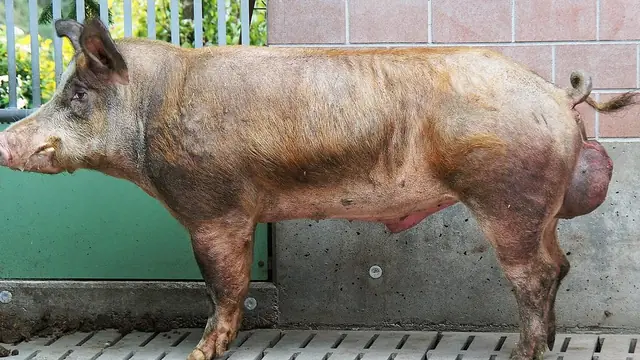
1. Teats. At least 14, seven a side, evenly spaced, all functional, none inverted and none of the small undeveloped "pin" nipples. Sixteen is better. Filipino guides say seven pairs and they are right; where they stop short is on why it matters, which is that inverted and pin teats are heritable. Select a gilt with one bad teat and you breed that fault into the herd for a decade. A sow with 12 usable teats cannot raise a 12-piglet litter, and F1 Large White × Landrace litters regularly reach that.
2. Feet and legs. Front legs straight and under the shoulder, rear legs slightly ahead of the hock, pasterns at about 45 degrees rather than flat to the ground. Watch her walk ten metres on concrete. Lameness is the top non-reproductive reason sows leave a herd anywhere in the world, and a backyard concrete pen is harder on feet than a slatted commercial one.
3. Vulva. Reject small or upturned vulvas. The research standard is a width above about 3.3 cm at 105 days, and the link to farrowing difficulty is well documented. A two-second check most backyard buyers never do.
4. Growth and litter of origin. Take an average-to-above-average gilt out of a large litter, not the biggest pig out of a small one. A heavy pig from a six-pig litter is heavy because she had less competition, and litter size is the trait you are buying. Reject anything under about 0.55 kg/day and reject the extremes at either end of fatness.
5. Her dam's record. Short weaning-to-service interval, large litters, no savaging, good udder at weaning. If the seller cannot tell you the dam's parity and last litter size, you are buying a pig, not a gilt.
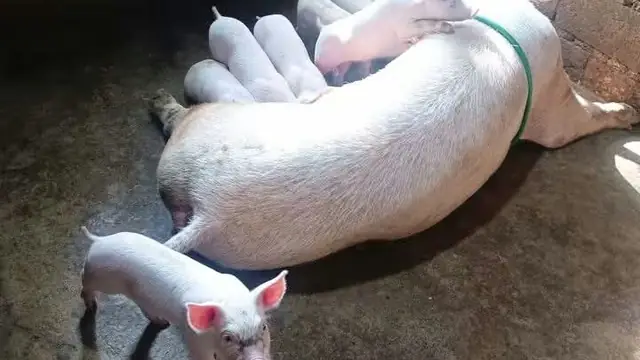
Do the teat count on the piglet at three weeks old, not on the finished gilt. Teat number is set at birth and you can count them cleanly on a piglet lying on its side. Mark the ones with 14+ with an ear notch or a stock marker and select from that shortlist later. It takes ten minutes for a whole litter and saves you feeding a gilt for five months before discovering she has 12.
Where to buy, and what to ask
Breeding-stock accreditation runs through the Bureau of Animal Industry under BAI Administrative Order No. 23, the revised guidelines for accreditation of swine breeder farms. An accredited farm must be a registered business with a permit to operate, hold pedigree and lineage records with average daily gain and feed conversion data, keep testing facilities and a backfat tester or lean meter, run a vaccination programme issuing certificates, and employ a full-time veterinarian.
That list is why accreditation matters to you. It is not a quality badge, it is a records requirement, and an accredited multiplier can tell you the sire line of the gilt you are buying. That is the one thing you need in order not to repeat the mistake above.
Nucleus farms hold the purebred Duroc, Large White and Landrace lines. Multiplier farms buy from them and produce the F1 Large White × Landrace gilts most backyard herds should be running. You buy from a multiplier. Why F1 rather than purebred is hybrid vigour in the sow, which is precisely the opposite of what inbreeding does to her.
Four questions before you pay:
- What is the sire line, and can I have it in writing? Without this you cannot avoid inbreeding two years from now.
- What parity was her dam, and what was that litter? Parity 2 to 4 dams with 10 or more born is what you want.
- What is your ASF and biosecurity status, and what is my province's zone? Movement rules change by zone and an unmoveable gilt is an expensive lawn ornament.
- What vaccinations has she had and when? You need the dates, not the assurance.
BAI publishes the current accredited list. In 2025 to 2026 listings a proven F1 Large White × Landrace at 100 to 120 kg ran ₱18,000 to ₱27,000, a younger 50 to 70 kg gilt ₱11,000 to ₱16,000, and native or upgraded crossbred gilts ₱8,000 to ₱14,000, per my replacement pricing.
The gilt you raise yourself is not free
This is the calculation that changes people's minds.
Keeping your own gilt means not selling her. At 95 kg and PSA's Q2 2026 national farmgate of ₱172.44/kg that is ₱16,382 of revenue you did not take. Then she is grown on to roughly 130 kg at eight months, another 35 kg of gain at a backyard FCR of about 3.5, so 122 kg of feed at ₱36.69: ₱4,477.
₱20,859. That is what your free gilt cost you, and it sits in the middle of the ₱11,000 to ₱27,000 band bought gilts trade in. Unlike the bought one, she brings no genetics you do not already have.
Home-raising still makes sense in two situations. If your sow line is good and you have an unrelated sire lined up, keeping a daughter preserves a maternal line you know works. And if you run native or upgraded native stock with no accredited multiplier within four hours, home-raising with a bought-in boar is the only realistic option. Outside those two, buy.
Growing the gilt out to service
The gilt still has to reach first service without being over-fattened or stunted, and this is where most backyard herds lose a year.
| Milestone | Target | Note |
|---|---|---|
| Select | 3 weeks (teats) then confirm at 5 months | Ear-notch the shortlist early |
| Start boar exposure | 160–180 days | 15–30 minutes daily contact |
| First observed heat | 200–220 days | 50% cycling by 200 days, 80% by 220 |
| Breed | Second or third heat | Not the first |
| At service | 8 months, 120–135 kg | Filipino guides say 7.5–8 months and 110–120 kg |
Breed on the second or third standing heat, not the first. Second heat sheds more eggs and gives a bigger first litter, and first-litter size is the strongest single predictor of a long productive life. The gilt-readiness checklist has the weight targets; the seven classic breeding mistakes opens with breeding at first heat because it is the commonest one in the country.
Daily boar contact from 160 days is the free part and almost nobody does it. No boar? Borrowing a neighbour's for half an hour a day at ₱100 to ₱300 is well spent on a pen of gilts you need cycling together. And feed her as a gestating sow, not a finisher: gaining, not fattening, on the gestation programme.
Free Tool
Sow Productivity Calculator (PSY)
Weaners per sow per year and where the year goes, so you can see whether your sows are worth replacing or worth keeping.
Bisaya / Cebuano
Ang imong gilt pool ug ang sayop sa pagbilin sa anak
- Kung lima ka anay ang imong nabuhi, duha ka bag-ong dumalaga kada tuig ang kinahanglan. Kung tulo ra, usa. Kung napulo, tulo o upat
- Ayaw ipabuntis ang anak sa imong butakal sa iyang kaugalingong amahan. Kana nga baktin 25 porsyento nga inbred. Mawad-an ka ug 0.6 hangtod 1.0 ka baktin kada anak ug 7.5 ka kilo sa timbang sa adlaw 160
- Ang gasto niana ₱17,600 ngadto ₱24,300 kada tuig. Mao ra kana ang bili sa pagpalit ug bag-ong dumalaga, apan kada tuig kini imong bayran
- Kung dili nimo kaya mopalit ug dumalaga, usba ang butakal, dili ang anay. Ang semilya gikan sa DA-ATI nga AI sa Barangay ₱200 ngadto ₱500 kada dose
- Ihapa ang utong sa dili pa nimo pilion. Katorse ang labing minus, pito kada kilid, tul-id ang agwat ug walay baliktad. Ihapa kini sa baktin nga tulo pa ka semana, dili sa dako na
- Ang dumalaga nga imong gipadako dili libre. Kung wala nimo siya gibaligya sa 95 ka kilo, ₱16,382 ang imong gipasagdan, ug ₱4,477 pa ang pagkaon niya hangtod moabot sa timbang nga pang-anay
Kung imong palitan, pangayo gyud ug papeles. Pangutana kinsa ang amahan sa dumalaga. Kung dili kini ikahatag sa nagbaligya, baboy ra ang imong gipalit, dili dumalaga nga pang-anay.
The record that prevents all of this
One sheet of paper on the wall. Three columns: sow, her sire, her dam. A row every time an animal enters the herd.
That is a pedigree, and it needs no software and no vet. What it does is answer in two seconds the only question that matters when you are about to serve a gilt: is this boar related to this female? If you cannot answer that today, you have an inbreeding problem you cannot measure, and the first sign will be litters shrinking for no reason anybody can explain.
Start it with the animals you have, even where half the parentage is unknown. Write "unknown" and move on. Two years from now every animal born on your place has a full line on that sheet, and the buying decisions get easy.