For raising fatteners, the three-way cross hybrid beats the purebred in almost every case: 10-15% faster growth, FCR 2.6-3.0 against 2.8-3.3, lower mortality, and the same ₱5,500-₱8,500 weaner price from an accredited multiplier. That works out to roughly ₱1,000-₱1,500 more profit per pig for the same money. Purebred only wins in three narrow cases.
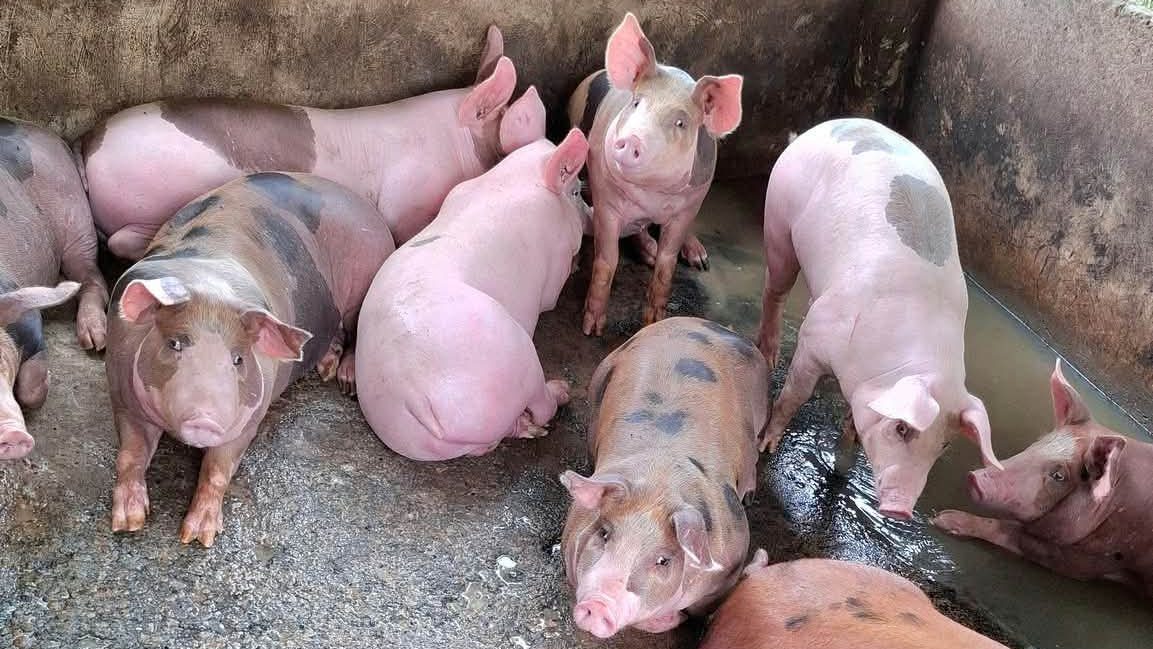
A pure Large White weaner and a three-way cross weaner can sit side by side at a Bulacan multiplier farm. Same price, same age, same vaccinations, same look. Buy the pure Large White and you spend the same feed money and the same labor over the next five months. But you reach market weight closer to 165 days instead of 152, FCR around 3.1 instead of 2.8, and a finisher near 89 kg instead of 93 kg at slaughter.
That gap is roughly ₱900-₱1,400 less profit per pig, for the same upfront cost. Across a 10-pig batch, that is ₱9,000-₱14,000 left on the table. For nothing. This is why most Philippine commercial farms run hybrids. The rest of this guide shows when purebred still fits.
Free Tool
Pig Setup Planner
The setup planner picks the right breed structure for your scale and market: whether to source three-way cross weaners or purebreds. 8 questions, evidence-backed recommendation.
What "Hybrid" Actually Means in Pig Farming
The term "hybrid" in Philippine pig production almost always refers to the three-way cross: an F1 (Landrace x Large White) sow bred to a Duroc terminal sire. The piglets carry genes from three different breeds, deliberately combined to capture each breed's strengths.
The structure:
- Generation 1: Pure Landrace boar × Pure Large White sow = F1 Landrace-Large White gilts (the maternal line)
- Generation 2: F1 LR-LW sow × Pure Duroc boar = Three-way cross piglets (the commercial finisher)
Multiplier farms produce the F1 gilts. Commercial farms buy F1 gilts and breed them to Duroc boars. The output is the three-way cross commercial pig.
Other valid hybrid combinations exist in the Philippines but are less common:
- Pietrain × (Landrace × Large White) for ultra-lean processor contracts
- Hampshire × (Landrace × Large White) for supermarket-spec lean carcasses
- Berkshire × Duroc for moderate premium meat positioning
For this article, "hybrid" means the standard LR × LW × Duroc three-way cross.
At-a-Glance Comparison
| Trait | Three-Way Cross (Hybrid) | Pure Large White | Pure Landrace | Pure Duroc |
|---|---|---|---|---|
| Days to 90 kg | 145-160 | 150-165 | 155-170 | 150-160 |
| Feed Conversion (FCR) | 2.6-3.0 | 2.8-3.2 | 2.9-3.3 | 2.7-3.1 |
| Dressing Percentage | 74-78% | 72-76% | 73-76% | 73-77% |
| Mortality (typical) | 5-8% | 7-10% | 8-11% | 7-10% |
| Born Alive (when used as dam) | 11-13 per litter | 10-14 per litter | 11-13 per litter | 9-11 per litter |
| Heat Tolerance | Moderate (Duroc influence) | Sensitive | Slightly better than LW | Best |
| Carcass: Marbling | Moderate (Duroc influence) | Low | Low | Moderate-high |
| Weaner Price (2026) | ₱5,500-₱8,500 | ₱5,500-₱8,000 | ₱5,500-₱8,000 | ₱5,500-₱8,000 |
| Gilt Price (2026) | ₱18,000-₱28,000 | ₱18,000-₱25,000 | ₱18,000-₱25,000 | ₱18,000-₱25,000 |
| Best Used For | Commercial fattening | Multiplier dam line | Multiplier dam line | Terminal sire |
| Philippine Availability | Widely available | Widely available | Widely available | Widely available |
The pattern is clear: hybrid wins on every production metric except specialized maternal-line or terminal-sire roles.
Why Hybrid Vigor Actually Matters
Hybrid vigor (heterosis) is the biological phenomenon where crossbred offspring outperform either parent breed on most traits. The mechanism:
- Pure breeds accumulate recessive deleterious genes through inbreeding
- Crossbreeding masks those deleterious genes with dominant alleles from the other breed
- The crossbred offspring expresses the optimal genetic combination
For pigs, the measured hybrid vigor effects (pig333, ThePigSite heterosis references):
- Growth rate: 8-12% improvement in average daily gain
- Feed conversion: 4-7% improvement in FCR
- Litter size: 5-10% more piglets born alive (when crossbred sow is dam)
- Piglet survival: 8-15% lower mortality (combined dam plus piglet hybrid vigor)
- Disease resistance: Reduced susceptibility to several common diseases
These individual percentages multiply across the production cycle. Pig333's heterosis figures put a purebred nucleus at about 24 pigs per sow per year; running the crossbred female to a third breed lifts total output roughly 17% over straight purebreeding. That is where the commonly cited 10-15% finisher performance lift comes from. The same heterosis effect on reproductive traits has been documented in Landrace × Large White crosses in UPLB research, so this is not just imported temperate data.
In peso terms, on a typical 90 kg fattener, priced with premium grower/finisher at ₱34.90-₱38.20/kg (₱1,747-₱1,910 per 50 kg bag, July 2026; mean ₱36.69):
- Pure breed: ₱103-₱121 feed cost per kg of liveweight gain (FCR 2.8-3.3)
- Three-way cross: ₱95-₱110 feed cost per kg of liveweight gain (FCR 2.6-3.0)
- Difference per 90 kg pig: ₱1,000-₱1,500, once the shorter days-on-feed and lower mortality are counted
That ₱1,000-₱1,500 difference is essentially free money for choosing the right breed structure.
One honest caveat. The FCR and days-to-market figures in the comparison table are well-managed numbers. Real backyard results run 30-50% softer because of cheaper mixed feed, heat stress cutting intake, and subclinical parasites. But the gap between hybrid and purebred holds up at backyard level too. If a purebred takes 200 days under poor management, the hybrid still beats it by a similar 7-13 days and a similar FCR margin. The advantage scales with your conditions; it does not disappear when management is rough.
When Hybrid Is the Clear Choice
Choose three-way cross hybrid pigs if:
1. You're a Fattener Operator
Buying weaners to grow out to market weight is the most common Philippine backyard pig operation. For fattening, hybrid wins on every metric: growth, FCR, mortality, sale price. There's no reason to buy purebred unless purebred is materially cheaper at your local multiplier, which it almost never is. Honestly, in most provinces it's the same price tag with a different label.
2. You're a Farrow-to-Finish at Backyard or Small-Commercial Scale
If you're keeping 3-10 sows and selling weaners or fattening to market, F1 gilts (Landrace × Large White) bred to Duroc are the standard configuration. This produces three-way cross piglets for fattening or sale as commercial weaners.
The F1 gilt is itself a hybrid (Landrace × Large White), so this entire structure captures hybrid vigor at both the dam and progeny level.
3. You're Selling to Standard Markets
Wet markets, traders, lechoneros, palengke vendors, processor contracts, integrator buyers all accept and pay standard farmgate prices for hybrid pigs. PSA's last official quarter put that rate at ₱172.44/kg liveweight (Q2 2026); PSA has not yet published July to September, but the DA said the national average was ₱150/kg in August 2026 (Manila Times, 28 Sep 2026). SINAG's ₱180-₱190 from May 2026 is history now. The ₱210/kg "floor" from November 2025 is an industry-agreed, DA-backed target, not enforceable. The national average has not reached it since it was set; four regions have, for a few months each (Cordillera 5, BARMM 2, Central Visayas 2, NCR 1). Treat it as a target, not a floor you can count on collecting. Whatever the number is that week, it is the same for a hybrid finisher and a purebred one. There's no commercial market disadvantage to hybrid production.
4. You Care About Margin
A 10-pig batch of hybrids vs purebreds at identical input cost delivers ₱10,000-₱15,000 more revenue. Over a year of running 2 cycles, that's ₱20,000-₱30,000 in extra profit. No additional capital, no additional management complexity, just a smarter breed choice.
That edge counts for more now than it did two years ago. PSA's official farmgate was ₱172.44/kg for Q2 2026 and the DA's August figure is ₱150/kg, while producer groups put cost of production at ₱180-₱190/kg (Daily Tribune, 2 Oct 2026; BusinessMirror, 9 Oct 2026). The average farm is selling for less than what it spent: ₱8-₱18 a kilo under at the PSA quarter, ₱30-₱40 under at the DA's August price. On margins that thin, the breed gap is not a bonus on top of your profit. It often is your profit. Run your own numbers in the profit simulator before your next batch, and use PSA's official ₱172.44 (Q2 2026) or the DA's August ₱150, not SINAG's old ₱185 and not the ₱214.52 peak of June 2025.
And if you want the price difference that genuinely exists in the published data, it is not between breeds. It is between farm types. I compute PSA's backyard-to-commercial gap month by month from two surveys neither agency ever subtracts from each other, alongside the all-farms series the ₱172.44 comes out of. The feed assumption behind every peso figure above is one dated retailer listing, which is all anyone has.
When Purebred Still Makes Sense
There are three specific situations where pure-breed pigs are the right call:
1. Multiplier Farm Operation
If your business is producing and selling breeding stock, pure Landrace gilts, pure Large White boars, F1 gilts for commercial farms, you must maintain pure lines. This is the only path to producing F1 gilts (which are themselves hybrids but require pure parents).
Multiplier farms are a specialty market with completely different economics than commercial fattening. The premium for breeding-quality purebred stock (₱20,000-₱40,000 per gilt or boar) justifies the production cost. But this is a small, specialized industry segment.
2. Specialty Heritage Production
Pure Berkshire production for premium specialty restaurant markets. Pure native pig production for traditional lechon markets at premium prices. Pure Duroc for branded premium pork programs. In all these cases, the pure-breed identity is part of the marketing position and justifies the production economics trade-off.
This is also a small specialty segment.
3. Conservation Programs
The Philippines has government and academic conservation programs for native pig breeds (Markaduke, Berkjala, Q-black). These programs maintain pure lines specifically to preserve genetic diversity, not for commercial profit. Farms participating in conservation programs receive subsidies and play a role in biological heritage preservation.
A Common Misunderstanding
Many first-time pig farmers think "pure-breed = better quality." That's wrong for production economics.
Pure breeds are necessary to PRODUCE hybrid breeds. The multiplier farm that maintains pure Landrace and pure Large White lines is the upstream supplier. The commercial fattener that buys F1 gilts and breeds them to Duroc is the downstream consumer.
If you're at the downstream end (which 95% of Filipino pig farmers are), buying hybrid stock is the correct economic choice. "Pure-breed" is not a quality marker for commercial fattening. It's a production stage upstream of you.
The actual quality marker is the multiplier farm's genetic merit, meaning the performance records of the pure breeds being used to produce the hybrids. A high-genetic-merit Landrace × Large White F1 gilt from INFARMCO or Topigs Norsvin will outperform an indifferently-bred F1 gilt from a small unaccredited multiplier, even though both are "F1 hybrids." The hybrid status matters less than the genetic source. So don't fixate on the word "hybrid" on the receipt; ask for the parent stock records instead.
Sourcing Hybrid Pigs in 2026
Where to source three-way cross weaners and F1 gilts in the Philippines:
Luzon-based multipliers:
- INFARMCO (Bulacan): pure lines plus F1 gilts
- Family Farms (Topigs Norsvin Philippines): full hybrid program
- PIC Philippines: proprietary hybrid lines for commercial integrators
- Numerous provincial multipliers and accredited DA-BAI multiplier farms
Visayas and Mindanao:
- Regional multipliers operating on Luzon-sourced parent stock
- Cebu, Iloilo, Davao have established F1 gilt suppliers
- Most regional multipliers charge 10-15% premium over Luzon prices due to transport
One caution if you are sourcing across islands right now. ASF came back in the Visayas in late June 2026: Negros Occidental (San Enrique, 23 June, about 1,902 pig deaths province-wide by 25 June, not all of them from ASF), Iloilo (Barotac Viejo, 29 June, its first case in four years), Bacolod and Negros Oriental on 1 July. Cebu banned Negros pigs and pork on 7 July (EO 39) and Capiz shut its border to pork on 24 June. Check the current LGU and provincial movement orders before you pay a deposit on stock that has to cross a strait.
What to verify before buying:
- BAI ASF-free certification of the source farm
- Performance records (dam's litter size, sire's FCR if available)
- Visual health inspection of the pigs
- Vaccination history
- Age and weight match (should be 25-30 days, 6-9 kg for weaners)
Crossbreeding Mistakes to Avoid
A few common errors when farmers try to "engineer their own hybrids":
1. Breeding F1 Sows to F1 Boars
This produces F2 piglets that lose most of the hybrid vigor. The genetic combinations become unpredictable and performance varies widely litter to litter. Always use F1 sows with a pure terminal sire (Duroc or Hampshire) to maintain consistent hybrid output.
2. Random Crossing Without a Plan
Just crossing any two breeds doesn't produce optimal hybrid vigor. The combinations need to be deliberate: Landrace × Large White (both maternal) for the dam line, Duroc (terminal) for the sire. Random crossbreeding (say, Landrace × Duroc directly) produces moderate hybrid vigor but is not as productive as the structured three-way cross.
3. Using Unverified Parent Stock
A "hybrid" produced from unverified parent stock can be no better than purebred. The hybrid advantage depends on the parent breeds being genuinely from distinct genetic lines. If both parents come from a closely-related multiplier herd, hybrid vigor is reduced or absent.
Buy F1 gilts from established multipliers with documented parent stock from distinct genetic lines. Don't try to engineer your own hybrids from random local stock.
Bisaya / Cebuano
Para sa mga mag-uuma
Hybrid (3-way cross) ba o purebred?
Para sa fattener operation (kasagaran sa Filipino backyard farmers), hybrid gyud, walay debate. Ang math:
- Mas paspas og tubo (10-15% mas paspas). Moabot sa market weight og 145-160 ka adlaw, kay sa 150-170 sa purebred
- Mas maayong feed conversion (FCR 2.6-3.0 kaysa 2.8-3.3)
- Mas ubos ang mortality (5-8% kaysa 7-11%)
- Parehas ra og presyo, ₱5,500-₱8,500 kada weaner sa parehong tindahan
- ₱1,000-₱1,500 nga dugang nga ginansya kada baboy, walay dugang nga gasto
Unsa ang three-way cross?
Standard Philippine commercial pig:
- F1 sow (Landrace × Large White). Naa kini maternal traits
- Duroc boar. Naa kini growth ug maayong karne
- Anak: three-way cross piglet nga ma-fatten hangtod market weight
80% sa mga komersyal nga baboy sa Pilipinas mao kini ang lahi. Dili coincidence.
Kanus-a maayo ang purebred:
- Multiplier farm ka. Kinahanglan ang pure Landrace, pure Large White, ug pure Duroc para makahimo og F1 gilts nga ibaligya sa commercial farmers
- Specialty heritage production. Pure Berkshire para sa premium restaurant market, o pure native para sa tradisyonal nga lechon market
- Conservation program. Pure native nga Pilipinhong breeds (Markaduke, Berkjala, Q-black) para sa genetic preservation
Para sa 95% sa Filipino fattener farmers, three-way cross gyud.
Komon nga sayop:
- Pagpalit sa pure Landrace o pure Large White para fatten-on. Parehas ra og bayad ang F1 hybrid, mas dako og produksyon. Free upgrade.
- Pagsabot nga "pure breed = mas maayong quality." Sayop kaayo. Pure breed kinahanglan para makahimo og hybrid; ang hybrid mao ang final commercial product.
- Pag-cross og random. F1 sow × F1 boar dili patas. Kinahanglan ang structured plan: F1 sow × pure Duroc terminal sire.
Asa mopalit og F1 gilts o three-way cross weaners:
- INFARMCO (Bulacan)
- Family Farms / Topigs Norsvin Philippines
- PIC Philippines
- DA-BAI accredited multiplier farms
- Regional multipliers sa inyong probinsya
Importante: i-verify ang ASF-free certification, performance records, ug genetic source ayha mopalit. Ayaw ipalit gikan sa source nga walay records.
Related Reading
- Hybrid (Three-Way Cross) Breed Guide: full breed page for commercial hybrids
- Landrace vs Large White Comparison: choosing the maternal line for hybrid programs
- Duroc vs Hampshire Comparison: choosing the terminal sire
- Best Pig Breeds Philippines for Small Farmers: full breed comparison guide
- Sow vs Fattener Profit Math: when to add F1 gilts to your operation
- Profit Simulator: model hybrid vs purebred cycle math
Sources
- Heterosis (hybrid vigour) and inbreeding, pig333: combined three-way-cross output gain of roughly 17% over straight purebreeding.
- Do Not Forget About the Basics: Heterosis, ThePigSite (Genesus-sponsored): heterosis defined, individual versus maternal heterosis, and why an F1 dam bred to a third-breed sire keeps 100% of both.
- University of the Philippines Los Baños (UPLB), Philippine Journal of Veterinary and Animal Sciences: heterosis in reproductive traits of Landrace × Large White crosses.
- Philippine Statistics Authority (PSA), OpenSTAT: average farmgate price of pigs for slaughter. Q3 2025 ₱191.51/kg; Q1 2026 mean ₱176.03/kg; Q2 2026 mean ₱172.44/kg (Apr ₱174.00, May ₱171.56, Jun ₱171.76).
- SINAG industry average, May 2026: ₱180-₱190/kg liveweight; eFeedLink trade quotes ₱183-₱193/kg (both history now).
- DA via Manila Times (28 Sep 2026): national liveweight ₱150/kg, August 2026 (trade-reported, not PSA). Cost of production ₱180-₱190/kg per producer groups (Daily Tribune, 2 Oct 2026; BusinessMirror, 9 Oct 2026).
- ₱210/kg target agreed by the industry with DA backing on 4 November 2025; not enforceable. The national average has not reached it since it was set; regions at or above it since then: Cordillera (5 months), BARMM (2), Central Visayas (2), NCR (1).
- Feed price survey (12 July 2026): premium grower/finisher ₱34.90-₱38.20/kg, ₱1,747-₱1,910 per 50 kg bag.
- Bureau of Animal Industry (BAI) and LGU executive orders, June-July 2026: ASF resurgence in Negros Occidental, Iloilo, Negros Oriental; movement bans in Cebu (EO 39) and Capiz.
- DA-BAI accredited multiplier farm registry; Topigs Norsvin Philippines and PIC Philippines published genetic performance data; INFARMCO production records (2024-2026).
Performance figures in the comparison table reflect well-managed conditions. Backyard results typically run 30-50% softer; the hybrid-over-purebred margin holds at backyard level. Prices vary by province and over time. Not veterinary advice; consult your local veterinarian or DA-BAI office for stock certification.