Nearly 49 percent of piglet deaths happen within the first 24 hours of birth, per a Philippine study tracking 242 litters in Benguet and Leyte. Crushing by the sow drives 27 percent, starvation 19 percent, scours 10 percent. Most are preventable for under ₱500 with bamboo guard rails, assisted nursing, a 100W heat bulb, and basic farrowing hygiene.
The Top Causes of Piglet Death
| Cause | Share of deaths | Peak risk period | Preventable? |
|---|---|---|---|
| Crushing by the sow | ~27% | First 72 hours | Yes, with guard rails |
| Starvation / failure to nurse | ~19% | First 24 hours | Yes, with assisted nursing |
| Scours / diarrhea | ~10% | Day 1-14 | Mostly, with hygiene + meds |
| Born weak / low birth weight | ~9% | Birth | Partially, with sow nutrition |
| Hypothermia | ~8% | First 6 hours | Yes, with drying + warmth |
A study of backyard farms in Northern Negros Occidental (2023) found even higher scours rates, with diarrhea causing 43% of piglet deaths. The numbers shift depending on farm conditions, but the top three killers are consistent: crushing, starvation, and scours.
1. Crushing by the sow (~27% of deaths)
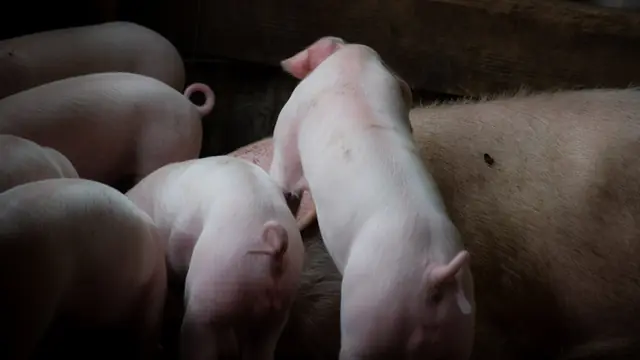
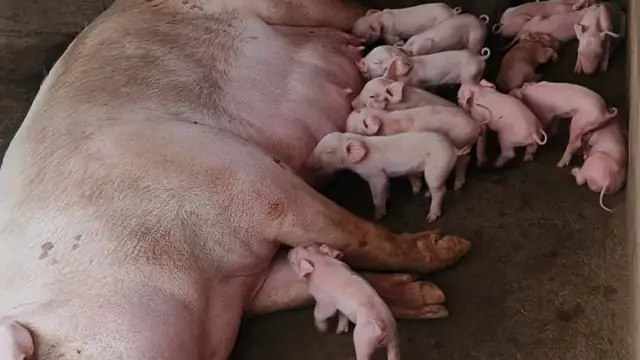
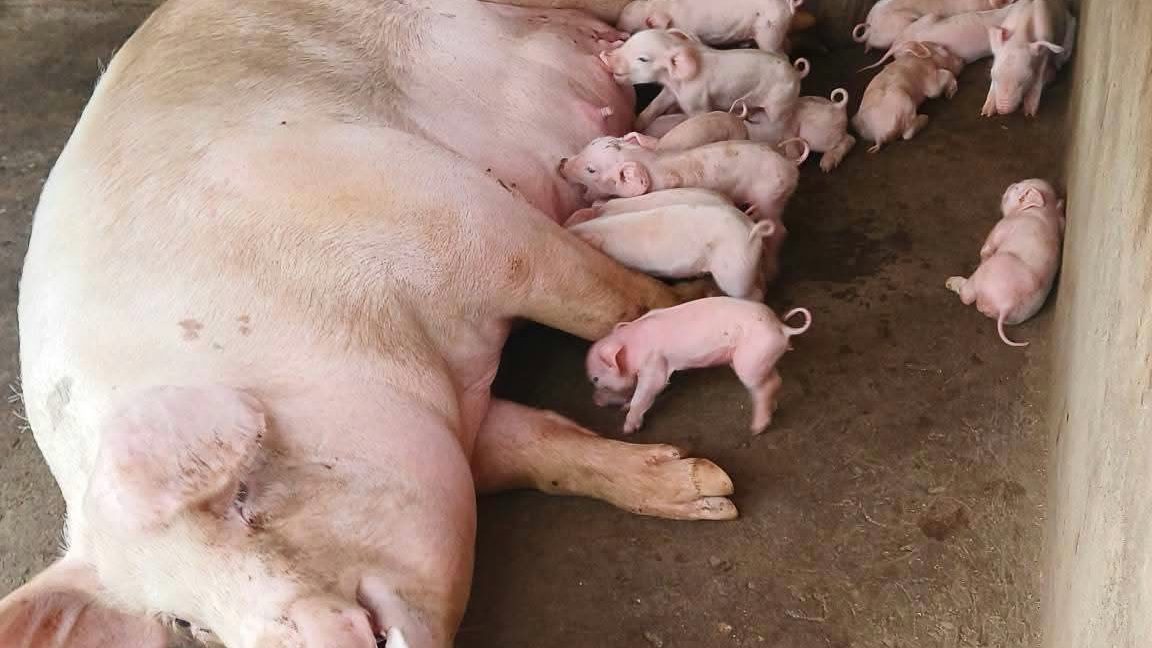
This is the number one killer. The sow lies down and a piglet gets trapped underneath. Larger sows are worse. It happens most often in the first 72 hours when piglets are small, slow, and sleep close to the sow for warmth.
The BAI Code of Practice for Pigs (Administrative Order No. 41, Series of 2000) requires that farrowing quarters include "means to protect piglets from overlaying by the sow." Guard rails are the simplest way to comply.
How guard rails work: A horizontal bar runs around the pen perimeter, 20-25 cm from the wall and 20-25 cm above the floor. This creates an escape zone piglets can duck into when the sow rolls over. The FAO Farm Structures guide specifies these same dimensions for tropical smallholder pens.
Materials and cost:
- Bamboo poles: ₱30-80 per pole, need 6-8 poles. Total: ₱200-500
- Coco lumber: ₱25-50 per board foot, need 10-15 bf. Total: ₱250-750
- Steel pipe (1-inch GI): ₱150-250 per 6m length. More durable but overkill for most backyard setups
Bamboo works but rots faster in Visayas humidity. Most farmers I've talked to in Cebu and Leyte replace bamboo rails every 2-3 farrowings. Coco lumber lasts longer if you keep it off wet concrete.
If you are building a new pen, see how to build a backyard piggery for full farrowing pen dimensions and guard rail placement.
2. Starvation / failure to nurse (~19% of deaths)
Piglets are born with zero antibodies and almost no energy reserves. Colostrum is the only source of both immune protection and calories in the first hours. According to the AHDB colostrum management guide, piglets need at least 150 ml of colostrum per kg of body weight within 16 hours to survive.
The timeline is harsh:
- 0-6 hours: Gut is fully open. Maximum antibody absorption. This is your window.
- 6-12 hours: Gut starts closing. IgG concentration in colostrum drops to 50-65% of the original level.
- 12-24 hours: Absorption drops to 10-15% of original capacity.
- 24-36 hours: Gut closure completes. After this point, the piglet can no longer absorb maternal antibodies at all.
Why piglets fail to nurse:
- Agalactia or mastitis. The sow has no milk or painful teats. More common in gilts.
- Too many piglets. A sow has 12-14 functional teats. Litters of 13+ mean somebody gets pushed out. Research shows litters above 13 have 24% mortality versus 12% for litters of 8-10.
- Weak piglets. Runts get shoved aside by stronger siblings, especially in the first scramble for teats.
- Sow won't lie down. Gilts and stressed sows sometimes refuse to nurse. This is where patience matters, and sometimes a quiet pen is all it takes.
What to do:
Physically place weak piglets on a teat within 6 hours. If the litter is too large, use split suckling: close the stronger half in the creep area for an hour while the weaker piglets nurse, then swap. This takes about 5 minutes per rotation and can save 2-3 piglets per litter.
If the sow has no milk, your options:
- Cross-foster to another sow that farrowed within 4 days and has spare teats. Mark fostered piglets so nobody moves them again. Match sizes: small piglets go to sows with smaller litters.
- Commercial milk replacer. B-MEG Piglet Milk Replacer runs about ₱250-400 per kg. Nuklospray Yoghurt is ₱1,200-1,600 per 3.5 kg bag. Mix 200g per liter of warm water (38-40°C) and feed every 2-3 hours for the first week.
- Emergency substitute. Fresh goat's milk works better than cow's milk because of the fat profile. Evaporated milk diluted 1:1 with water plus a pinch of sugar works for a day or two, but it is not a real replacement.
3. Scours / diarrhea (~10-43% of deaths)
The percentage varies wildly by farm. International data puts it at ~10%, but that Northern Negros study found 43% on Philippine backyard farms where sanitation was poor. In my experience, scours kills more piglets than the textbooks suggest, especially during the wet season when pens stay damp.
The pathogen depends on when the diarrhea appears:
| Timing | Likely cause | What it looks like |
|---|---|---|
| Day 1-3 | E. coli (ETEC) | Profuse watery diarrhea, rapid dehydration |
| Day 1-3 | Clostridium perfringens Type C | Bloody/hemorrhagic diarrhea, very high mortality |
| Day 5-14 | Coccidiosis (Cystoisospora suis) | Yellow-gray pasty diarrhea, fetid smell |
| Day 7-21 | Rotavirus | White "milk scour," high morbidity but lower mortality |
Prevention:
- Scrub the farrowing pen with lime (apog) at least a week before the sow enters. Conventional disinfectants don't kill coccidia oocysts, but lime and flame do.
- Keep the pen dry. Scours pathogens thrive in wet, dirty conditions. Good pen flooring with proper drainage makes a big difference.
- Ensure every piglet gets colostrum. Maternal antibodies are the first line of defense against E. coli.
- For coccidiosis prevention: toltrazuril (Baycox 5%) given as a single oral dose at 3-5 days of age. Dose is 20 mg/kg body weight. For Baycox 5% (50 mg/mL), that's about 0.6 mL for a 1.5 kg piglet. Baycox 100 mL costs ₱1,200-1,800; generic toltrazuril (Tolcox) runs ₱400-800 for 100 mL. Per-piglet cost: ₱3-12. The NADIS veterinary guide reports this single dose reduces coccidiosis from 71% to 22% of litters.
Toltrazuril is a preventive, not a treatment. Give it at day 3-5 before symptoms appear. Once piglets have active diarrhea, you need oral electrolytes to prevent dehydration and an antibiotic if E. coli is suspected. Consult your municipal vet for the right antibiotic, as resistance patterns vary by area.
For more on disease prevention and biosecurity, see preventing pig diseases before they start.
4. Born weak / low birth weight (~9% of deaths)
Piglets under 800-1,000 grams at birth have very low survival rates regardless of management. A 2022 study in the journal Animals found that non-viable piglets averaged just 590 grams. These are typically runts from large litters or from sows with poor nutrition during the last trimester.
What you can do:
- Feed the sow adequately during the last 3 weeks of gestation. Protein supplementation with copra meal (₱18-22/kg) or fish meal (₱35-45/kg) increases average piglet birth weights. Check BAI's wholesale copra meal series before you budget that line, because it has traded from roughly ₱7 to ₱20 a kilo since January 2023 and the sow does not care which end of that range you bought at. A sow needs roughly 2.5-3.0 kg of feed daily in late gestation.
- Avoid breeding very young gilts. Wait until she is truly ready: at least 8 months old, 100+ kg, and on her second or third heat cycle.
- Native pig litters are smaller (6-8 piglets) but piglets tend to be more uniform in size. Crossbred and commercial sows throw bigger litters with more variation, which means more runts.
And honestly, some runts just won't make it even with perfect management. Focus your energy on the piglets you can save.
5. Hypothermia (yes, even in the Philippines)
This one surprises a lot of farmers. But here's the biology: a piglet's body temperature in the womb is 39-40°C. At birth, it drops fast. A Brazilian study in tropical conditions (similar latitude to Mindanao) measured surface temperature drops of 2-4°C within 30 minutes of birth. Piglets need an ambient temperature of 34°C in the first week. A typical Philippine rainy season night drops to 22-25°C. That is a 10-degree gap.
The real danger is the cascade effect. A cold piglet gets sluggish. A sluggish piglet doesn't reach the teat fast enough. A piglet that misses colostrum gets weaker. A weak piglet sleeps close to the sow. A piglet sleeping close to the sow gets crushed. Hypothermia, starvation, and crushing are not three separate problems. They are one chain reaction.
Prevention:
- Dry piglets immediately after birth with clean rags. This alone prevents the worst temperature drops.
- Provide a creep area with supplemental heat. The BAI Code of Practice (AO No. 41) specifies 32°C in the creep area for the first three weeks. A 100-watt incandescent bulb (₱30-50) works for small pens. Infrared heat bulbs (150-250W, ₱150-350) are better. Position the bulb 45-60 cm above the bedding.
- Use rice straw or dried banana leaves as bedding. Never bare concrete, which conducts heat away from piglets fast.
- During the rainy season, check for drafts and leaks in the farrowing pen. A dry pen at 25°C with bedding and a heat lamp is fine. A wet pen at 25°C with bare concrete kills piglets.
A simple test: if you see piglets huddling in a tight pile, they're too cold. If they're spread apart and sleeping on their sides, the temperature is right. If they're panting or avoiding the heat source, it's too hot. Adjust the lamp height accordingly.
Farrowing Supply Kit with Costs
Everything you need for one farrowing, with approximate prices as of 2025. Prices vary by province, so expect ₱100-200 variation in Visayas and Mindanao compared to Luzon.
| Item | Purpose | Approximate cost |
|---|---|---|
| Guard rails (bamboo, 6-8 poles) | Anti-crushing | ₱200-500 |
| Clean rags (old t-shirts work) | Drying piglets | Free-₱50 |
| Povidone-iodine 10%, 60 mL (Betadine or generic) | Navel dipping | ₱80-180 |
| Nylon thread or dental floss | Tying umbilical cord | ₱30-50 |
| Iron dextran 100 mL vial (Ferrodex, Hi-Jectifer, or generic) | Day 3 injection, prevents anemia | ₱200-550 |
| Toltrazuril 100 mL (Baycox or Tolcox) | Day 3-5 oral dose, prevents coccidiosis | ₱400-1,800 |
| Heat bulb, 100-250W | Creep area warmth | ₱30-350 |
| Rice straw or banana leaves | Bedding | Free-₱50 |
| Milk replacer, 1 kg (B-MEG or Nuklospray) | Emergency if sow has no milk | ₱250-1,600 |
| Total (basic kit without milk replacer) | ₱940-3,480 |
The iron dextran and toltrazuril bottles last multiple litters. Per-piglet cost for iron is about ₱2-5; for toltrazuril, ₱3-12. These two products alone prevent the most common nutritional deficiency (anemia) and the most common gut infection (coccidiosis) in neonatal piglets.
The Farrowing Timeline
1 week before the due date
Move the sow to a clean, dry farrowing pen. Scrub walls and floor with lime solution. Install guard rails if not already in place. Set up the creep area with bedding and heat source. Have your supply kit ready.
BAI guidelines say sows should be in the farrowing pen at least 3-5 days before the expected due date (AO No. 41, Series of 2000).
Day of farrowing
Have clean rags, iodine, thread, and a notebook ready. If this is the sow's first litter (gilt), plan to be present for the entire farrowing. Gilts are more likely to reject piglets or lie on them, and they have higher dystocia rates because of a narrower pelvis. If labor stalls for more than 30 minutes between piglets or the sow strains without producing one, see our dystocia (difficult farrowing) guide for the manual intervention sequence.
First 6 hours (the critical window)
- Dry each piglet immediately as it's born.
- Dip or spray the navel stump with iodine.
- Make sure every piglet latches onto a teat. Physically place weak ones on rear teats (these produce more milk).
- If the litter exceeds the number of functional teats, begin split suckling.
- Record the time, number born alive, number stillborn, and any abnormalities.
Day 1-3
- Watch for diarrhea. Watery stool in the first 3 days usually means E. coli.
- Day 3: Iron dextran injection. Standard dose: 1 mL of 100 mg/mL solution (or 0.5 mL of 200 mg/mL), injected IM in the neck or ham. This prevents iron deficiency anemia, which causes pale, weak piglets by week 2. See iron injection for piglets for the full protocol.
- Day 3-5: Toltrazuril oral dose for coccidiosis prevention (see dosing above).
First week
- Check that all piglets are nursing and gaining weight. A healthy piglet should visibly fill out by day 3-4.
- Remove any dead piglets immediately. Decomposition attracts flies and bacteria.
- If you plan to castrate male piglets, see when to castrate piglets in the Philippines for timing and technique.
A Note on ASF and Farrowing Biosecurity
The last national count BAI published was on 8 May 2026: 8 active barangays across 7 provinces, down 92% from the 98 barangays of 31 December 2025. That figure is stale, and reading it as today's situation would be a mistake. ASF is back in the Visayas. San Enrique in Negros Occidental was confirmed on 23 June 2026, with 1,902 hog deaths province-wide by 25 June, not all of them from ASF. Barotac Viejo in Iloilo followed on 29 June, its first case in four years. Then Bacolod and La Libertad in Negros Oriental on 1 July. Capiz red-zoned five LGUs and shut its border to pork on 24 June, and Cebu banned Negros hogs and pork on 7 July under EO 39. ASF has not been eradicated, and backyard farms remain the most vulnerable.
The farrowing period is not when you worry about ASF specifically. The standard biosecurity measures that protect piglets from scours and other neonatal diseases, clean pens, controlled visitor access, no swill feeding, are also the basics of ASF prevention.
The DA's BABay ASF program (Administrative Order No. 07, Series of 2021) emphasizes barangay-level surveillance. If you are in a yellow or pink zone, your municipal vet can advise on current restrictions and whether movement permits are needed for bringing in a new sow.
For broader disease prevention strategies, including the vaccination schedule for sows before farrowing, we have separate guides.
What Experienced Farmers Get Wrong
"Kung daghan kaayo ang baktin, dili tanan mabuhi." (If there are too many piglets, not all will survive.)
You hear this a lot, and it's partly true. But it's not inevitable. The Lanada field trial proved that basic interventions (guard rails, assisted nursing, iron injection, hygiene) reduced pre-weaning mortality to zero in treated herds. Zero. The problem is not litter size. The problem is management during the first 72 hours.
Most farmers I've talked to in Cebu and Davao lose piglets because they were not present during farrowing, not because the litter was too big. Sus, even just being there for the first 12 hours and drying each piglet as it comes out makes a bigger difference than any medicine.
The other common mistake: treating all five causes separately. They are not separate. A cold piglet becomes a starving piglet becomes a crushed piglet. Fix the temperature problem and you fix half of everything else.
Pre-weaning mortality is not just a welfare number, it is a margin number. A 5-sow operation losing 17% of piglets versus 9% is roughly 30 fewer pigs to market per year at typical Philippine litter sizes. Do that math at today's prices, not at 2024's. As of May 2026, SINAG puts the industry farmgate average at ₱180-190/kg while cost of production sits around ₱180/kg. The average farm is selling at roughly its own cost. On a 95 kg hog that leaves a few hundred pesos a head, not thousands, so 30 extra pigs is maybe ₱10,000-20,000 a year, not ₱120,000. The price half of that arithmetic is PSA's backyard farmgate series, monthly since 2010, and it is the number to rerun the calculation against before you decide a farrowing kit is too expensive.
That sounds worse, but it actually makes farrowing management matter more, not less. The sow eats the same whether she weans 8 piglets or 11. Her gestation feed, her lactation feed, her breeding cost are already spent by the time the piglets hit the floor. Every one you keep alive spreads that fixed cost across more animals. In a year where the average farm barely clears its own cost, the piglets you save in the first 72 hours are the whole margin.
Free Tool
Pig Profit Simulator
Run two batch scenarios with different pre-weaning mortality rates (say 17% vs 9%) and the same feed and price assumptions, to see exactly how many pesos a year your farrowing protocol is worth.
Bisaya / Cebuano
Para sa mga mag-uuma
Ang pinaka-daghan nga rason ngano mamatay ang baktin sa unang semana:
- Nahigpitan sa anay (27%), butangi og guard rail ang tangkal. Gamita og kawayan o kahoy, mga ₱200-500 ra ang gasto.
- Wala makasuso (19%), siguraduha nga makasuso ang tanan sulod sa 6 ka oras. Kung daghan ra kaayo, gamita ang split suckling.
- Kalibanga / scours (10-43%), limpyo ug uga ang tangkal. Toltrazuril sa day 3-5 para malikay sa coccidiosis.
- Gamay ra kaayo pagkatawo (9%), pakan-a og sakto ang anay samtang nagburos, labi na sa last 3 weeks.
- Katugnaw (8%), pahiran dayon ang baktin kung matawo, butangi og bombilya sa creep area.
Ang labing importante: naa ka sa tangkal panahon sa panganak. Kadaghanan sa kamatayon mahitabo sa unang 24 ka oras. Kung naa ka didto, ma-tabangan nimo ang mga baktin nga dili makasuso o nakatulog duol sa anay.
Related Guides
- Iron injection for piglets: full protocol, dosage, and brand comparison
- Common pig diseases in the Philippines: symptoms and what to do for each one
- How to build a backyard piggery: includes farrowing pen design with guard rail placement
- Best pig breeds for small farmers: breed traits including mothering ability and litter size
- How many piglets does a native pig have?: litter size expectations by breed type
- Preventing pig diseases: biosecurity basics for backyard and semi-commercial farms
- Feed calculator: estimate daily feed requirements for sows and piglets
Sources: Lanada EB, Lee JA, More SJ, Cotiw-an BS, Placer AA, Miller DG (2005) "A longitudinal study of unweaned piglets raised by smallholder farmers in the Philippines" (Preventive Veterinary Medicine 71:1-2); Lanada EB, Lee JA, More SJ (2001) "A field trial of the effect of improved piglet management on smallholder sow productivity in the Philippines" (Preventive Veterinary Medicine); BAI Administrative Order No. 41, Series of 2000 "Code of Practice and Minimum Standards for the Welfare of Pigs"; DA Administrative Order No. 07, Series of 2021 "BABay ASF Programme"; IRJSTEM (2023) backyard swine production study, Northern Negros Occidental; FAO Farm Structures in Tropical Climates, Chapter 10; AHDB "Colostrum Management for Pigs"; NADIS "Coccidiosis in Piglets"; MDPI Animals (2022) neonatal piglet post-mortem study; BAI national ASF situation report (8 May 2026); DA and LGU advisories for Negros Occidental, Negros Oriental, Iloilo, Capiz and Cebu (June-July 2026); SINAG farmgate and cost-of-production estimates (May 2026).