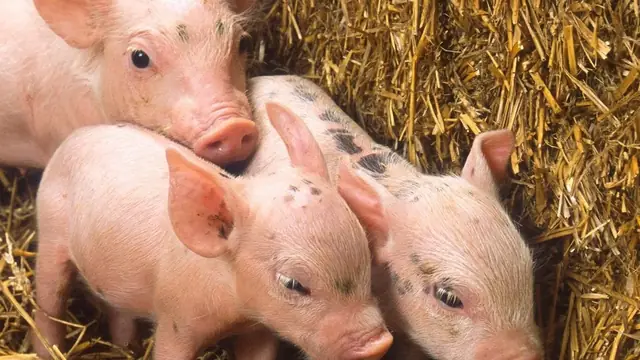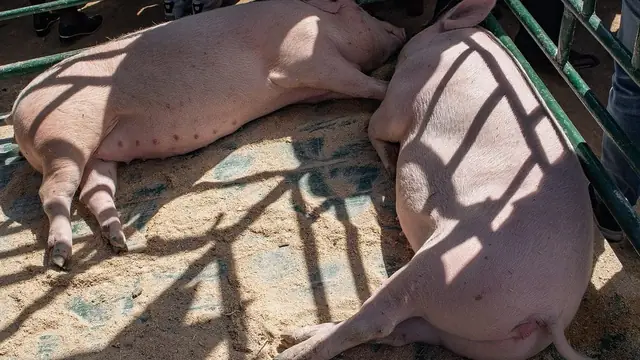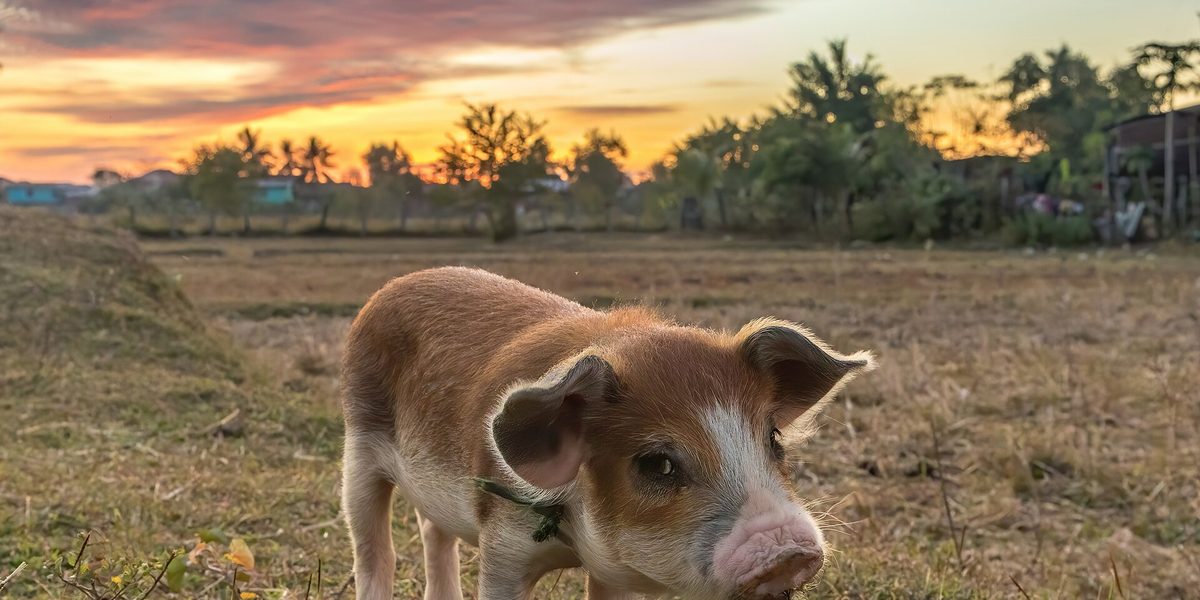
"Pilia ang baktin nga kusgan, dili ang barato. Ang barato gyud, mahal ra inig kahuman." (Choose the strong piglet, not the cheap one. The cheap one always ends up expensive in the end.)
A bad weaner costs ₱5,000 upfront plus ₱9,000 to ₱11,000 in feed before you find out it never grows. Twelve fast checks at the seller's pen catch most failures in under two minutes. Six visual, five hands-on, one paperwork. Run them in order, every time, and walk away when something fails.
Before you arrive: set the rules
Tell the seller before you drive over: you want to see the sow, you want a vaccination record, and you want to inspect the piglets calmly without a rush. If they refuse any of those, save the trip. A serious breeder welcomes inspection. A rushed seller is selling problems.
Also bring three things in your pocket:
- A pen and the printed checklist below (or screenshot on your phone)
- A small bag of pellets to test feed response
- A roll of paper towels in case you need to wipe a mucky piglet for a real look
Phase 1: Visual checks (60 seconds, do not enter the pen yet)
Stand at the rail. Don't go in. The point of this phase is to watch a piglet behaving naturally before your presence changes anything. As soon as you climb into the pen, every piglet will stand up, get curious, or hide. You lose the resting picture.
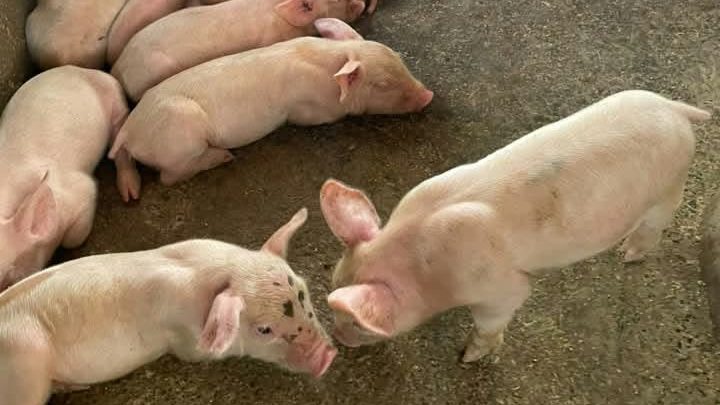
Test 1: The herd posture
Look at the whole batch. Healthy weaners stand or lie in a loose heap, breathing easily, ears up. If most of them are piled tightly together with their heads down, the pen is cold or they're sick. If they're spread out panting with their bellies pressed to the ground, they're heat stressed. If a few are in the corner alone, those are the ones being bullied. Usually they're the ones already weak.
Test 2: The breathing test
Pick the piglet you're considering. Watch its flank rise and fall. A healthy weaner breathes 25-40 times per minute (Penn State Extension). Anything over 50 at rest is concerning. Visible labored breathing, flank pumping hard, or open-mouth breathing means walk away. Pneumonia is the second-biggest killer of newly weaned pigs after scours, and a piglet who is wheezing now will be dead or stunted in two weeks.
If you see one piglet sneezing, that's normal. If three out of ten are sneezing, that's a herd respiratory problem. Atrophic rhinitis (Merck Vet Manual) typically shows up at 3-8 weeks with sneezing, nasal discharge, and a faintly twisted snout. Do not buy weaners from a pen with this.
Test 3: Coat and skin from a meter away
A healthy piglet has a smooth, lightly oily-looking coat that lies flat. Rough, dull, "haystack" hair means malnutrition or worms. Bald patches with crusty edges around the head and ears are mange. Greasy, blackened patches with a sweetish smell are exudative dermatitis ("greasy pig disease"), a bacterial skin infection that spreads fast in warm pens and can kill a young piglet in days.
You don't need to enter the pen for this. Skin problems are visible from outside.
Test 4: Eyes and nose
Bright, clear, no discharge. Crusty corners, watery streaks down the face, or a wet smear of mucus on the snout are all signs of active infection. A piglet rubbing its face on the pen wall is dealing with something. Could be flies, could be irritation from rhinitis. Either way, it's a flag.
Test 5: The walk
Watch a piglet walk across the pen. Healthy pigs move smoothly, four legs landing evenly, weight distributed across all hooves. Limping, dragging a back leg, walking on tiptoes, or refusing to put weight on a leg all mean lameness, usually from joint infection (streptococcal arthritis is common at this age) or from a bad concrete floor. Lameness in a weaner rarely fixes itself.
A pot-bellied piglet with thin ribs and rough hair is a textbook worm picture. A pot-bellied piglet with a rounded body and a smooth coat is well-fed. The difference matters.
Test 6: Tail position
Healthy weaners carry their tails in a relaxed curl or straight up. A tail that hangs limp and wet is a sign of fever, illness, or dehydration. It's the simplest field health indicator pigs give you, and most farmers ignore it.
Phase 2: Hands-on (60 seconds, ask permission first)
Tell the seller you'd like to handle the one or two piglets you're seriously considering. Most will agree. If they don't, that itself is information.
Wear gloves if you have them. If you don't, wash your hands before going to the next farm.
Test 7: The lift test
Pick the piglet up under the front legs. A healthy weaner kicks, squeals loudly, and tries to twist away. A weak, sick, or dehydrated piglet hangs limp, squeals weakly, or doesn't fight at all. This is the single most useful test in the whole inspection. The lift test takes three seconds and catches almost every truly sick piglet that passed visual checks.
Test 8: Gum and mouth check
Gently part the lips. The gums should be moist and pink, similar to a healthy human's. Pale, white, or grayish gums signal anemia, usually from heavy worm load or iron deficiency. Yellow-tinged gums signal liver problems. The mouth should not smell. Bad breath in a piglet can mean pneumonia, dental issues, or gut disease.
This is not a fun test for the piglet, so do it once and move on.
Test 9: Navel and groin (the hernia check)
Run a finger gently across the underside of the belly at the navel. There should be a small, flat scar. A soft, rounded lump under the navel skin is an umbilical hernia. A Michigan State review puts its frequency at 0.4-1.2% and notes a suggested familial cause (Hernias in Growing Pigs, The Pig Site). In one California herd, 1.5% of pigs developed one, most of them detected at 9-14 weeks of age, and pigs from Duroc sires were about twice as likely to get one as pigs from Yorkshire sires (Searcy-Bernal et al. 1994, JAVMA). So a piglet may pass at 8 weeks and develop one later. Big hernias make a pig less valuable at slaughter, because buyers re-sort them to specialty slaughter. Do not buy a piglet with a hernia, no matter how cheap.
For boars, also check the scrotum for swelling on one side. That's a scrotal hernia, same rules.
Test 10: Hocks, knees, and feet
Run a hand down each leg. Joints should be smooth, not hot, not swollen. Feet should be evenly worn, no overgrown claws, no cracks bleeding at the coronary band. Pinkish-red swellings around the hocks suggest joint infection. Black, scabbed knees from rubbing on rough concrete are common but not dangerous on their own, though they tell you something about the seller's pen quality.
Test 11: Body condition score
Press lightly along the backbone with the flat of your hand. On a healthy weaner, you should feel the spine but not see it. The hip bones should round, not stick out. The rib cage should be covered. This is a body condition score of 3 on the 1-5 swine BCS scale (Penn State Extension), the target for any age.
A BCS 1-2 piglet has visible ribs, sharp hip bones, and a sunken flank. That's not a good piglet at a discount. That's a starved or sick piglet.
A BCS 4-5 piglet looks chubby with no spine palpable. Less common at the buying stage and not necessarily a problem, but can mean overfeeding and a piglet that struggles to keep gaining once you switch feeds.
Test 12: The feed response
This is the closing test. Offer a small handful of pellets from the bag you brought. A healthy weaner will sniff, root, and start eating within a few seconds. A sick piglet will sniff once and walk away, or won't even sniff. Loss of appetite is the single most reliable sign that something is wrong with a pig of any age.
If the piglet eats, watch how it eats. Vigorous, eager, head down is what you want. Slow, picking, dropping pellets could be a tooth issue, could be early illness. Either way concerning.
Phase 3: Paperwork and the sow
A piglet that passes all 12 tests can still come from a problem herd. Two things to verify before paying:
The vaccination record. At minimum: classical swine fever (CSF) vaccine. The first dose is typically given at 5-6 weeks. Common Philippine brands are Porcilis CSF Live (MSD), Coglapest (Ceva), and Suigen HC (Virbac). Ask for the actual record: date, brand, batch number. A seller who waves a hand and says "vaccinated na" without paperwork is not vaccinated. Buy with that assumption.
See the sow. Walk to the sow's pen. She should be in good condition, calm, with a clean udder. Ask about her parity. Best weaners come from sows on their 2nd to 5th litter. First-litter piglets are smaller and weaker; sows over the 6th litter often produce smaller litters with more variation. A litter of three or four piglets is a small-litter sow and may indicate inbreeding or fertility issues. A litter of seven-plus from a calm, well-conditioned sow is the gold standard.
While you're there, count the sow's teats. At least 12 functional, well-spaced teats is the heritable trait you want. Same applies to boars. Teat count is genetic, and a future breeder buyer will care.
The decision matrix
After the 12 tests plus paperwork, sort the piglet into one of three buckets:
| Result | What it means | What to do |
|---|---|---|
| All 12 pass + sow seen + record clean | Confidence buy | Pay, transport, follow arrival protocol |
| 1-2 minor flags (e.g. small scabs, slight hair roughness, no record) | Negotiable | Knock ₱300-₱500 off the asking price for risk, deworm and vaccinate on arrival, quarantine 14 days strictly |
| Any single major flag (lameness, hernia, labored breathing, BCS 1, no appetite) | Walk away | The cheapest piglet at the gate is rarely a good deal. The expensive one is the one that dies in week two. |
If more than one piglet in the litter shows a major flag, walk away from the entire litter even if the one you wanted looks fine. That's a herd management problem and the rest will catch up to whatever's spreading.
A worked example of why this matters
Two farmers buy 10 weaners in the same week, same area, same money budget. Both sell at ₱172.44/kg, PSA's national average for Q2 2026 and the last official quarter (PSA has not yet published July to September), with an underweight pig docked hard by the buyer.
| Decision | Farmer A (skipped inspection) | Farmer B (ran 12-test checklist) |
|---|---|---|
| Weaners purchased | 10 at ₱4,500 = ₱45,000 | 8 at ₱5,200 = ₱41,600 (rejected 2) |
| Mortality in first 30 days | 2 head (worm load + pneumonia missed) | 0 head |
| Stunted finishers (70 kg) | 3 head, docked to ₱165/kg = ₱34,650 | 0 head |
| Healthy finishers at 95 kg | 5 head at ₱172.44/kg = ₱81,909 | 8 head at ₱172.44/kg = ₱131,054 |
| Total feed cost over the cycle | ₱98,000 (paid for the dead and stunted too) | ₱78,400 |
| Net at sale | −₱26,441 (a loss) | +₱11,054 |
Read that top line again. Farmer A didn't make less money, he lost money. That's the part most guides won't say out loud. At PSA's ₱172.44/kg against a cost of production that producer groups put at ₱180-190/kg in October 2026, the average farm is already selling below its own cost. There is nothing left to absorb two dead pigs and three stunted ones.
And ₱172.44 is the better case. The DA said the national liveweight price had fallen to about ₱150/kg by August 2026 (Manila Times, 28 September 2026). Rerun the same two batches there, with the stunted pigs docked to about ₱143: Farmer A brings in ₱101,280 against ₱143,000 spent and loses ₱41,720. Farmer B brings in ₱114,000 against ₱120,000 and loses ₱6,000. The checklist does not make a ₱150 market profitable. It turns a large loss into a small one.
Both halves of that table move, and both are published. PSA's backyard farmgate series is what a wet-market seller is actually paid, monthly since 2010, and the premium feed listing is the dated retailer price the ₱98,000 and ₱78,400 lines are built on. Rerun the table with this month's figures rather than taking mine.
Farmer B's ₱11,054 is also not take-home. That is ₱1,382 a head before meds, iron, dewormer, water, power and hauling; strip those out (₱500-800 a head) and a backyard batch of eight is clearing maybe ₱600-900 a head at ₱172.44. Thin. Which is exactly why the failures matter more than they used to: when the margin per pig was wide, one dead weaner was an annoyance. At today's prices it eats the profit on three healthy ones.
The 12-test sequence is two minutes per piglet. That's the highest-paid two minutes in the entire production cycle.
Free Tool
Pig Profit Simulator
Run the batch through the simulator before you pay. At PSA's official ₱172.44/kg for Q2 2026, a ₱5,000 weaner that finishes clean at 95 kg on ₱9,000-₱11,000 of feed clears roughly ₱400-₱2,400 a head before meds and utilities. At the DA's August 2026 ₱150/kg the same pig runs −₱1,750 to +₱250. Stunted to 70 kg it is a loss either way.
ASF status check. Before buying from a new source, confirm the area is clear, and do not trust an old headline to tell you that. BAI's latest national bulletin, dated 9 October 2026, counts 226 active barangays across 24 provinces. The count bottomed at 6 barangays in 4 provinces on 22 May 2026, then rose with every bulletin to a peak of 293 barangays in 31 provinces on 24 September. The resurgence started in the Visayas from late June: San Enrique in Negros Occidental confirmed 23 June with 1,902 pig deaths province-wide by 25 June, not all of them from ASF, Barotac Viejo in Iloilo on 29 June (its first case in four years), then Bacolod and La Libertad in Negros Oriental on 1 July. Capiz red-zoned five LGUs and shut its border to pork on 24 June. Cebu banned Negros pigs and pork on 7 July under EO 39, and by September ASF was confirmed in Cebu province itself (Ginatilan, and Pamutan, Toong and Buhisan in Cebu City). Every bulletin is kept as its own series. Call your Provincial Veterinary Office the week you buy, not the month before. Do not move pigs out of a quarantine zone, and do not buy from one no matter how good the price.
Common seller behaviors to flag
A few patterns worth recognizing:
- The piglet is always in the corner. When you ask to see the litter, the seller goes to a separate pen and brings out one piglet. You never see siblings or the sow. This is the bait-and-switch. The piglet you see is not the one you'll get.
- "Vaccinated na, sir, sigurado." With no record, no card, no batch number, and the seller can't name the brand. Treat as unvaccinated.
- Sow not available "kay na-anak na lang gabii." Sometimes true. But if the sow is "always away" on every visit, she's been culled or was never there.
- Strong push to buy today, "kay maubsan na." Real demand is real. But high pressure is also how unhealthy litters get unloaded fast. Sleep on it for any purchase over ₱5,000 total.
I'll be honest, more than once I've ignored my own checklist because the piglet looked cute and the price was right. It cost me more than just the piglet each time. The list works if you actually use it.
What this checklist does not catch
A clean two-minute exam is not a guarantee. PRRS-positive herds, subclinical mycoplasma, and early ASF infections can all walk past this list. You're catching the obvious, not the silent. That's why arrival quarantine and deworming on day one still matter. See the arrival protocol section in the buying guide for what to do once they're home.
The other thing this list doesn't replace is breeder reputation. A trusted source from a multiplier farm or a fellow farmer in the barangay outranks any inspection of an unknown seller's litter. Inspection is for verification. Source is for trust.
Bisaya / Cebuano
Para sa mga magbababoy
Unsa ang i-check sa baktin sa dili pa palit?
Una, tan-aw lang (60 segundo, dili pa sulod sa kulungan):
- Aktibo ba, dili hilom-hilom?
- Hinay-hinay nga ginhawa, dili gakahak (25-40 ginhawa kada minuto sa baktin nga walay sakit)
- Limpyo ang panit, walay galis o pulahay
- Limpyo ang mata ug ilong, walay sip-on o uhog
- Maayo molakaw, walay piang
- Karaol ang ikog (kung nagbitay ang ikog, naa kasakit)
Sunod, hawid (60 segundo, pananghid usa sa tag-iya):
- Hawira ang baktin sa atubangan. Kung kusgan mosinggit ug malayo molihok, maayo na. Kung lus-on lang, walay kakusog, pasagdi.
- Tan-awa ang lagus. Pula-pulang lagus = maayo. Putiay = naa siya'y ulod o iron deficiency.
- Hikapa ang pusod, dili dapat naa'y bukol nga humok (hernia).
- Tan-awa ang tul-ang sa likod, dili dapat tinuod-tinuod (BCS 3 ang target).
- Hatagi og pellets. Kung modali mokaon, maayo. Kung dili man lang mosimhot, dili siya himsog.
Ayaw kalimti ang inahan. Pinakamaayo ang baktin gikan sa inahan nga ika-2 hangtod ika-5 nga pasangan. Pagkihaa ang teats sa inahan, dapat dose o sobra.
Ang baratong baktin nga sakit-sakitan, mas mahal ra inig kahuman. Kung daghan kabantay nga sakit ang batch, palayo gyud bisan unsa ka barato.
Use these alongside
- Best Age to Buy Piglets for Fattening in the Philippines for pricing, where to buy, and arrival protocol
- How to Deworm Pigs in the Philippines for the day-one deworming many sellers skip
- Iron Injection for Piglets if your new piglets came from a sow that wasn't on iron supplementation
- Why Piglets Die in the First Week for the post-purchase risks the inspection doesn't catch
Sources: MSD Veterinary Manual, Prepurchase Examination of Ruminants and Swine; Penn State Extension, Swine respiratory rate norms; Penn State Extension, Body Condition Scoring in Swine; Merck Veterinary Manual, Atrophic Rhinitis in Pigs; The Pig Site, Hernias in Growing Pigs; Searcy-Bernal et al. 1994, umbilical hernias in a swine herd, JAVMA; BAI Administrative Order No. 23, Accredited Breeder Farms; Bureau of Animal Industry, ASF situation updates; Lanada et al. 2005, smallholder weaning practices in the Philippines.