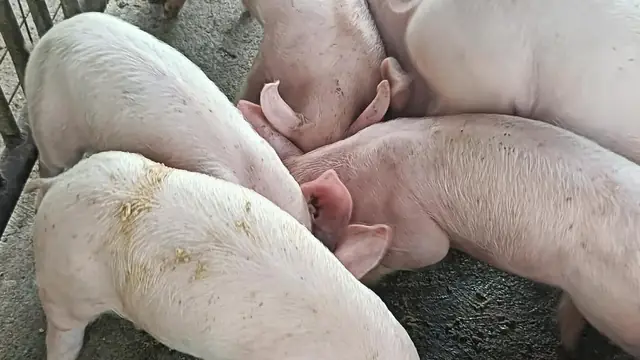
A 10-pig backyard piggery produces roughly 30 to 50 kg of fresh manure a day. That sounds like free money on the ground. It is also, depending on your setup, a real disposal cost, an LGU complaint waiting to happen, or both. The reason anybody bothers with the question in 2026 is that the pigs themselves stopped carrying the farm: PSA's backyard farmgate series has fallen through four straight quarters, and a side income that clears ₱20,000 a year is no longer rounding error against that. The five real ways to turn that into income pay very differently.
The five paths are: basic composted sacks, vermicompost, biogas (energy substitution), slurry sales to vegetable farms, and integrated tilapia. They differ wildly in capital, time, and realistic returns. Most backyard raisers should pick exactly one. A few should pick zero and just spend the money on proper disposal. This is the side-by-side comparison, with the peso figures checked against 2025 Philippine sources.
How much manure are you actually talking about?
A 90-kg pig produces roughly 4 to 6 kg of fresh manure plus 6 to 9 liters of urine per day. For a 10-head operation averaging 50 to 70 kg per pig across the cycle, that's roughly 30 to 50 kg of fresh manure daily, or 11 to 18 tonnes a year.
After 45 to 60 days of basic composting, which shrinks the volume by 50 to 65 percent as water evaporates and organic matter breaks down, you're left with 4 to 7 tonnes of dry finished compost a year. That's about 80 to 140 sacks at 50 kg each.
Those are the numbers everything below is built on. Pin them down before you spend a peso on any side path.
Option 1: Basic composted-sack sales
The simplest, lowest-capital path. Pile manure in a covered area, turn every 7 to 10 days, finish in 45 to 60 days, bag at 50 kg, sell.
| Parameter | Typical |
|---|---|
| Capital to start | ₱5,000 to ₱15,000 (tarp, pallets, sacks, turning fork) |
| Time per week | 4 to 6 hours |
| Annual output (10-pig farm) | 80 to 140 sacks |
| Sale price per sack | ₱150 to ₱400 |
| Gross annual revenue | ₱12,000 to ₱56,000 |
| Bag, transport, marketing cost | ₱40 to ₱80 per sack |
| Net annual income | ₱8,000 to ₱45,000 |
The variance is wide because everything depends on buyer access. A backyard raiser in a vegetable-farming municipality (Benguet, Nueva Vizcaya, Bukidnon) can move 100-plus sacks a year. A raiser in a city or rice-farming area might struggle to sell 30. There is a lot of competing supply: PSA counted 7,080,312 head on smallhold farms on 1 July 2026, and every one of them produces manure somebody nearby would also like to sell. For context, chemical fertilizer ran ₱1,500 to ₱1,600 per sack in early 2025, so composted manure is a budget input, not a premium one. Price it as one.
Where it pays: Near vegetable farms, ornamental nurseries, or organic-certified rice farms. Steady local demand that doesn't depend on online channels.
Where it doesn't: Urban or peri-urban areas with no agricultural buyers, or places where every other piggery is also selling sacks (Pampanga lowlands, central Luzon plains) at saturation pricing.
Option 2: Vermicompost
African nightcrawlers (ANC) eat aged pig manure and produce castings that retail well above basic compost on a per-kilogram basis.
| Parameter | Typical |
|---|---|
| Capital to start | ₱25,000 to ₱50,000 (worm beds, initial worms 5 to 10 kg, shade structure) |
| Time per week | 6 to 10 hours |
| Annual output (10-pig farm) | 800 to 1,400 kg vermicompost |
| Sale price per kg, small packed bags | ₱20 to ₱50 |
| Sale price, bulk sack level | ₱16 to ₱20/kg (₱800 to ₱1,000 per 50-kg sack) |
| Packaging, transport, marketing | ₱8,000 to ₱15,000 |
| Net annual income | ₱20,000 to ₱45,000 |
Vermicompost has the highest per-kg margin of any waste path but needs the most management. Worm populations are sensitive to temperature, pH, ammonia, and moisture. Live ANC starter worms themselves are not cheap, running anywhere from ₱250 up to ₱1,000-plus per kilo depending on the seller, so the worm stock alone is a real line item. Fresh pig manure must be aged 14 to 21 days before feeding to worms. Fresh manure kills them. No shortcut there.
One realistic per-bed benchmark from a Philippine vermicomposting guide: 150 kg of waste with about 2 kg of worms yields roughly 90 kg of compost per cycle, around 12 cycles a year at ₱20/kg bulk. That's roughly ₱21,600 per bed annually before costs. The ₱30,000-plus figures only show up once you've built a small-bag retail channel that sells above bulk price.
Where it pays: Operators willing to spend close to 10 hours a week and build a small online retail brand. Premium urban gardening, hydroponics, and ornamental plant markets. Peak demand runs January to May (pre-rainy-season planting).
Where it doesn't: First-year backyard raisers without the time or the retail skill. Hot, dry areas where you can't keep beds humid without daily watering. Anyone who wants passive income. Honestly, this one is not passive at all.
Bisaya / Cebuano
Sa vermicompost, ang pinakadakong sayop kay ang pagpakaon og presko nga hugaw sa mga ulod. Kinahanglan i-age usa ang hugaw og 2 ngadto 3 ka semana una iduha sa worm bed, kay daghan pa kaayo og amonyaka. Pag-direkta sa presko, mamatay ang ulod ug mag-restart ka, sayang ang puhunan. Kining mga buyers sa Facebook organic gardening groups, mas ganahan sila og maayong packaging, 5 ngadto 10 ka kilo nga gagmay nga bag, dili 50 ka kilo nga sako. Mas dako ang presyo ana.
Option 3: Biogas
Anaerobic digestion converts slurry to methane (cooking gas substitute, small generator fuel) and stabilized digestate that's still usable as fertilizer or pond input.
| Parameter | Typical |
|---|---|
| Capital to start | ₱30,000 to ₱120,000 (HDPE bag digester up to fixed-dome concrete) |
| Time per week | 1 to 2 hours |
| Pigs needed for steady output | 8 or more |
| Slurry feed needed | ~80 liters/day for an 8 m³ digester |
| Biogas value produced | ~₱1,000/month at 8 m³ scale |
| LPG cooking gas saved annually | ₱8,000 to ₱18,000 |
| Net annual savings (not cash income) | ₱8,000 to ₱18,000 |
Biogas is the only path here that doesn't directly generate cash. It substitutes for a cost. That's a real economic benefit but a different kind, and you can't pay your feed dealer in saved LPG. An 8 cubic meter digester fed about 80 liters of pig slurry a day produces roughly ₱1,000 worth of biogas a month, which lines up with a household burning through an 11-kg LPG tank (around ₱1,068 in NCR as of early 2024) every two to three weeks. It also produces digestate that captures some of Option 4's value.
The detailed biogas digester ROI piece walks through sizing, payback, and the technical setup. The bigger ₱36,000-a-month savings figures you'll see online come from running a water pump on biogas at commercial scale, not from a backyard cooking setup. Don't budget on those.
Where it pays: Operations with 10-plus pigs that still cook with LPG. Rural setups that face frequent outages and benefit from gas-powered backup. Combined operations with crops or aquaculture that absorb the digestate.
Where it doesn't: Under 8 pigs (insufficient feedstock). Operations on cheap municipal power that won't use the gas output meaningfully.
Option 4: Slurry sales to vegetable farms
The most overlooked path. Some vegetable and rice operations buy raw or partially-composted slurry directly from piggeries by the truckload. No on-farm processing required.
| Parameter | Typical |
|---|---|
| Capital to start | ₱0 to ₱20,000 (covered slurry tank if needed) |
| Time per week | 1 to 3 hours (loading and coordination) |
| Sale price | ₱600 to ₱1,500 per cubic meter |
| Annual output (10-pig farm) | 8 to 15 cubic meters |
| Annual gross revenue | ₱5,000 to ₱18,000 |
| Transport cost | usually paid by buyer |
| Net annual income | ₱5,000 to ₱12,000 |
This option is buyer-dependent and the figures above assume a buyer actually exists. If there are vegetable farms or banana and papaya growers within 5 to 10 km willing to buy, slurry sales are almost pure margin because you're not processing anything. If no such buyer exists, this option is zero. Not low. Zero.
Where it pays: Near operations that want organic input but have no manure source of their own: banana plantations, vegetable cooperatives, organic-certified rice farms, nurseries that use it as plant-trough fertilizer.
Where it doesn't: Areas with no agricultural buyers. Areas where rules require composted (not raw) manure for fertilizer use. Operations that haven't built a relationship before producing volume.
Option 5: Integrated tilapia
Covered in depth in the pig-tilapia integrated farm piece. Summary numbers for the comparison below.
| Parameter | Typical |
|---|---|
| Capital to start | ₱500,000 to ₱1,000,000 per hectare (setup plus operations) |
| Time per week | 10 to 20 hours (water management plus fish operations) |
| Annual incremental net | ₱150,000 to ₱500,000 over running the piggery alone |
Tilapia sits in a completely different capital tier. Setup and operations run ₱500,000 to ₱1,000,000 per hectare, feed alone is about 72 percent of variable cost, and tilapia retailed around ₱177/kg in April 2025. Annual revenues at real scale reach ₱700,000 to ₱1.3M, but a small two-cycle backyard pond might gross only ₱60,000 to ₱70,000. It's not really side income. It's a second business stacked on the piggery, and it should be planned like one.
Side-by-side comparison
Same farm, same year, apples to apples. Net figures are for a 10-pig backyard operation running two cycles, with the 30-pig column scaled for buyer access at that size.
| Path | Start capital | Weekly hrs | 10-pig net/yr | 30-pig net/yr | Skill |
|---|---|---|---|---|---|
| Basic composted sacks | ₱5k to ₱15k | 4 to 6 | ₱8k to ₱45k | ₱30k to ₱110k | Low |
| Vermicompost | ₱25k to ₱50k | 6 to 10 | ₱20k to ₱45k | ₱55k to ₱140k | Medium-high |
| Biogas (savings, not cash) | ₱30k to ₱120k | 1 to 2 | ₱8k to ₱18k | ₱25k to ₱45k | Medium |
| Slurry sales | ₱0 to ₱20k | 1 to 3 | ₱5k to ₱12k | ₱15k to ₱40k | Low |
| Integrated tilapia | ₱500k+ | 10 to 20 | capital tier mismatch | ₱150k to ₱500k | High |
Run your own pig economics first with the profit simulator and the break-even calculator. Side income only matters if the core operation already clears its costs. A piggery losing money on feed doesn't get fixed by selling sacks.
The most common scaling mistake
Operators see these numbers and try to do three of them at once. A 10-pig farm with a tiny vermi bed, a small compost pile, and a half-built biogas chamber ends up doing none of them well. Manure goes stale before the worms can process it. Compost piles run too small to hold proper temperature. Biogas runs short on feedstock.
The practical sequencing for a backyard raiser:
- Start with basic composted sacks. Lowest capital, lowest skill, builds your buyer relationships. Run this for 6 to 12 months.
- Add either biogas or vermicompost as a second layer, but only one. Biogas if you have steady LPG spend and the capital. Vermicompost if you have time, retail skill, and garden buyers.
- Consider slurry sales once you've reached 20-plus pigs and have local vegetable-farm relationships.
- Treat tilapia or integrated farming as a separate capital decision, not a side-income one.
When to skip waste monetization entirely
Some operations should skip all five paths and just pay for proper manure disposal. That's not a failure. It's a realistic match to operation size and circumstances.
You should skip if:
- You're under 5 pigs. Volume too small to be worthwhile.
- You're in an urban or peri-urban area with no agricultural buyers within 15 km.
- You have less than 4 hours a week beyond core pig care.
- Your LGU prohibits on-site manure processing or sale.
In any of those cases, paying ₱500 to ₱1,500 per month for waste pickup beats half-running a side operation that never pays back. Saying no to a side income is a valid decision, and a lot of small raisers should make it.
What this means for your operation
Under 10 pigs with limited time: run basic composted sacks. ₱8,000 to ₱20,000 a year of side income that covers the electricity bill for a few months. Not life-changing, but real.
10 to 20 pigs with a few hours a week: biogas plus composted sacks is the cleanest combination. Biogas zeroes out the LPG bill, sacks bring in the cash.
20-plus pigs near a vegetable-farming municipality: slurry sales become the highest-margin option per peso of capital. Almost zero processing, tried and tested na by farms that already do it.
If you have the time, the retail aptitude, and 12 to 18 months of patience: vermicompost has the best per-kilogram margin. It works best when a partner or spouse can run the selling side, because the farming and the retail are two different jobs.
₱500,000-plus to invest with aquaculture knowledge: integrated tilapia transforms the operation, but plan it as a business, not a manure side hustle. For where your scale should be before you even think about side income, the backyard vs semi-commercial ROI breakdown and the income goal worksheet are the better starting points.
Sources
- Philippine Statistics Authority: Average Farmgate Price of Hogs for Slaughter, Q3 2025 (₱191.51/kg liveweight)
- Philippine News Agency: DA sets ₱210/kg minimum farmgate price for live hogs (Nov 2025)
- Climate Tracker Asia: Philippine pig farmers embrace biogas (LPG price, water-pump savings, digestate use, Apr 2024)
- BusinessDiary PH: How to start a vermicomposting business (capital, ₱20/kg bulk price, per-bed yield)
- Smallholding Hero: Tilapia farming in the Philippines, cost and profit 2025
- Philippine News Agency: Organic farming and fertilizer price context
Tools and related reading
- Biogas digester ROI for piggery covers biogas sizing, payback, and technical setup
- Pig-tilapia integrated farm is the higher-capital integrated option
- Backyard vs semi-commercial ROI on what scale you should run first
- Pig farming profit on 10 pigs
- Cost to raise a pig in the Philippines 2026
- Set a realistic pig-farm income goal
- Profit simulator and break-even calculator for your core pig economics