Water is the most underestimated input in backyard pig farming. Sus, farmers will carefully calculate feed costs down to the last peso but then give their pigs water twice a day from a bucket.
That's a problem. Research on Philippine smallholder pig farms (Lee et al., 2005, Preventive Veterinary Medicine) found that inadequate water supply, particularly for lactating and gestating sows, was a key management constraint. Pigs that don't drink enough eat less, grow slower, and get sick more easily.
The basic rule: pigs drink roughly 10% of their body weight per day. In Philippine heat (30-37°C during dry season), add 30-50% on top of that.
Daily Water by Pig Size
| Pig Category | Weight | Liters/Day (Temperate) | Liters/Day (Philippine Heat) |
|---|---|---|---|
| Weaned piglets | 5-10 kg | 1-2 L | 2-3 L |
| Growers | 20-40 kg | 4-6 L | 6-9 L |
| Finishers | 60-100 kg | 6-8 L | 8-12 L |
| Pregnant sow | 120-180 kg | 12-15 L | 15-22 L |
| Lactating sow | 120-180 kg | 20-25 L | 25-35 L |
| Boar | 150-250 kg | 10-15 L | 15-20 L |
The lactating sow stands out. She produces 5-10 liters of milk per day and needs about 5 liters of water for every liter of milk. If she doesn't drink enough, milk production drops and her piglets starve. Most backyard sow mortality problems we hear about trace back to water, not feed.
What This Actually Costs
Water is cheap compared to feed, but it's not free. At Manila Water's 2026 rate of about PHP 68/cubic meter (provincial rates are lower, typically PHP 20-40/cu.m.), here's what water costs per pig per day:
| Pig Category | Liters/Day | Daily Cost (Provincial) | Monthly Cost |
|---|---|---|---|
| Grower (30 kg) | 7 L | PHP 0.14-0.28 | PHP 4-8 |
| Finisher (80 kg) | 10 L | PHP 0.20-0.40 | PHP 6-12 |
| Lactating sow | 30 L | PHP 0.60-1.20 | PHP 18-36 |
The cost is almost nothing. The issue isn't expense, it's infrastructure and habit. Plenty of farmers don't provide enough water simply because carrying buckets is tedious, or they don't have a reliable supply during dry season.
Why Heat Makes Everything Worse
Pigs can't sweat. They have very few sweat glands and thick subcutaneous fat, so they depend on panting, wallowing, and shade to cool down. When ambient temperature exceeds 25-30°C, which is basically year-round in the Philippines, pigs are in some degree of heat stress.
Research on heat stress in tropical pig farms shows that for every degree above the pig's comfort zone:
- Feed intake drops by 80-100 grams per day
- Water consumption increases proportionally
- Growth rate slows, which means longer time to market and higher total feed cost
During dry season (March through May), daytime temperatures in Central Luzon, Cebu, and Davao regularly hit 33-38°C. This is well above the threshold for all pig categories. Water becomes your most important management tool during these months, not just for drinking but for cooling.
A dehydrated pig stops eating before it stops drinking. If your pigs have suddenly reduced feed intake during hot weather, check water supply first. It's the cheapest fix and the most commonly missed.
Signs Your Pig Is Dehydrated
Check daily during hot weather:
- Skin tenting: pinch the skin on the shoulder. If it stays tented for more than 2 seconds, the pig is dehydrated
- Sunken eyes
- Dry snout (should normally be moist)
- Dark, concentrated urine or reduced urination
- Constipation or hard feces
- Reduced feed intake before reduced water intake
- Lethargy and reluctance to move
If you see skin tenting in a lactating sow, act immediately. Give her fresh, clean water and if she won't drink, try adding a small amount of sugar or electrolytes to encourage intake. A dehydrated sow can lose her entire litter.
Water Delivery Systems
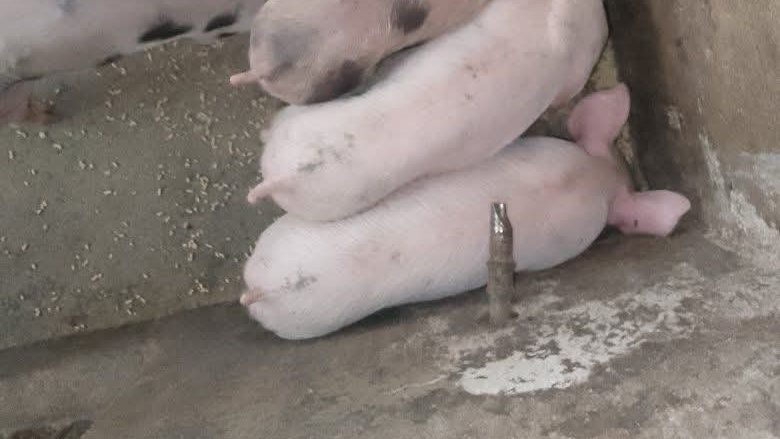
Nipple Drinkers (Best Option)
Stainless steel nipple drinkers cost PHP 25-80 each on Shopee and Lazada, with heavy-duty sets running PHP 150-300 including connectors. You need 1/2-inch pipe, a few fittings, and an elevated water container or pressurized line.
Recommended flow rates:
- Piglets: 0.5 L/min
- Growers and finishers: 1.0 L/min
- Sows: 1.5-2.0 L/min
Nipple drinkers keep water clean (huge advantage in Philippine heat, where a bucket becomes a bacterial soup within hours), reduce waste by 20-30% compared to troughs, and let pigs drink whenever they want. The initial cost is maybe PHP 200-500 per pen. That pays for itself in one batch through reduced disease risk alone.
Common mistake: installing nipple drinkers too high or with flow rate too slow for piglets. Test the flow by pressing the nipple yourself. If you have to push hard, a piglet can't use it.
Troughs
Cheaper upfront (a concrete trough costs almost nothing to build), but you need to clean them at least twice daily. In hot weather, algae and bacteria grow fast. If you use troughs, tip them and scrub them every morning. Honestly, the labor adds up compared to just installing nipples.
Automatic Float Valve Systems
If you have reliable water pressure, a float valve on a trough or tank gives you the best of both worlds: automatic refill, constant supply. A basic float valve costs PHP 150-350. Combined with a small elevated tank (500-1,000 liter polyethylene, PHP 3,000-8,000), this setup works well for 10-20 head operations.
For more on pen water system design, see pig pen designs and layouts.
Rainwater Collection
If you're in the Visayas or anywhere with decent wet season rainfall, a basic roof-to-tank system can offset a big chunk of your water cost. PhilRice's rainwater harvesting guide covers the basics.
A 50 sq.m. roof catching 2,000 mm of annual rainfall (typical for Visayas) collects about 100,000 liters per year. That's enough to supply 10-15 finishers for the entire wet season. You need gutters, a first-flush diverter (to keep the initial dirty runoff out), and a storage tank. A 1,000-liter tank costs PHP 3,000-5,000. Not a huge investment for a reliable backup water source.
During dry season, you'll still need municipal or deep well water. But the wet season savings are real, especially in areas where water supply is inconsistent.
Quick Checklist
- Water available 24 hours a day, not just during feeding
- Clean containers daily (or use nipple drinkers)
- Increase supply by 50% during March-May dry season
- Lactating sows checked for adequate intake twice daily
- Nipple drinker flow rate tested monthly
- Backup water plan for dry season or outages
Tools
- Feed Calculator: water and feed intake are linked; model both together
- Pen Space Calculator: includes water point spacing recommendations
Sources
- Lee et al. 2005: Growing pigs raised by smallholder farmers in the Philippines (Preventive Veterinary Medicine)
- Penn State Extension: Livestock Water Quality (1 to 2 gallons per 100 lb of body weight per day)
- Pork Information Gateway: Water Recommendations and Systems for Swine
- pig333: Heat Stress in Pigs
- Animal Frontiers: Heat Stress Adaptations in Pigs
- Manila Water 2026 Tariff Rates (BusinessWorld, Dec 2025)
- PhilRice: Rainwater Harvesting Technology
- DOST-PCAARRD Swine Industry Strategic Plan
Bisaya / Cebuano
Para sa mga mag-uuma
Pila ka litro ang kinahanglan sa baboy kada adlaw?
- Baktin (weaned): 2-3 litro
- Grower: 6-9 litro
- Finisher: 8-12 litro
- Nagburos nga anay: 15-22 litro
- Nagpasuso nga anay: 25-35 litro (pinakadaghan!)
Init kaayo sa Pilipinas, mao nga kinahanglan og mas daghan nga tubig ang baboy kaysa sa ubang nasod. Ang tubig kinahanglan 24 oras, dili lang panahon sa pagpakaon. Limpyohi ang sudlanan sa tubig kada adlaw, o mas maayo kung mogamit og nipple drinker (PHP 25-80 lang matag usa sa Shopee). Kung nagpasuso ang imong anay ug dili moinom og igo, mawala ang gatas ug mamatay ang mga baktin.