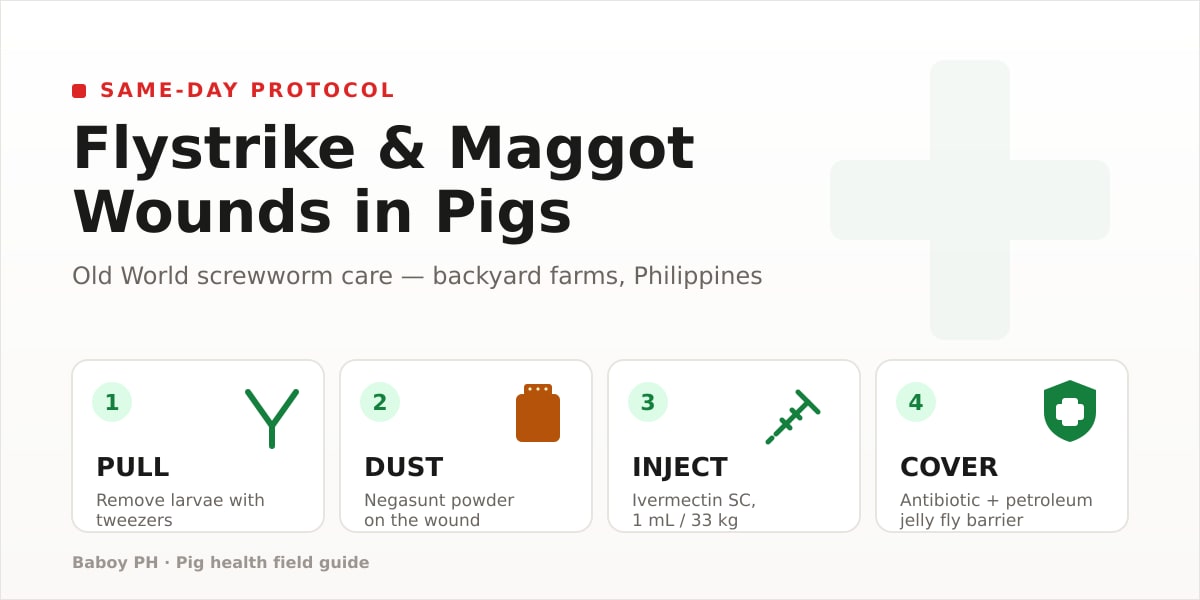
A wound with maggots ("uod sa sugat") is a same-day problem. Chrysomya bezziana, the Old World screwworm, is found across the Philippine islands per the FAO, and the Merck Veterinary Manual puts one egg mass at 150-500 eggs. WOAH says larvae emerge within 12-24 hours and burrow straight in. Pull them out, dust with Negasunt, inject ivermectin, cover with antibiotic. Most adult-pig wounds clear in a week.
How To Spot It Before It Gets Deep
The Merck Veterinary Manual notes that screwworm larvae bury in so only their tail ends show, so a small wet hole can hide a thumb-sized cavity. I check every pig with a cut morning and afternoon for:
- Egg masses. Cream-white clusters like stuck-together rice grains at the wound edge. Wipe them off with gauze now and you skip everything below.
- A wet, growing wound. A clean cut gets drier and smaller each day. Weeping or wider than yesterday means look closer.
- The smell. Merck's facultative myiasis page describes "a peculiar, distinct, pungent odor" in struck tissue, and struck sheep that go dull, stop eating and bite at the spot. In my experience a struck pig goes the same way.
- Rubbing. A pig grinding one spot against the wall, or a piglet shaking its head nonstop.
Wet floors keep wounds from drying in the rainy season, so I double these checks from May to November.
DIY Or Vet?
| Situation | Action |
|---|---|
| Adult pig, single surface wound, fewer than ~50 maggots, eating | DIY with the protocol below |
| Castration wound day 2-5 with maggots | DIY, same protocol, prevention has failed |
| Newborn piglet with maggots in the navel | Vet today. Prognosis poor without intervention |
| Deep cavity, foul black exudate, fever, off feed | Vet. Antibiotics, possibly IV fluids |
| Multiple wounds on one pig | Vet. Systemic ivermectin is mandatory |
| Vulva of a post-farrow sow with maggots | Vet. Risk of tracking up the reproductive tract |
Time matters more than skill on this one. Larvae burrow head-down and dig deep. The longer you wait, the more tissue gets eaten.
Who to call in the Philippines
Call your Municipal Agriculturist Office (municipal or provincial vet) or a private vet, and say "maggots in a wound" so it's treated as same-day. Old World screwworm is a WOAH-listed disease, so if several pigs, or pigs and goats in the same barangay, are getting struck at once, mention it. That is worth a report, not just a treatment.
The Four-Step Protocol
1. Pull them out
Restrain the pig (a snare or strong help, not a wrestling match). Glove up. Use blunt forceps or tweezers. Work systematically from the wound margin inward. Crush each maggot you remove, or burn them on a metal lid. Do not toss them on the floor, in the trash, or in the compost, because they drop off and pupate. A UC Riverside screwworm sheet for vets says to kill them by burning or sealing them in 70% alcohol.
Flush after each pass with warm water plus dilute povidone-iodine (1 part Betadine to 10 parts water). Repeat removal until the wound is visibly clear. Expect 2-3 passes for a heavy infestation.
2. Dust with Negasunt
Negasunt (Bayer / Elanco) is coumaphos 3% plus propoxur 2% plus sulfanilamide 5%, per the FDA fact sheet issued for its 2026 US emergency use against screwworm. That sheet says to apply enough to cover the open wound, repeat every 2 to 3 days for larger or deep wounds, and keep going until granulation tissue forms. It also caps one person at 3 large wounds a day, because coumaphos and propoxur are nerve poisons, and sets a 28-day slaughter withdrawal in the US. Look for it at Pacifica or Univet shops, or via Lazada and Shopee PH.
3. Inject ivermectin
The Ivomec 1% label gives swine 300 mcg/kg subcutaneously in the neck, which is 1 mL per 33 kg, and says not to treat within 18 days of slaughter. PH brands include Agmectin, GenVet Ivermec and Iverbest; Viddavet lists a 100 mL ivermectin at ₱447 (its page says IM, so read your own bottle's route). See how to inject pigs for SC technique.
4. Cover with antibiotic
Secondary bacterial infection is the killer once maggots are gone. A pen-strep such as Robipenstrep (procaine penicillin + dihydrostreptomycin): Viddavet's page gives no dose, and the Penstrep-400 label gives 1 mL per 10 kg IM for 3 days. A long-acting oxytetracycline is the other common choice (Oxytetra Robi LA 100 mL is ₱507 on Viddavet); dose it by its label.
Finish with a petroleum jelly or camphor ring around the wound edge as a fly barrier. Keep the pig in a shaded, screened recovery pen for 7 days.
The PH Flystrike Kit
Prices are Viddavet online listings checked October 2026 (sale, regular in brackets); I did not find a PH listing for the rest, so ask your agrivet.
| Item | Use | PHP |
|---|---|---|
| Negasunt powder | Topical maggoticide + fly repellent | ask agrivet |
| Ivermectin 1% 100 mL | Ivermectin SC | 447 (600) |
| Robipenstrep 100 mL | Antibiotic cover | 267 (500) |
| Povidone-iodine Woundex 120 mL | Wound flush | 147 (907) |
| Cypermethrin spray (Cyporlene, Sumicidin) | Pen-wall fly control | ask agrivet |
| Petroleum jelly | Wound-margin barrier | ask drugstore |
| Tweezers + gauze + gloves | Manual removal | ask drugstore |
Where Flies Hit, And Why
The four PH backyard hotspots, in order of how often they go wrong:
- Castration wounds (day 2-5). The most preventable failure. Castrate in cool morning (5-8am), use a clean blade, keep the pig in a dry, shaded pen, dust the cut with Negasunt for 7 days. See when to castrate piglets.
- Newborn piglet navel. Highest mortality site. Dip the navel in 7% iodine within an hour of birth, repeat on day 2, check for cream-coloured rice-grain eggs at the wound edge for 5 days. See iron injection piglets and why piglets die in the first week.
- Vulva of post-farrow sows. Lochia (post-farrowing discharge) draws flies for 5-7 days. Spot-check, wipe clean. Compare with the swollen vulva guide.
- Foot abscesses, ear notches, fight wounds. Anywhere there is exposed tissue. The pig limping guide covers abscess care.
Add tail docking and teeth clipping to that list, and dip or dust those the day you cut. Fight wounds spike in the days after you mix pens. WOAH says infestations "are generally acquired at sites of previous wounding," and the Merck screwworm page advises avoiding elective surgery during the fly season. For a backyard raiser, that means castrating young and, where you can, in the drier months.
Prevention That Actually Works
A University of Kentucky extension report by Lee Townsend (on The Pig Site) says manure, spilled feed and wet bedding "should be removed twice a week in order to interrupt the breeding cycle of flies."
- Compost manure properly. Turn weekly, cover with rice hulls or a tarp. An open, wet pile next to the pen is a fly nursery.
- Fix pen drainage. Standing water and wet slurry are breeding sites. See the pen design guide.
- Spray where flies rest. The Kentucky report puts residual sprays on walls, ceilings and posts. Spray weekly during May to November, following the label.
- Rotate chemical class. Cypermethrin and deltamethrin are both pyrethroids, and Kentucky suggests alternating pyrethroids with organophosphates to slow resistance.
- Window-screen the recovery pen. Merck advises confining wounded animals to fly-free areas. A small mesh-covered pen for piglets after castration or docking is the cheap version.
- Bury or burn carcasses and afterbirth the same day. Merck lists carrion as a breeding site.
What Not To Do
These show up in old PH backyard advice and on Facebook posts. They cause more harm than the maggots:
- Kerosene or gasoline poured on the wound. Burns living tissue, does not kill embedded larvae, leaves the pig with a chemical burn on top of the original wound.
- Hot water "pasteurisation." Will burn the pig. Larvae buried in deep tissue do not feel surface heat.
- Tobacco juice or nicotine paste. No evidence it works, and nicotine absorbs through wounds. Real harm in piglets.
- Wait-and-see. A fresh egg batch hatches within a day, and every hour the larvae dig deeper. The single most expensive thing you can do is leave it overnight.
Bisaya / Cebuano
Para sa mga mag-uuma
Kung naa nay uod sa sugat sa baboy (nilangawan na), karon dayon, dili ugma. Ang screwworm fly nga Chrysomya bezziana anaa dinhi sa Pilipinas, ug mopisa ang itlog sulod sa 12 hangtod 24 ka oras. Ipa-restrain ang baboy, sul-obi og guwantes, kuhaa pinaagi sa tweezer ang tanang uod nga makita. Hugasi og Betadine nga gisagol sa tubig (1:10), unya butangi og Negasunt nga pulbos hangtod matabonan ang samad, balika kada 2-3 ka adlaw.
Ipa-tuslok og Ivermectin (1 mL kada 33 ka kilo, SC sa liog), ug Robipenstrep IM (1 mL kada 10 ka kilo) sulod sa tulo ka adlaw, sumala sa label. Para sa bag-ong gianak nga biik nga gilangawan ang pusod, tawga dayon ang vet, peligro kaayo. Ayaw og bubu og kerosene, gasolina, init nga tubig, o tobacco juice. Mas grabe pa kaayo ang mahimo.
Sources
- FAO: Screwworm flies and wound myiasis (tropical livestock guide)
- Merck Veterinary Manual: Obligatory Myiasis-producing Flies
- WOAH: Old World Screwworm (Chrysomya bezziana)
- DailyMed: IVOMEC (ivermectin) Injection label (swine 300 mcg/kg SC, 1 mL per 33 kg, 18-day slaughter withdrawal)
- FDA: Negasunt Powder EUA fact sheet (composition, application every 2-3 days, 28-day US withdrawal)
- Interchemie Penstrep-400 label (1 mL/10 kg IM for 3 days)
- Viddavet PH online store (kit prices, October 2026)
- WVS Academy: Topical ivermectin for myiasis
- Merck Veterinary Manual: Facultative Myiasis-producing Flies
- University of Kentucky (L. Townsend) via The Pig Site: Insect control on swine
- UC Riverside: Treatment for screwworm myiasis, for large-animal vets